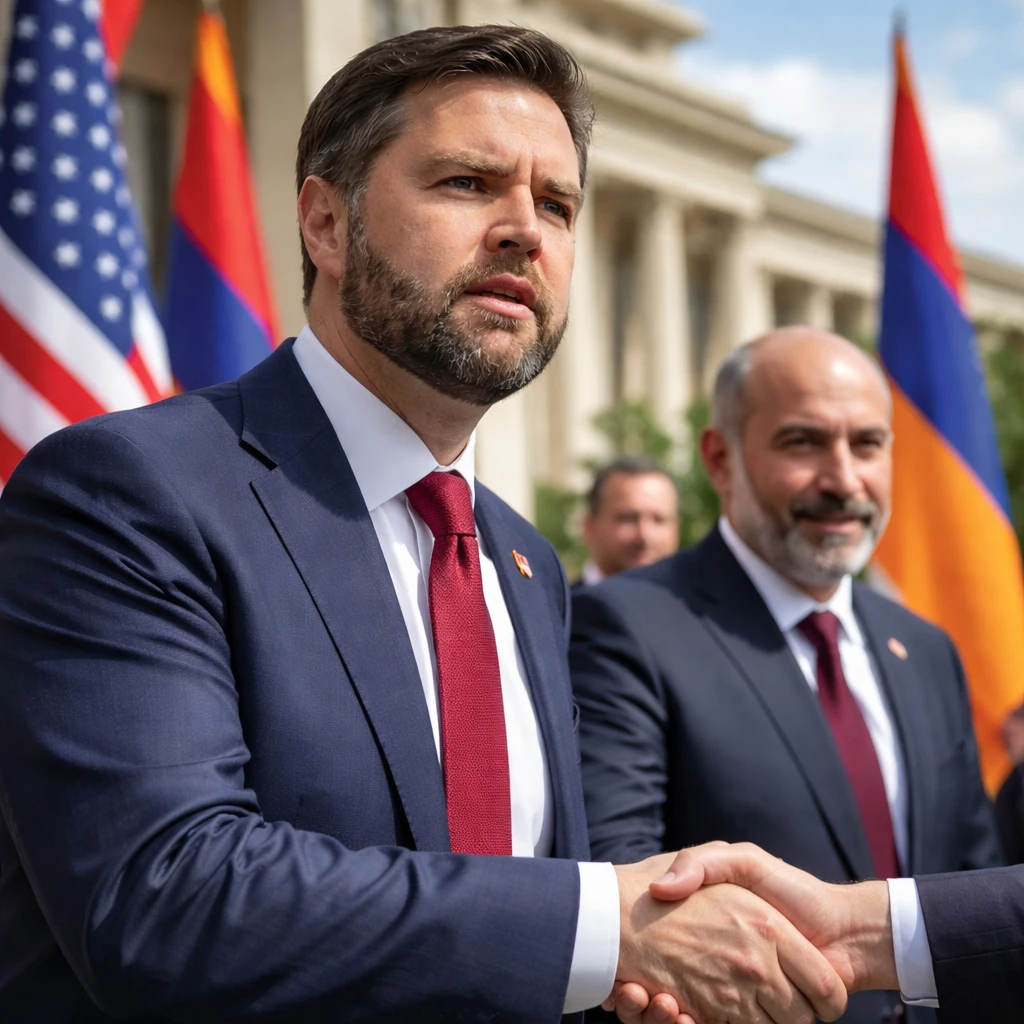

In an unprecedented diplomatic engagement, Vice President JD Vance arrived in Yerevan, Armenia on Monday, marking the first instance a sitting U.S. vice president has set foot in the country. This visit underscores the Trump administration's focus on strengthening economic ties and advancing a U.S.-facilitated agreement aimed at resolving a longstanding conflict with Azerbaijan.
During his stay, Vance met with Armenian Prime Minister Nikol Pashinyan, where they signed a memorandum to propel forward negotiations concerning a civil nuclear energy deal. Highlighting U.S. commitment, Vance announced readiness to supply Armenia with sophisticated computer chips and surveillance drone technology, along with pledges to bolster the nation's infrastructure through investment.
This diplomatic engagement follows a significant agreement signed at the White House in August by Pashinyan and Azerbaijani President Ilham Aliyev. The accord reaffirmed both leaders' commitment to ultimately signing a comprehensive peace treaty, which has been preliminarily approved with foreign ministers initialing the document. However, final leadership signatories and parliamentary ratification remain pending, leaving the treaty incomplete.
Vance emphasized the necessity of proactive forward-looking leadership in the peace process, stating, "Peace is not made by cautious people. Peace is not made by people who are too focused on the past. Peace is made by people who are focused on the future." He also plans to proceed to Azerbaijan the following day, continuing diplomatic outreach.
The breakthrough accord connects to the establishment of a major transit corridor—the "Trump Route for International Peace and Prosperity." This corridor is designed to link Azerbaijan with its autonomous Nakhchivan exclave, separated by a 32-kilometer segment of Armenian territory. This land passage has been one of the central sticking points in resolving conflict over the Nagorno-Karabakh region, internationally recognized as such but long under ethnic Armenian control.
This protracted conflict over Karabakh has spanned nearly 40 years, resulting from ethnic and territorial disputes. Since 1994, ethnic Armenian forces, supported by Armenia, had maintained control over the region. However, a significant six-week war in 2020 resulted in Azerbaijan regaining parts of Nagorno-Karabakh and adjacent areas. This conflict escalated in September 2023, when Azerbaijan launched a swift offensive compelling the local separatist authorities to surrender. Following Azerbaijan's complete control, most of the approximately 120,000 Armenian inhabitants fled to Armenia.
During his visit, Vance expressed political backing for Prime Minister Pashinyan in forthcoming elections and acknowledged Armenia as one of the oldest nations with historical Christian roots. Prime Minister Pashinyan reciprocated by expressing appreciation to President Donald Trump and Vice President Vance, confirming his acceptance of an invitation to Trump's Board of Peace inaugural meeting scheduled for February 19 in Washington. The board oversees ceasefire oversight efforts in Gaza.
Pashinyan described the vice presidential visit as having "truly historic and symbolic importance," reflecting the depth of the "strong and strategic partnership" between Armenia and the United States. Vance and his wife, Usha, arrived from Milan, having attended the Winter Olympics with family. Their arrival ceremony in Yerevan included a red carpet welcome, an honor guard, and an official delegation. The route to the meeting was adorned with Armenian and U.S. flags alongside small demonstrations, including one featuring a sign questioning President Trump's support related to controversial actors.