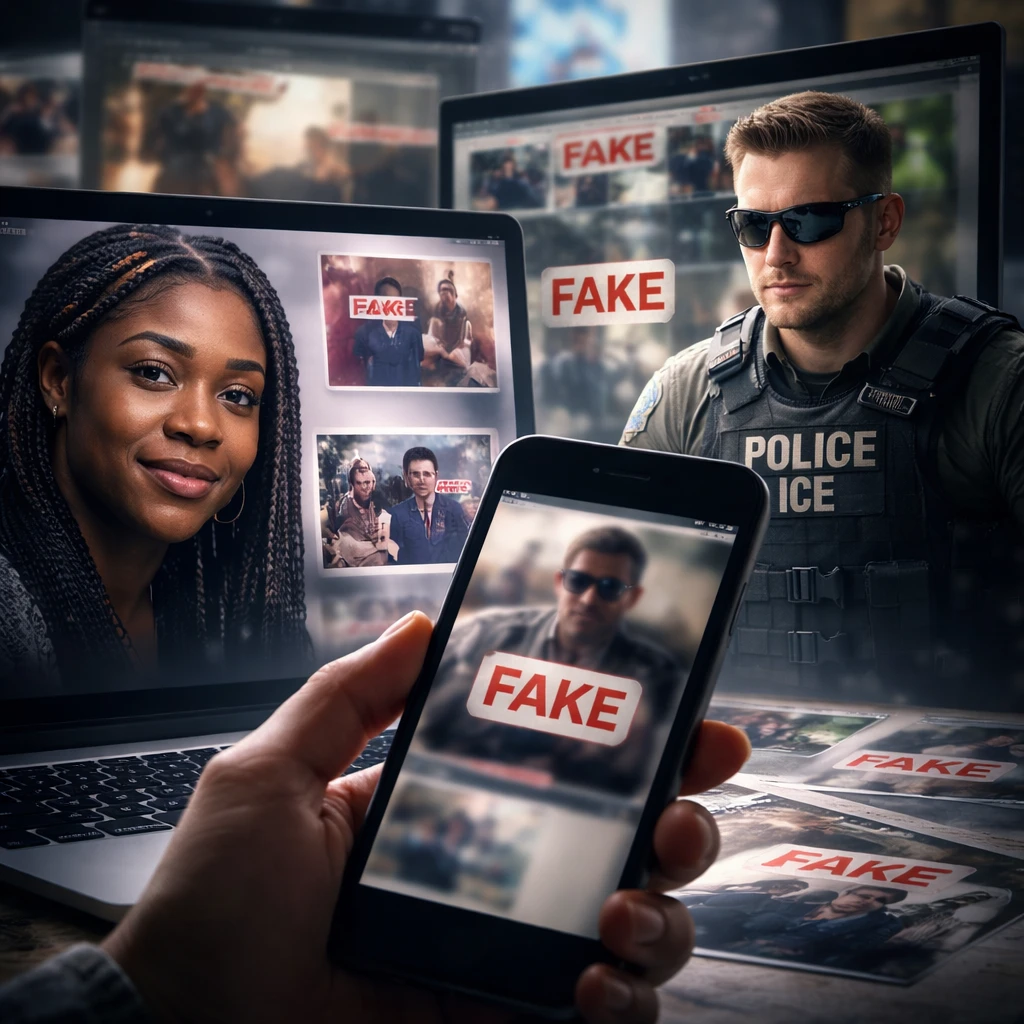

Following the tragic shooting of 37-year-old Minneapolis resident Renee Good, an Immigration and Customs Enforcement (ICE) officer was involved in an incident that, rather than clarifying facts, resulted in a surge of misinformation disseminated through social media channels. This misinformation included images incorrectly identified as either depicting Good or the officer and a misrepresented video allegedly featuring Florida Governor Ron DeSantis commenting on the event.
Misidentified Depictions of the Officer
Among the circulating images were fabricated visuals purportedly showing the ICE officer at the scene without a mask. These images originated as screenshots taken from the shooting footage but were manipulated or generated artificially. Experts in digital forensics, including Hany Farid from the University of California, Berkeley, assessed these images and concluded they were likely created by artificial intelligence (AI) technologies rather than representing the actual appearance of the officer. Farid emphasized the significant challenges AI faces in reconstructing accurate facial identities, particularly when half the face is obscured, rendering such enhancements unreliable in this context.
False Identification of the Victim in Photos
Two separate photographic misrepresentations claimed to feature Renee Good. One set depicted a blonde woman with a small child, who was actually Renee Paquette, a former WWE wrestler. Paquette shared these images publicly on Instagram in 2023 and 2024, celebrating motherhood and personal milestones. She publicly corrected the misconception, extending her condolences to Good’s family.
Another incorrectly assigned photo showed a woman with short pale pink hair wearing a green sweater. This image is of Gabriela Szczepankiewicz, a poetry prize honoree from a 2020 Old Dominion University Facebook post. Szczepankiewicz and Good, who is also identified as Renee Macklin in the post, were both recognized in a university award announcement, but their photographs have been mistakenly interchanged by some online.
Inaccurate Associations with Nazi Symbolism
A widely disseminated photo of a man displaying a neck tattoo resembling the Nazi SS lightning bolts was falsely attributed to the ICE officer involved in the shooting. The image surfaced from a separate Instagram video dated January 5, preceding the shooting by two days, and features a different individual altogether. The tattooed man acknowledged the presence of the tattoo but clarified it was years old and that he had not altered it. Analysis of the shooting footage revealed that the actual ICE officer did not have such a tattoo, nor did he share the same physical characteristics, including distinct earlobe shape differences.
Misrepresented Video of Florida Governor Ron DeSantis
An online video purported to show Florida Governor Ron DeSantis addressing the shooting incident was found to be incorrectly contextualized. The footage is from a June interview on "The Rubin Report," where DeSantis discussed Florida's policies on protest actions that obstruct traffic and individuals' rights to self-defense when threatened during such events. DeSantis’s remarks were reactive to a different protest context and had no direct relation to the Minneapolis shooting or its aftermath.
These instances reveal a broader challenge in the digital information landscape following high-profile incidents, where AI-generated content, recontextualized media, and visual misattribution contribute to public misunderstanding. Verification by digital forensics professionals remains critical in distinguishing authentic material from manipulated or fabricated content in real time.