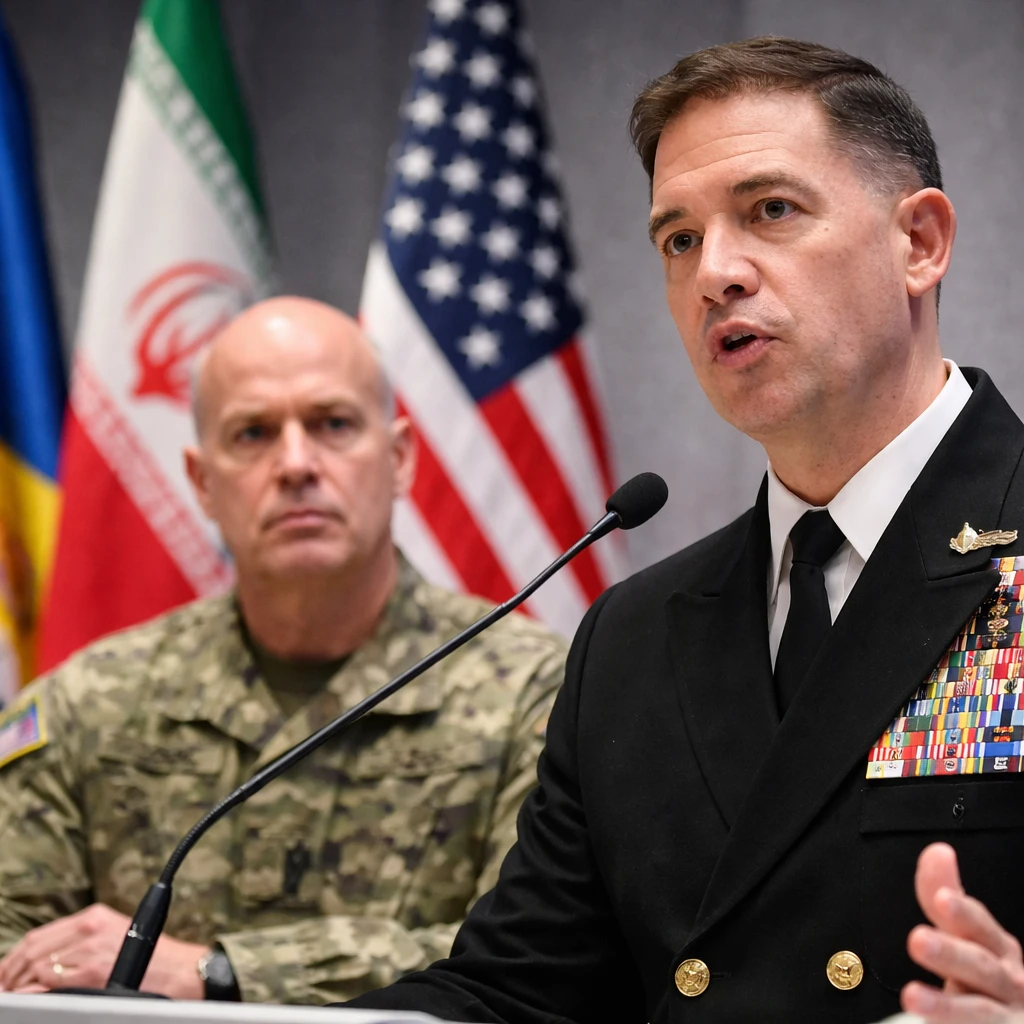
President Donald Trump has notably deviated from standard diplomatic practices by assigning active military figures to engage directly in sensitive international negotiations. This approach was demonstrated recently when Admiral Brad Cooper, commander of U.S. Central Command (CENTCOM), participated in indirect discussions in Oman focused on Iran’s nuclear ambitions. Cooper's appearance in his dress uniform underscored the demonstration of American military strength in the region.
Simultaneously, Army Secretary Dan Driscoll assumed a vital role in the ongoing negotiations aimed at resolving the protracted Russia-Ukraine conflict. Driscoll has been maintaining communication with Ukrainian officials during intervals between formal talks, according to sources familiar with the discussions who spoke anonymously due to the delicate nature of the conversations.
Alongside special envoy Steve Witkoff and presidential advisor Jared Kushner, these military leaders represent a strategic blend of military insight and diplomatic negotiation within the Trump administration. This approach reflects a departure from conventional foreign policy frameworks, favoring the utilization of military expertise and presence in complex diplomatic arenas.
Critics like Elisa Ewers, with a background in national security roles across previous administrations, argue that relying on active military personnel for diplomacy diminishes the value of traditional diplomatic skills and established diplomatic channels. Ewers highlights the substantial commitment needed to achieve successful diplomacy and cautions against overusing military solutions, invoking the adage that "not every nail needs a hammer." She now contributes to Middle East research at the Center for a New American Security.
Contrastingly, Eliot Cohen, a former State Department counselor, notes historical precedents such as the involvement of American generals in Cold War-era arms control discussions. However, Cohen emphasizes that deploying a civilian leader like Driscoll for negotiations is less typical, though consistent with presidential prerogative to entrust sensitive missions to trusted individuals outside standard diplomatic corps.
The recent talks in Oman were intended to de-escalate rising tensions between Iran and the United States amid volatile regional conditions. President Trump described the discussions as "very good" and signaled that further meetings were scheduled, though he warned of severe consequences should Iran fail to reach an agreement on its nuclear program.
In a demonstration of both diplomatic engagement and military posturing, the administration previously dispatched the aircraft carrier USS Abraham Lincoln and accompanying naval vessels to the Persian Gulf during Iran's harsh suppression of nationwide protests. Michael O’Hanlon, a defense analyst at the Brookings Institution, interprets Cooper’s presence at the talks as a gesture meant to project determination and possibly intimidate, while questioning the impact given the already strained U.S.-Iran relations.
Michael Singh, formerly senior director for Middle East affairs on the National Security Council, attributes Cooper’s involvement more to his profound regional expertise. Singh contrasts the military commander’s detailed knowledge of Iran’s capabilities with the more generalist experience of Witkoff and Kushner, noting the technical complexity of nuclear negotiations necessitates such specialized input.
Cooper’s extensive discourse during his Senate confirmation in June covered Iran’s nuclear and military capacities, illustrating the depth of his engagement. Singh, now at the Washington Institute for Near East Policy, contends that Cooper’s ability to access expert military assessments enhances the negotiation team's analytical capabilities.
Additionally, Cohen observes that Cooper’s involvement implicitly conveys the possibility of military consequences, which inherently forms part of negotiation dynamics. Notably, the White House has withheld public explanation of the rationale behind Cooper’s appointment to the talks.
Meanwhile, Driscoll’s diplomatic efforts in the Ukraine conflict have evolved since his unexpected selection for negotiation duties in November. Prior plans for his Ukraine visit allowed Driscoll to meet Ukrainian President Volodymyr Zelenskyy and key defense figures, facilitating dialogue at a moment when peace talks had stalled.
Driscoll, a former armor officer who served in Iraq and reached the rank of first lieutenant, has actively contributed to multiple negotiation rounds, including sessions held in Abu Dhabi. According to informed sources, he functions as a liaison sustaining communication between Ukrainian officials and U.S. representatives such as Witkoff and Kushner, effectively bridging civilian and military perspectives.
His role complements that of U.S. General Alexus Grynkewich, the commander overseeing U.S. and NATO forces in Europe, who participated in talks to restore military-to-military channels between the United States and Russia. This reengagement represents a critical step toward continuous military dialogue as part of the broader peacebuilding process, according to official military communications.