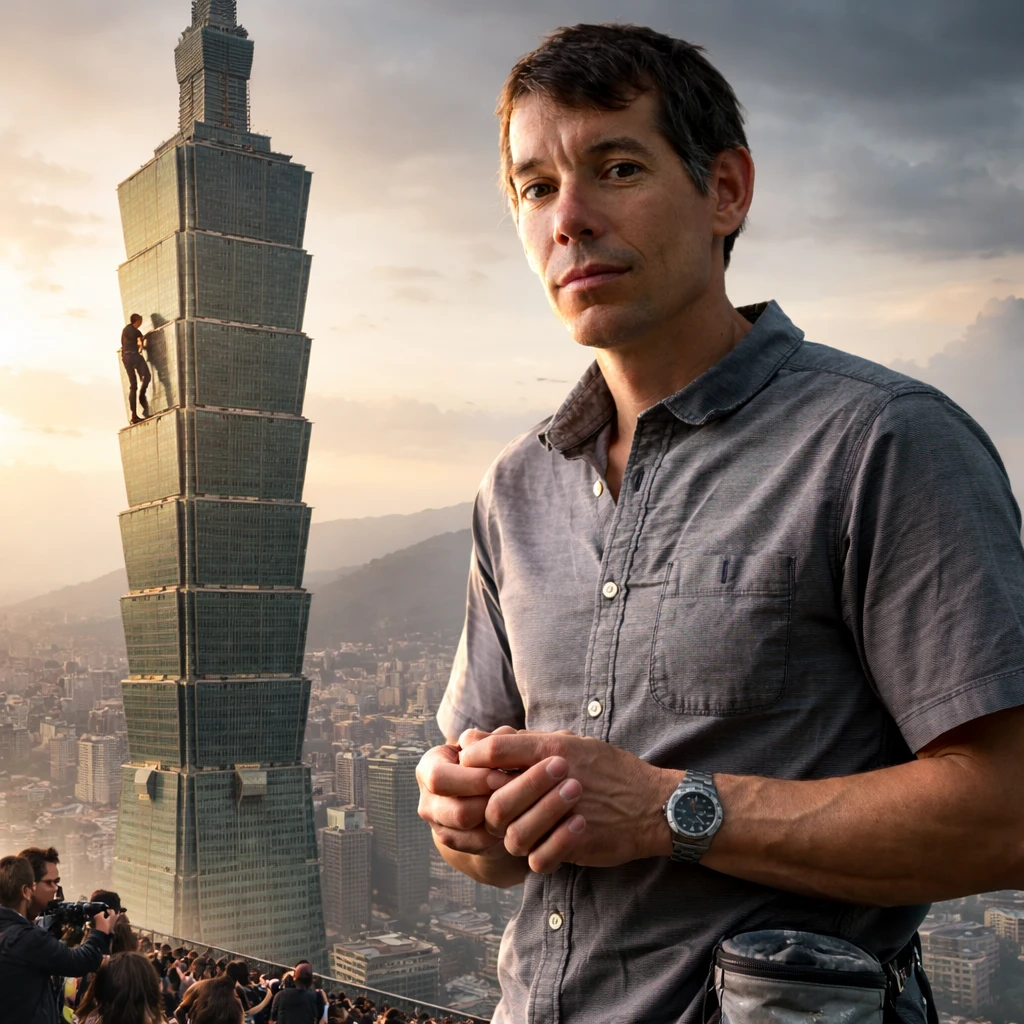
Rising prominently above Taiwan's capital, Taipei 101 stands at 1,667 feet (508 meters), its steel and glass construction engineered to withstand earthquakes. This iconic skyscraper has long fascinated professional climber Alex Honnold, who, after more than a decade of interest, will attempt to scale it in his signature free solo style—ascending without any ropes or safety gear. Set for Saturday morning, the climb will be broadcast live by Netflix, continuing his trend of pushing climbing boundaries on a global stage.
The announcement of this event has generated a wide range of reactions, blending excitement with concern over the ethical ramifications of a high-risk challenge broadcast live for public viewership. Some question Honnold’s choice to pursue such perilous endeavors at this stage in his life, as he is now a married father to two young daughters.
Honnold’s reputation rests on his ropeless ascent of Yosemite’s El Capitan, immortalized in the documentary “Free Solo.” He has consistently demonstrated a drive to find unique, imposing climbing objectives. Reflecting on his selection, he told reporters late last year that climbers search for singular challenges—massive and standout in their surroundings—describing Taipei 101 as meeting this ideal.
History and Preparation for the Climb
While Honnold is not the first to conquer Taipei 101’s facade, he will be the pioneer to do so without any protective equipment. French climber Alain Robert previously scaled the tower on Christmas Day, 2004, during its grand opening, completing the ascent in nearly four hours despite an injured elbow and adverse weather. In contrast, Honnold, after months of dedicated training and route practice on the building, anticipates that the climb will be demanding but not extreme. He has even engaged with Robert through his climbing podcast.
The skyscraper’s 101 floors include a notably challenging segment in the middle, consisting of 64 floors characterized by the "bamboo boxes" that define the building's unique appearance. These sections are divided into eight segments, each comprising eight floors of steep, overhanging climbing sections followed by balconies offering Honnold brief rest opportunities.
The live broadcast, titled "Skyscraper Live," will run with a 10-second delay and commence Friday evening for U.S. viewers. Event producer James Smith, affiliated with Plimsoll Productions, emphasized the extensive safety measures in place, including consultations with risk experts from Secret Compass, a group specializing in risk management for film and television. Smith highlighted the diverse experience of the safety and filming team, which includes professionals accustomed to managing intricate, dangerous shoots such as penguin documentaries in Antarctica and high-altitude crane walks for actors.
During the climb, communication between Smith and Honnold will be maintained, with cameramen positioned inside the building and multiple vantage points to observe and assist if needed. Four high-angle camera operators, suspended on ropes, will capture the ascent for broadcast and to monitor Honnold’s status.
Weather conditions are vigilantly monitored by professional forecasters commissioned specifically for this event, with a small chance of light rain expected on climb day. Should conditions worsen, the climb will be postponed, underscoring the priority placed on safety.
Local climbing community perspective
Taiwanese climber Chin Tzu-hsiang shared his enthusiasm for the event, noting that many in Taiwan have long admired Taipei 101 and dreamed of scaling it. Honnold is recognized widely among climbers locally, and the upcoming live event has stirred enthusiasm even among novices. Chin expressed confidence in Honnold’s preparation and prudent approach to risk management, seeing the climb as an inspiration that helps realize a shared ambition among climbers in Taiwan.
Ethical Considerations and Public Safety
The combination of novelty and risk inherent in the climb make it an exceptional subject for televised content. Smith characterizes the event as the "highest, biggest urban free solo" ever attempted, emphasizing its historic nature and the value of broadcasting it live for audiences worldwide.
However, this perspective is balanced by ethical reflections from experts such as Subbu Vincent, director of media and journalism ethics at Santa Clara University. Vincent highlights the necessity for a "back-off clause" that allows the climb to be stopped if risks become unacceptable and stresses that live broadcasting introduces unique responsibilities, such as employing a delay so the broadcast can be halted instantly in an emergency.
Despite these safeguards, concerns remain regarding the potential influence on impressionable viewers. The act of free soloing, while culturally embedded within climbing, involves substantial risk and has led to fatalities, including a recent death of an 18-year-old climber in Yosemite. Additionally, a trend known as "roof-topping," where individuals illegally access skyscraper rooftops for photos, has resulted in numerous accidents.
Author Jeff Smoot, who has extensively studied free solo climbing culture, acknowledges these risks but explains that for climbers the practice represents a meditative and artistic discipline rather than mere thrill-seeking. Although initially questioning the rationale behind Honnold’s choice to climb Taipei 101 live without ropes, Smoot concludes that the inherent danger is precisely what captivates the public’s interest.
The official Taipei 101 management has declined to comment on the event, and Secret Compass has not responded to interview requests.