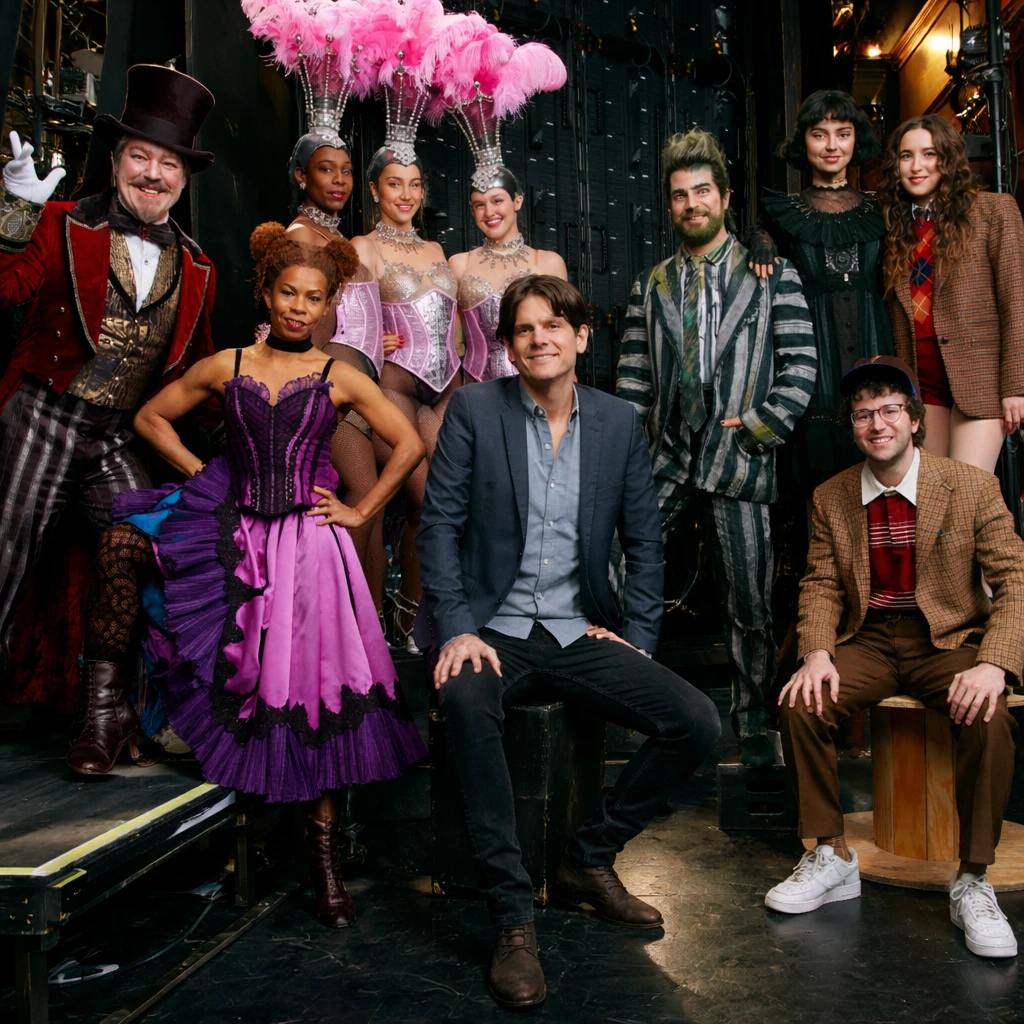

In a noteworthy development within the Broadway sphere, director Alex Timbers has advanced beyond his earlier achievement of presenting two simultaneous productions. As 2026 commences, Timbers commands four active shows on New York’s famed theater avenue, illustrating sustained creative momentum over the past decade and a half.
These four titles include the recently debuted "All Out: Comedy About Ambition," alongside Timbers' established successes "Beetlejuice," "Just in Time," and "Moulin Rouge! The Musical," the latter securing the 2020 Best Musical award as well as a Tony for Best Directing credited to him. Reflecting on the shared thread among these varied works, Timbers remarks that they prioritize joy and actively recognize the presence of their audience, positioning viewers as integral to the experiential fabric.
Historically, a few directors have reached the milestone of holding four Broadway shows concurrently. This feat was accomplished by Joe Mantello and Casey Nicholaw in 2016, Susan Stroman in 2001, and twice by Trevor Nunn in 1988 and 1995. Timbers’ tenure with four active shows will conclude upon the finale of "Beetlejuice" set for Saturday.
Timbers is particularly known for his penchant to blend highbrow and lowbrow humor, sincerity with subversion. His spectrum of current shows encompasses a jukebox musical, a highly original film adaptation, an elegant staged reading featuring notable stars, and a hybrid memory play combined with a biographical musical format.
A defining aspect of Timbers’ direction involves collapsing the traditional "fourth wall," as demonstrated in "Beetlejuice," where the titular character directly addresses the audience from the outset, humorously commenting on the divergence from the original material. This approach fosters an immediate, often interactive engagement between performers and spectators, emphasizing the vitality of live theater.
Timbers’ breakthrough Broadway season occurred in 2010 upon mounting "The Pee-wee Herman Show" and "Bloody Bloody Andrew Jackson." The former tackled a challenging mix of puppetry and iconic performers while the latter offered an emo-rock portrayal of U.S. President Andrew Jackson characterized by unconventional visual flair.
Following these, Timbers contributed to the stage adaptation of "Rocky," directed "Peter and the Starcatcher"—a pared-back retelling of Peter Pan—and collaborated with musician David Byrne on the production "American Utopia." His work on "Here Lies Love," an immersive musical about Imelda Marcos, innovated by inviting audiences to dance alongside performers, further breaking conventional spectator boundaries.
Timbers observes that contemporary audiences often crave productions that are vibrant and anarchic, blending popular appeal with artistic sophistication. His works strive to inhabit this intersection, incorporating elements that deliver a visceral, joyful experience beyond rigid genre classifications.
As he develops a musical adaptation of "The Princess Bride," Timbers anticipates continued demand for theatrical experiences that defy expectation and emphasize emotional connection, particularly among younger demographics and those less accustomed to traditional theater.
Influenced by historic variety shows such as the early-20th century "Ziegfeld Follies" and the 1930s revue "Hellzapoppin," Timbers aims to replicate a form of entertainment that combined humor, music, audience interaction, and topical relevance. He views these shows as adaptable models, blending popular appeal with a sophisticated evening out, aspirations that continue to inform his directing philosophy.