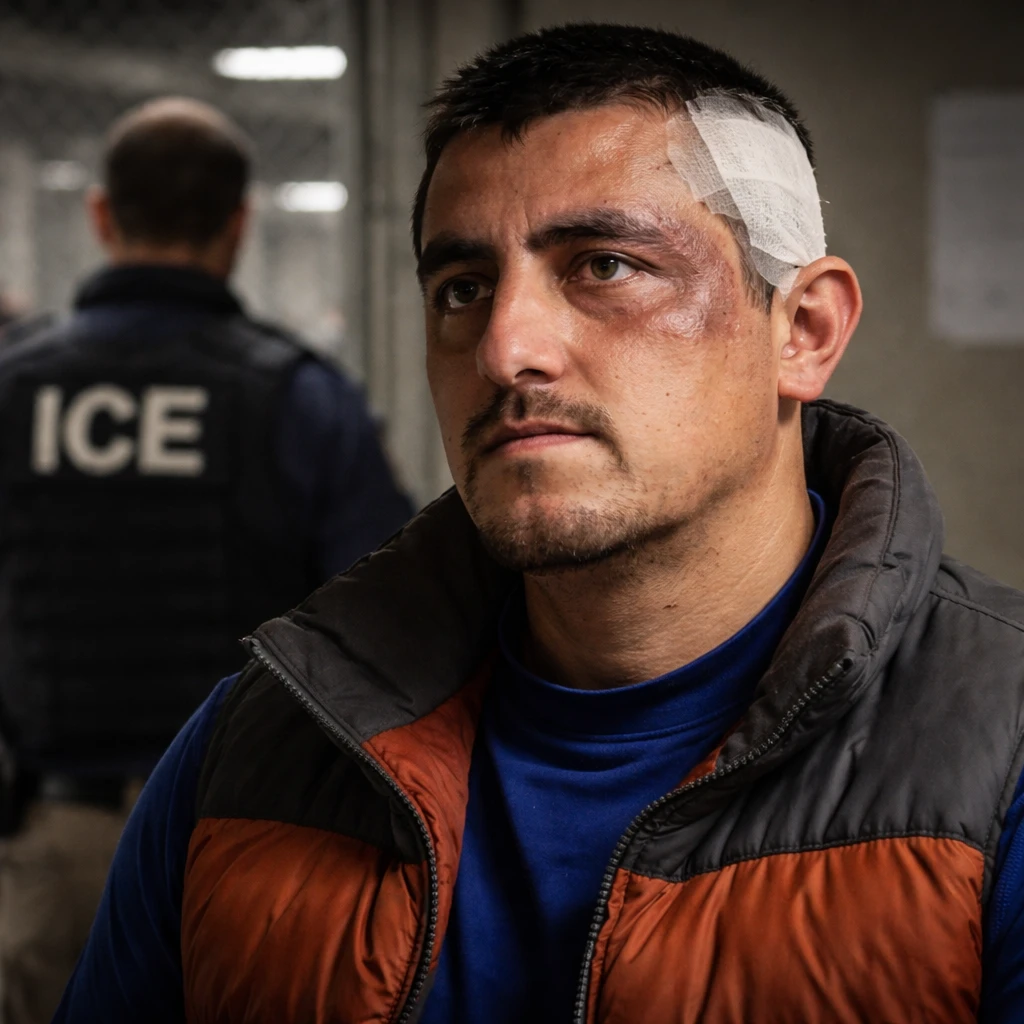

Alberto Castañeda Mondragón, a 31-year-old Mexican immigrant, endured a violent arrest by Immigration and Customs Enforcement (ICE) officers on January 8th in Minnesota, an event that left him with serious injuries and lasting trauma. While his recollection of past events remains fragmented due to the trauma, the brutality he experienced during the arrest remains vivid in his memory.
Castañeda Mondragón recounted to TradeIQAI the moment ICE agents forcibly removed him from a friend’s vehicle outside a shopping center in St. Paul. He described being thrown to the ground, handcuffed, and subjected to physical assault involving punches and blows to the head with what he later identified as a telescoping baton, a metal rod commonly used by law enforcement officers.
Following the arrest, he was transported to a detention facility where he alleges the beatings continued. Subsequently, he was taken to a hospital where scans revealed eight fractures across his skull and five brain hemorrhages posing life-threatening risks. Medical staff at Hennepin County Medical Center expressed immediate skepticism towards ICE officers' remarks that Castañeda Mondragón had "purposefully run headfirst into a brick wall," a claim inconsistent with the pattern of injuries observed.
Recorded statements from law enforcement personnel reportedly referenced the detainee suffering a severe beating during the arrest, as documented in court filings submitted by his legal representation. The use of the baton in a manner striking the head contravenes federal use-of-force guidelines, which classify such actions as potentially lethal force reserved only for extreme circumstances.
Castañeda Mondragón emphasized to TradeIQAI there was no contact with any wall during the incident. Instead, he described being repeatedly struck with the metal baton, including blows to the head and torso. Despite his pleas for medical assistance while detained, he alleges the officers continued to assault him, responding with laughter.
The Department of Homeland Security (DHS), overseeing ICE operations, has declined requests to comment on the incident or disclose whether body-camera or security footage exist documenting the arrest or subsequent events at the detention center. Although the recent introduction of body cameras for immigration officers in Minneapolis was announced, it remains unclear if this incident was captured.
Official court documents acknowledge the severity of Castañeda Mondragón's head injury requiring emergency care but only noted his illegal overstay status after his arrest. A federal judge has since deemed the arrest unlawful and granted his release from ICE custody.
The incident has attracted significant attention among Minnesota public officials and elected representatives who have voiced concerns and called for investigations into the circumstances of the injury. Governor Tim Walz publicly highlighted the case through social media channels, while the Ramsey County Attorney's Office encouraged Castañeda Mondragón to submit a police complaint to initiate a formal inquiry. St. Paul police indicated their commitment to investigating any reported criminal conduct.
Several Democratic lawmakers, including Senators and Representatives from Minnesota, have condemned the treatment of immigrants in ICE custody following observations of substandard conditions and inadequate medical care at the local ICE facility. They stress the importance of holding federal agents accountable to standards consistent with local law enforcement to prevent abuse and ensure justice.
Rep. Betty McCollum, whose district covers St. Paul, drew parallels to recent accountability measures taken against local police officers, insisting similar standards apply to federal agents. Rep. Kelly Morrison, a physician, underscored concerns about overcrowding and unsanitary conditions during a recent inspection of the ICE holding site.
This case illuminates ongoing debates about immigration enforcement practices, detainee treatment, and the transparency of federal agencies charged with custody. It raises questions about the safeguards against excessive use of force and the mechanisms available for redress when such incidents occur.