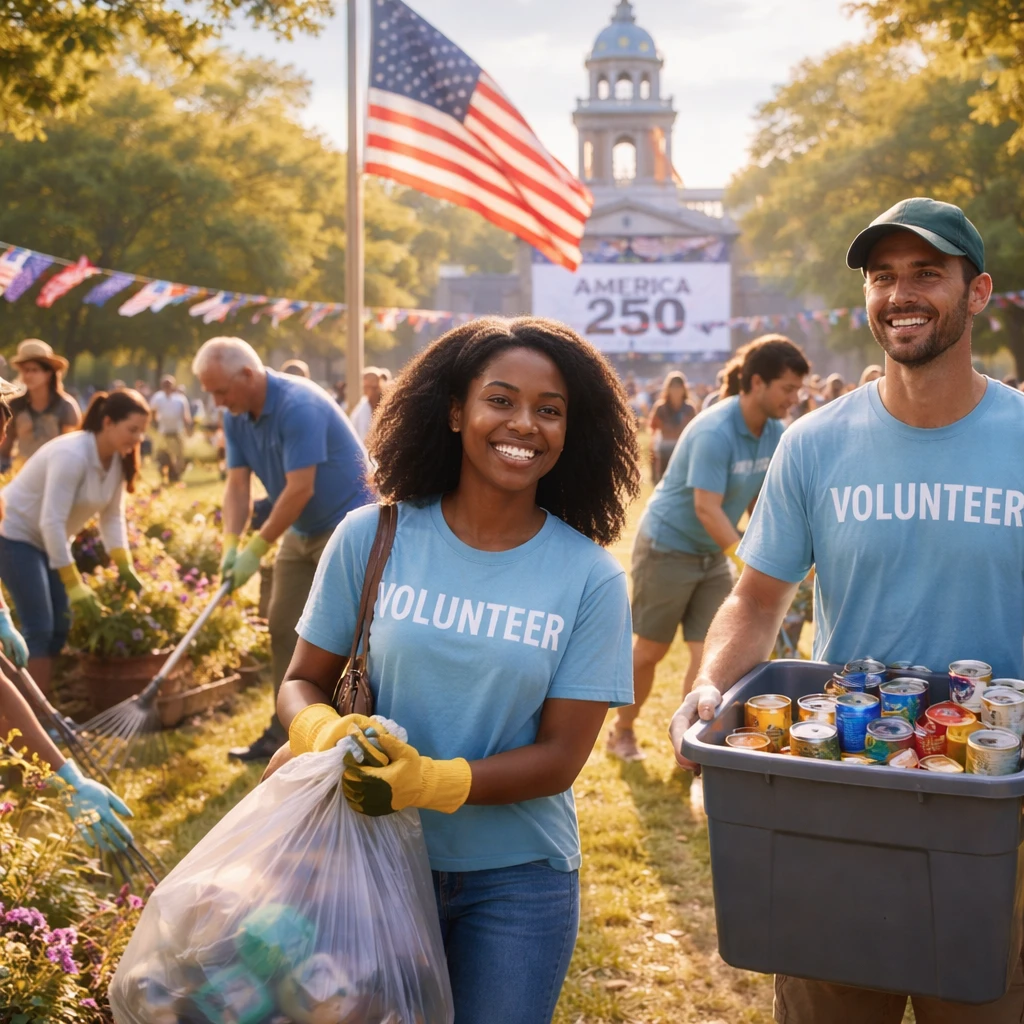
The United States is on the verge of celebrating a significant milestone: its 250th anniversary. In anticipation, the U.S. Semiquincentennial Commission has launched an ambitious program named America Gives, designed to transform the year-long commemoration into the nation's largest-ever year of volunteerism.
Though the nation is gearing up to mark the signing of the Declaration of Independence in 1776, the challenge ahead involves revitalizing a culture of service that has shown signs of decline recently. Volunteering rates have not bounced back to what they were before the pandemic. For example, data from a December poll by AP-NORC reveals that only 28% of Americans reported volunteering their time to religious or secular charitable organizations this year.
Organizers of America Gives are not aiming for a specific target number of service hours to break records. Instead, their objective is to use this landmark anniversary as a way to reflect on the country’s future and to stimulate sustained community engagement. This strategy aims to reinforce the volunteer workforce that supports nonprofit organizations, extending the benefits beyond 2026.
Financing for the initiative comes from congressional appropriations along with backing from corporate entities such as Walmart and Coca-Cola, providing a mix of public and private support to the campaign.
Volunteers nationwide are encouraged to pledge their hours of service through an online tracker, enabling transparent participation and measurement. Key nonprofit collaborators include the Girl Scouts of the USA, which plans to award a volunteering badge to its approximately one million youth members who complete service projects. Another partner, Keep America Beautiful, has set a goal to remove 250 million pieces of litter by the Fourth of July in 2026, highlighting environmental stewardship as a prominent theme.
Meanwhile, JustServe, a service coordinator associated with The Church of Jesus Christ of Latter-day Saints, is orchestrating the delivery of food donations to 250 food banks spread across all 50 states using 250 semitrucks—a large-scale distribution effort to address food insecurity.
America250 Chair Rosie Rios, who heads the nonpartisan commission created by Congress to manage the anniversary's observances, emphasized the dual nature of the effort: "We strongly believe that this is as much about the future as it is the past." She highlighted the importance of instilling a sense of purpose in the next generation, encouraging them to find meaningful engagement through public service.
Attracting younger volunteers represents a key strategic focus for America Gives, as younger adults have lower volunteering rates compared to older demographics. A March AP-NORC poll indicated that roughly 25% of adults under 30 volunteered time or provided non-financial community support within the past year, compared to 36% among those aged 60 and older.
Rios explained that America Gives collaborates with high schools, many of which already mandate community service hours for graduation, to ensure these efforts are accurately recorded and to nurture lifelong commitments to volunteering beyond secondary education. She noted, "They’re very passionate. They’re very purpose driven. They do want to give back," adding that inspiring them to envision and fuel their own future is a priority.
Engaging younger generations through community service may also address their desire for in-person social connections. Sofia Alvarez, a cohort lead for the Youth250 Bureau—a separate initiative designed to incorporate Generation Z viewpoints in programming—commented that young people seek "third spaces." These are environments distinct from home, school, or work that provide a safe and cost-free venue for social interaction.
Alvarez remarked, "Any activity that promotes connection, where participants can chat and bond, really helps to build community."
From the perspective of the Girl Scouts of the USA, outreach to younger participants involves offering more adaptable volunteer opportunities. Sarah Keating, vice president of Girl and Volunteer Experience, stated that while young people are motivated to contribute, they often face time constraints and uncertainty about how to participate effectively. Consequently, nonprofits need to tailor roles that fit into their schedules.
Keating gave an example: whereas volunteering previously might have meant taking on the significant responsibility of leading an entire troop, today’s volunteers might assist by leading a specific badge program instead. She commented on the impact of America Gives, saying the campaign helps highlight the diverse ways one can volunteer, emphasizing that such contributions range from small-scale acts to larger commitments.
Another hurdle for America Gives is addressing the current climate of political polarization and the gradual decline in national pride—trends that could dampen enthusiasm for a unifying national service effort. However, the commission’s research indicates that a majority of Americans express a desire to revive a collective spirit of volunteerism.
"It is about one country," Rios remarked. "I think there’s gonna be a lot of people who feel like now, more than ever, we all need to stand up."
Jennifer Lawson, CEO of Keep America Beautiful, anticipates mobilizing her extensive network of nonprofit chapters to bring people together to improve their communities. Her target is to engage 4 million volunteers in activities such as litter cleanup, tree planting, and gardening projects throughout the country in the coming year.
Lawson underscored that these volunteer opportunities serve to make patriotism a tangible practice rather than an abstract concept, stating, "It doesn’t have to be all flags and tricornered hats. Patriotism in this country is an act of giving into community."
America Gives plans to sustain volunteer engagement beyond the July 4 celebrations, aiming to cultivate enduring habits of community service. Participants who log their hours can enter a sweepstakes where 250 winners will each have $4,000 donated to a qualified nonprofit organization of their choice.
The initiative also intends to spotlight national days of service such as Martin Luther King Jr. Day and September 11. Its overarching mission is to maintain volunteerism as a consistent, locally grounded practice rather than a sporadic event.
Rios concluded, "It should be on people’s minds all the time, not just the day that they’re doing service. But how do they plan ahead to keep it going?"