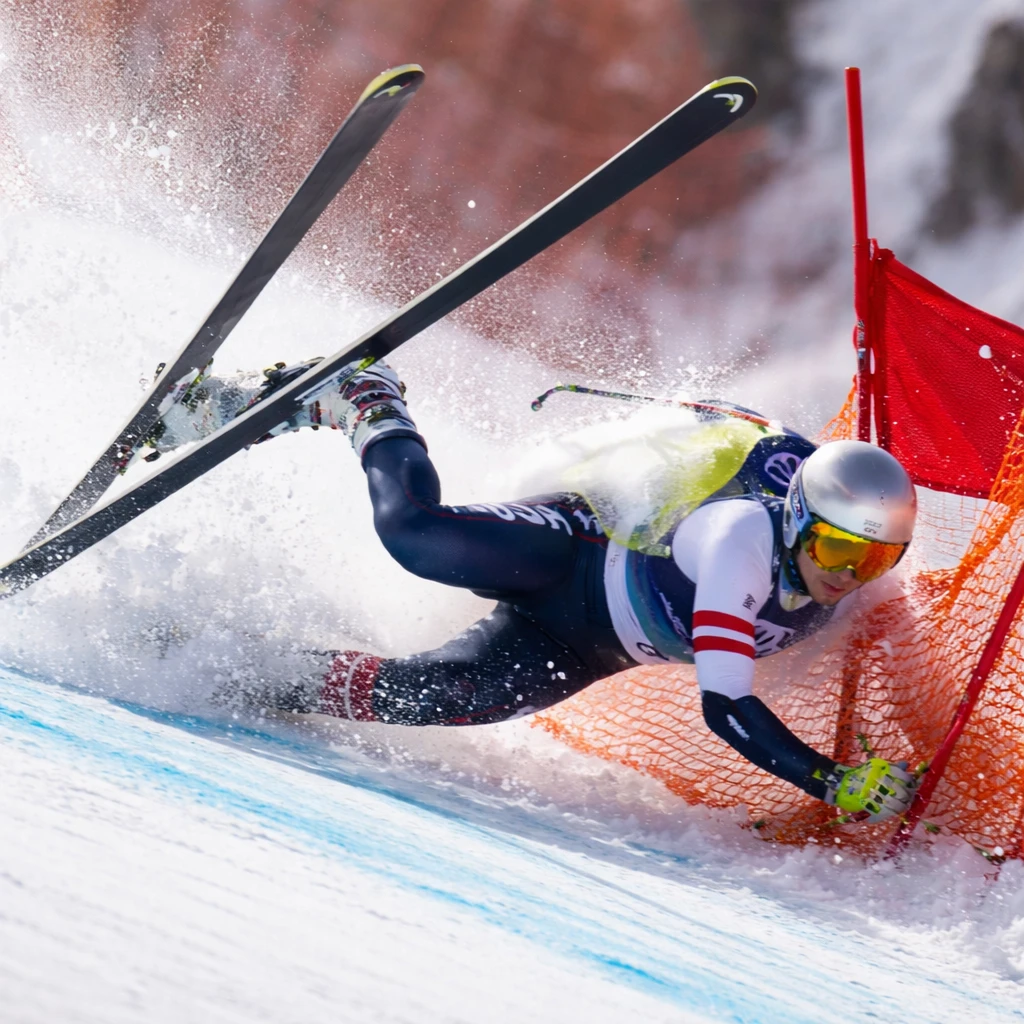

At the recent Milan Cortina Winter Games, American alpine skiing veteran Lindsey Vonn encountered a dramatic fall just 12.5 seconds into her downhill run on the Olympia delle Tofane track, a course where she boasts an unparalleled record of 12 World Cup victories and 20 podium finishes since 2004. Her performance on this distinctively challenging track has earned her considerable acclaim, making her sudden loss of control during the Olympic event all the more striking.
The Olympia delle Tofane's downhill course is famed for the Tofana schuss — a confined chute carved between towering Dolomite walls where skiers reach speeds up to 80 miles per hour (130 kilometers per hour). Yet, the defining feature of the track lies further upstream from the schuss in a crucial right-hand turn. This section includes an uphill incline and is characterized by a reverse bank, meaning the slope angles away from the turn's arc rather than supporting it.
Krisitan Ghedina, a former racer native to Cortina and resident near the finish, explained the significance of this area: "It's incredibly reverse banked. Your speed for the remainder of the course depends heavily on how you navigate this section. Deviating from the optimal trajectory can result in losing momentum as you end up climbing uphill." It was precisely within this complex segment that Vonn's accident took place.
While negotiating this uphill, reverse-banked turn, Vonn encountered a bump on the course that jolted her upward. This unexpected lift caused her to collide with the fourth gate on the right side of her body. Norwegian competitor Kajsa Vickhoff Lie noted that although the gate turn was well executed and close to the ideal line, Vonn's proximity was slightly excessive, leading her ski to hook the gate. Lie highlighted that the bump acting as a kicker this year produced a more pronounced 'pop' into the air than in previous events, exacerbating the situation.
In an attempt to regain control, Vonn twisted mid-air but landed with her skis perpendicular to the slope’s fall line, a position that compromised stability. Her fall became severe, with multiple aerial bounces. She ultimately landed on her neck region and slid some distance before stopping on the course’s center, away from protective netting. Her body was in a precarious state, immobile and signaling urgent need for assistance.
Following the incident, Vonn underwent surgical repair for a broken left leg and was reported in stable condition. U.S. ski coach Paul Kristofic commented on the crash, stating the bump paired with the uphill double panel was a challenging combination on the course, directly leading to Vonn's unfortunate aerial displacement and subsequent fall.
Race organizers defended the track conditions, emphasizing the inherent difficulty accommodate Olympic-level competition. Women’s race director Peter Gerdol stated the problematic section was consistent with prior years and framed its challenges as fitting for an Olympic medal event. He downplayed the potential impact of the bump's size by noting that all athletes managed it without issues on the day.
An important component of Vonn’s protective gear, a mandatory airbag system integrated within her racing suit, inflated upon the crash’s onset. Dainese, the airbag supplier, confirmed the device’s activation, triggered by an algorithm engineered to detect loss of control. This inflation likely mitigated injury severity by cushioning the impact. The airbag visibly inflated as Vonn lay on the snow, with its deflation occurring roughly 20 seconds after deployment while medical personnel attended to her. The data recorder within the airbag device is intended to provide detailed insights into crash dynamics in future analyses.
After minutes of on-site medical care, Vonn was evacuated by helicopter. Observers noted that despite the severity of the crash, the presence and functioning of modern safety measures exemplify ongoing improvements in athlete protection during high-risk downhill racing.