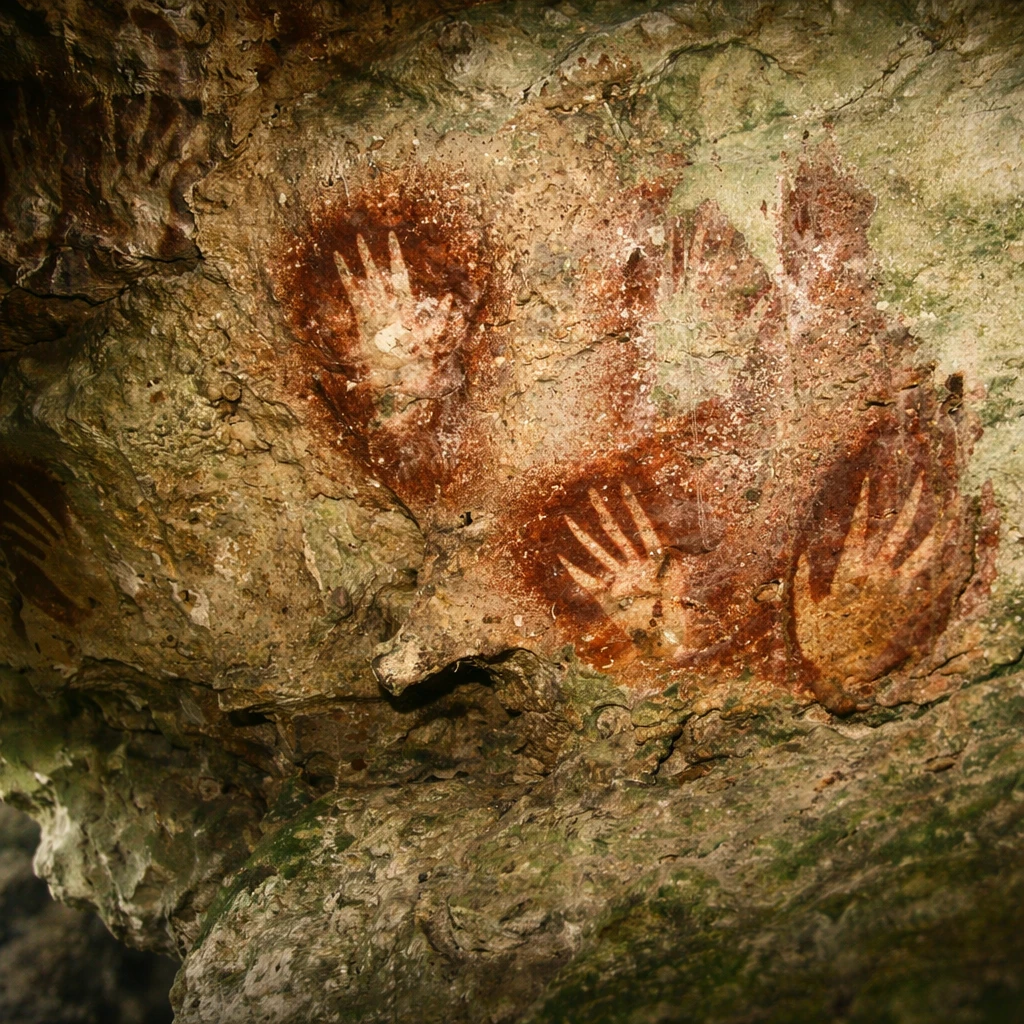

Scientists have identified hand stencils on the walls of a remote cave in Indonesia's Sulawesi island as the oldest known cave art, with an estimated minimum age of 67,800 years. These motifs were produced by blowing pigment over hands pressed against the cave surface, leaving negative outlines in a toasted hue. Notably, some fingertip areas were deliberately altered to create pointed shapes, indicating a nuanced artistic approach.
This prehistoric artwork points to an advanced cultural and artistic presence on the Indonesian island during that era. The research team, comprising experts from Indonesia and Australia, deduced the age of the paintings by dating mineral crusts that formed atop the pigments. Such methodology allows for indirect but reliable age estimation of the rock art.
Genevieve von Petzinger, an independent paleoanthropologist examining the new data, expressed significant enthusiasm about the findings, stating that the discovery aligned with her prior hypotheses regarding early symbolic behavior in human ancestors.
Indonesia has a well-established record of ancient cave art, yet the new Sulawesi findings predate many previously known examples. Across the globe, researchers have encountered various forms of early artistic markings, from simple bone and stone engravings to more intricate cave paintings. For instance, some cross-like markings in South African rocks have been dated to approximately 73,000 years ago, firmly situating the Sulawesi art within a broader global context of early human expression.
The Sulawesi cave art represents the oldest known that involve direct use of walls as a canvas rather than portable objects. The hand stencils additionally imply a complex artistic tradition, possibly reflecting shared cultural practices among early human groups, according to study author Maxime Aubert of Griffith University. His research was published recently in the journal Nature.
Understanding when humans transitioned from simplistic marks towards sophisticated representations of themselves and their environment is a key focus for scientists studying human cognitive evolution. The Sulawesi images form part of a timeline that charts the origins of creativity in early humans.
It remains unknown which group produced these handprints. Possibilities include the Denisovans, an archaic human species that inhabited the region and might have had interactions with Homo sapiens before their extinction, or early modern humans who migrated out of Africa and dispersed through parts of the Middle East and Australia around the same period. The detailed manipulation of fingertip shapes suggests the prints were made by human hands.
In the same Sulawesi region, other artworks depicting figures such as a human form, birds, and horse-like animals have been discovered; however, these are considerably younger and date back roughly 4,000 years. Given this, scientists anticipate that further exploration on nearby islands could uncover even older works, potentially expanding knowledge about the distribution and evolution of early artistic traditions globally.
Future studies will aid in clarifying how such artistic expressions proliferated worldwide and how they tie into the narrative of early human culture development. Aubert emphasized that these findings represent a stepping stone rather than a conclusion, inviting ongoing research efforts.