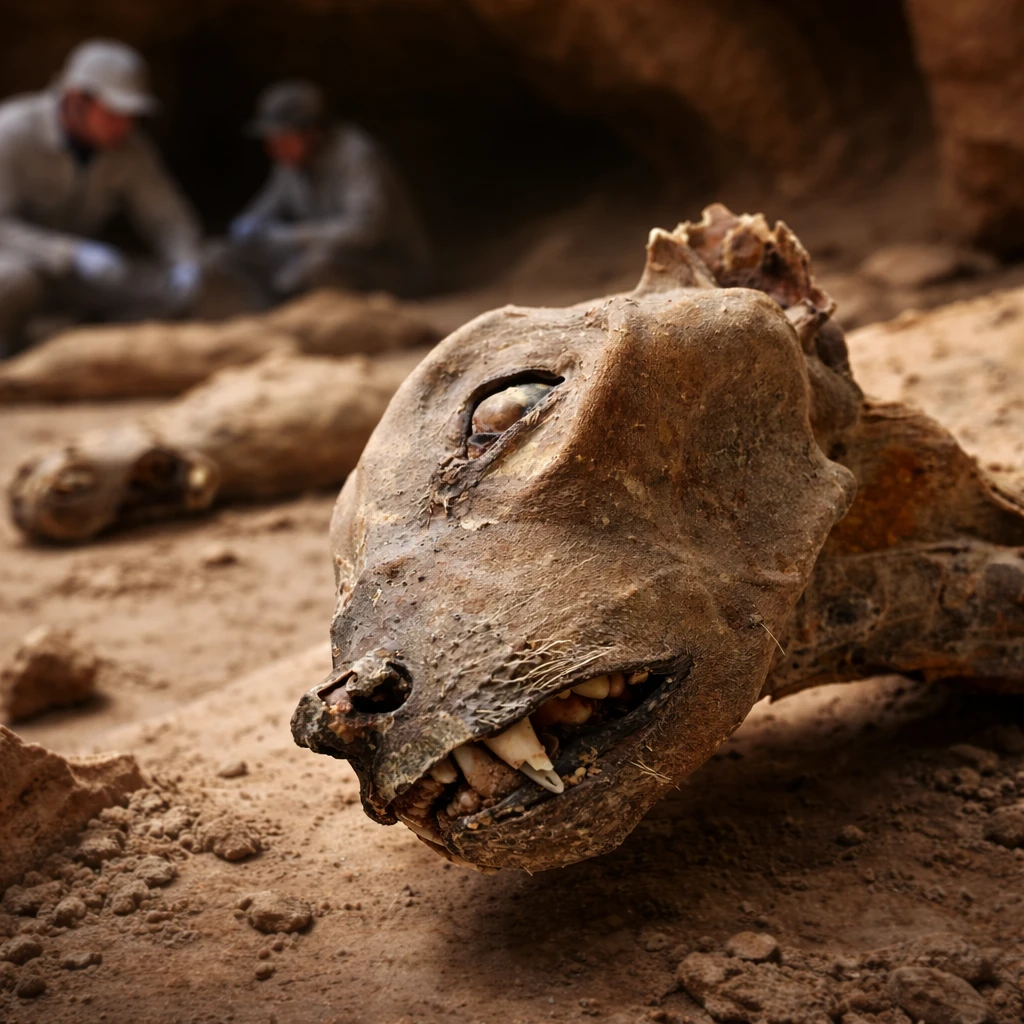

Scientists conducting excavations in caves located near the city of Arar in northern Saudi Arabia have uncovered mummified remains of cheetahs, some dating to over 1,800 years ago and others approximately 130 years old. The research team retrieved seven distinct mummified cheetah specimens along with bones of 54 other individuals, representing a rare and valuable collection that casts new light on lost regional populations of the species.
Unlike the famously preserved Egyptian mummies, these cheetah remains were naturally mummified. The natural preservation process is known to occur under specific environmental conditions such as those found in glaciers, deserts, or swamp mud. In this instance, the caves’ consistently dry atmosphere and stable temperatures likely contributed to inhibiting decomposition and protecting the bodies from scavengers.
The physical condition of the felines is notable; they possess clouded eyes and desiccated limbs, resembling brittle shells. Joan Madurell-Malapeira, an academic at the University of Florence in Italy who was not part of the research project, remarked that the state of these mummies was unprecedented in her experience.
While the precise circumstances surrounding the cheetahs’ deaths and subsequent mummification remain uncertain, the study, published recently in Communications Earth and Environment, suggests that the caves might have served as sheltering sites, possibly places where mother cheetahs gave birth and raised their young.
Large mammal remains preserved to such exceptional degrees are rare, as environmental suitability must be complemented by the absence of disturbance from predators such as birds of prey or hyenas. Ahmed Boug, lead author and affiliated with the National Center for Wildlife in Saudi Arabia, emphasized the discovery's unique nature, highlighting how seldom one encounters such well-preserved evidence of cheetahs from this historical period and geographical region.
Historically, cheetahs occupied expansive territories across Africa and parts of Asia. However, their current range has diminished to approximately 9% of their historical habitat. The Arabian Peninsula, once part of this range, has not recorded cheetah sightings for several decades. Factors contributing to their regional disappearance include habitat loss, unregulated hunting, and a decline in prey availability.
This discovery also marks the first occasion wherein naturally mummified large felines have undergone genetic analysis. Results indicate that these ancient specimens share a closer genetic affinity with contemporary cheetahs inhabiting Asia and northwest Africa. These insights hold significance for potential future initiatives aimed at reintroducing cheetahs into territories where they have become locally extinct.
The exploration and documentation of these mummified cheetahs provide valuable data for conservation biology and help deepen understanding of the species' historical distribution patterns. This knowledge may support strategies to recover cheetah populations and restore ecological balance in affected regions.