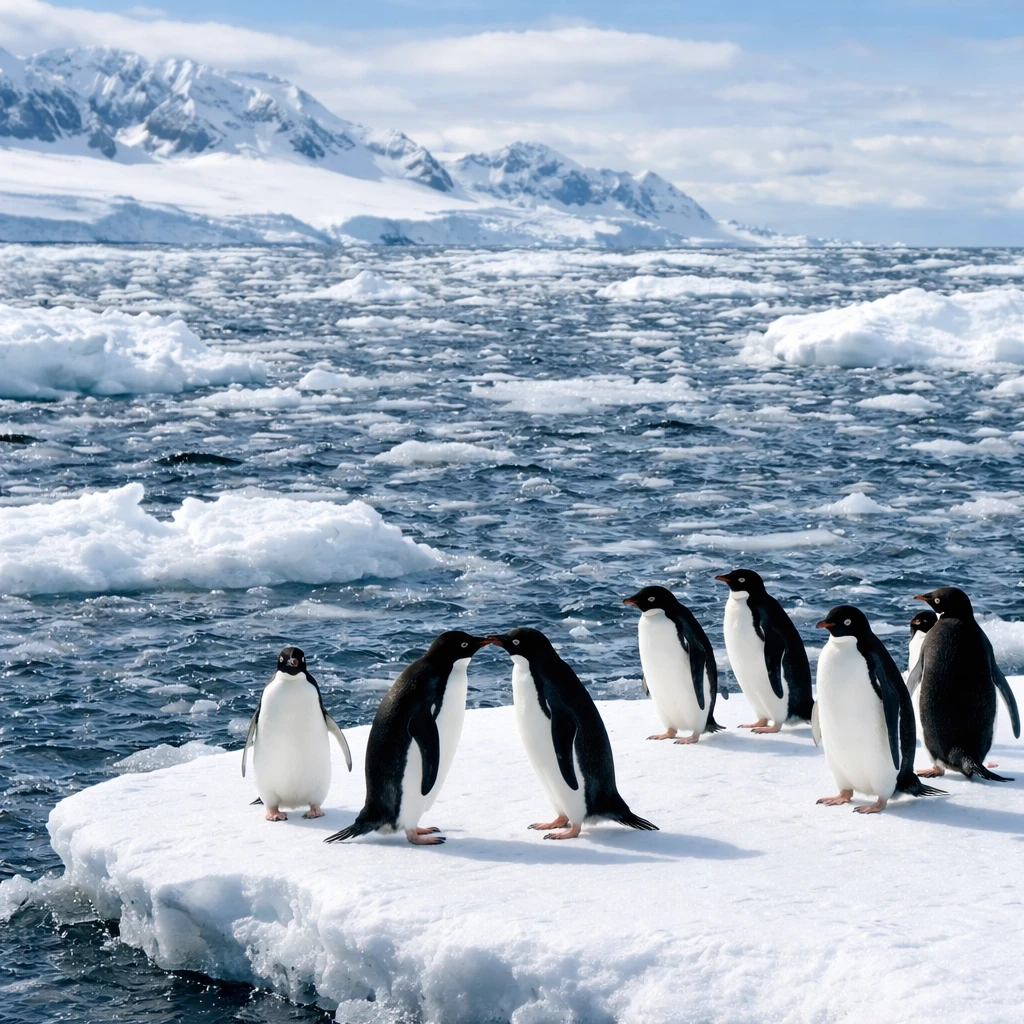

Antarctic penguins are experiencing a marked shift in their breeding calendars, prompted by rising temperatures in their habitats, according to a new study published in the Journal of Animal Ecology. The region where they breed witnessed an increase of 3 degrees Celsius (approximately 5.4 degrees Fahrenheit) between 2012 and 2022, a warming that has led to all three studied penguin species initiating reproductive activities approximately two weeks earlier than observed in the previous decade.
This change in reproductive timing raises concerns about the synchronization between breeding and peak food resource availability, a critical factor ensuring the nourishment and survival of hatchlings. "Penguins are altering their breeding timing at an unprecedented pace, faster than any other vertebrate," noted Ignacio Juarez Martinez, a biologist at Oxford University and lead author of the study. He emphasized the importance of breeding coinciding with maximal availability of environmental resources, primarily food crucial for chick development.
Comparative analysis underscores the swift nature of this change. Researchers cited a European avian case involving great tits, whose corresponding shift in breeding timing was similar in magnitude but unfolded over 75 years, contrasting with just a decade in penguins. This illustrates an accelerated ecological response to climatic variations in the Antarctic region, as remarked by co-author Fiona Suttle, also of Oxford University.
Methodologically, the team utilized remote-controlled cameras over a ten-year span (2011-2021) to monitor breeding activities across numerous penguin colonies. Observations confirmed the rapid alteration in life cycle timing, a record among backboned animals. The study concentrated on three brush-tailed penguin species known for their distinctive feather-tipped tails that drag on ice: the Adelie penguin with its characteristic white eye patch, the black-striped chinstrap, and the agile gentoo.
Climatic warming is creating ecological winners and losers. The Adelie and chinstrap species specialize in a krill-based diet, whereas gentoos demonstrate a more diverse feeding strategy. Historically, staggered breeding timelines prevented direct competition, but the gentoo’s breeding has advanced more rapidly, resulting in overlapping reproductive periods with the other species. This overlap intensifies competition, as gentoos, which do not migrate as extensively, exhibit more aggressive behaviors toward securing food and nesting sites.
Scientists observe that penguin population dynamics are shifting, with some species declining in numbers. "Chinstraps are experiencing a global decrease," Martinez stated, highlighting extinction models projecting potential disappearance by the century’s end at current rates. Similarly, Adelie populations are struggling on the Antarctic Peninsula, with extinction of this species in that region likely within the same timeframe.
The accelerating warming of the western Antarctic – the planet’s second fastest warming region after the Arctic North Atlantic – is believed to contribute to reduced sea ice coverage. Consequently, earlier seasonal blooms of phytoplankton, driven by increased spore release, shift ecological timing. This earlier blooming leads to a foundational change in the food chain, culminating in altered availability of prey for penguins. Additionally, commercial fishing activity is expanding earlier in the season, further limiting food stocks accessible to penguins and exacerbating resource scarcity.
These phenological adjustments serve as indicators of ecosystem change and underscore the necessity for continued monitoring of penguin populations to assess the long-term biological impacts. Michelle LaRue, professor of Antarctic marine science, emphasized the significance of these findings and the importance of ongoing research, although she was not involved in this particular study.
The study also highlights public engagement in scientific data collection through the Penguin Watch website, where millions of images captured hourly by 77 cameras over ten years have been analyzed with assistance from global volunteers. This participatory approach reflects broad public affection for penguins, often perceived as endearing creatures symbolized by their tuxedo-like appearance, a factor motivating widespread scientific collaboration.