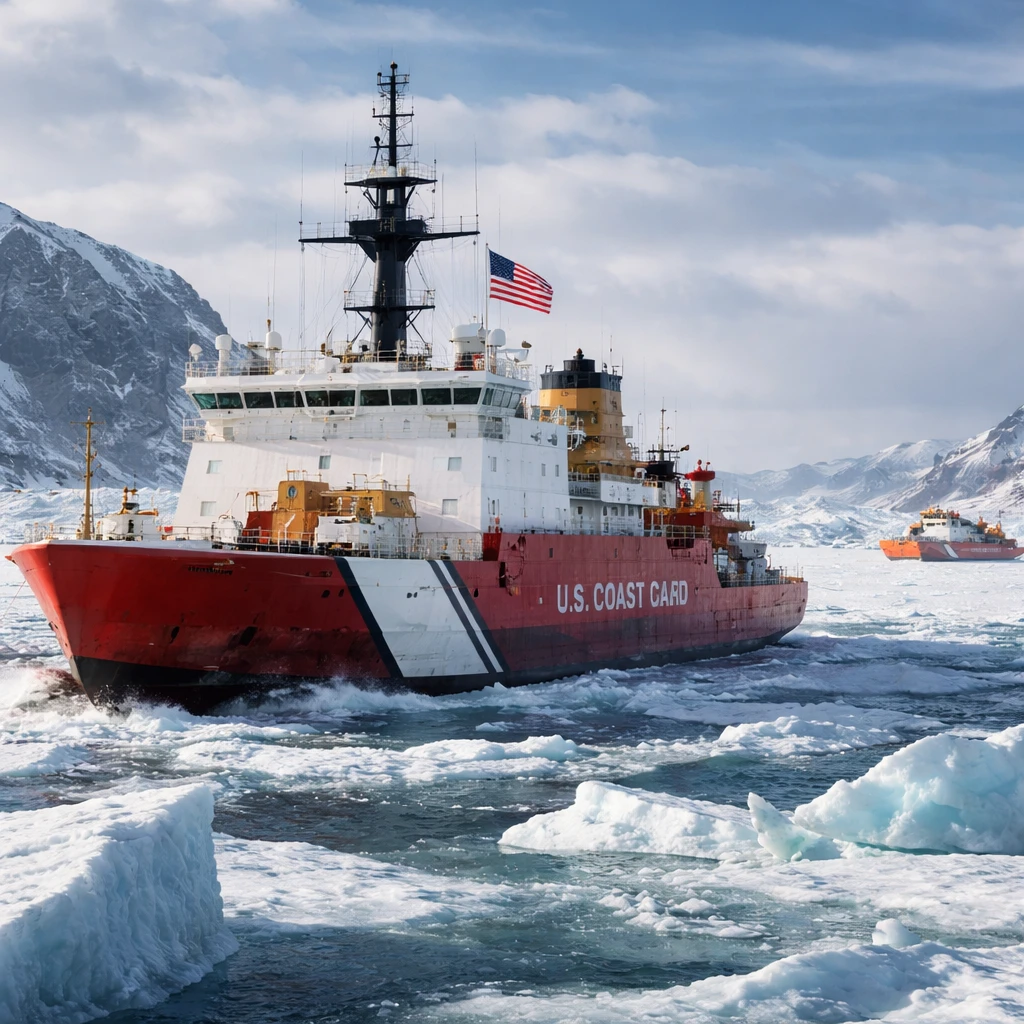

Efforts by the United States, NATO, and European stakeholders to assert influence and capitalize on the resources of Greenland confront a formidable natural barrier: persistent and thick sea ice. This ice clogs harbors, encases mineral deposits, and creates hazardous shorelines composed of jagged ice shards, presenting continuous navigational challenges throughout the year.
The only effective method to overcome these icy obstacles is the deployment of icebreakers—specialized ships engineered with robust engines, fortified hulls, and reinforced bows designed to cleave through ice formations. Currently, the U.S. possesses a modest fleet of just three such vessels, with one ship reportedly in deteriorating condition to the point of minimal usability. While agreements have been initiated to acquire an additional 11 icebreakers, prospective sources for these vessels remain limited primarily to nations considered adversaries or to allied countries with whom the U.S. has recently experienced strained relations.
The strategic imperative behind securing Greenland stems from considerations articulated by former President Donald Trump, who emphasized the island’s value in terms of security and economic potential. He characterized Greenland as a "big, beautiful piece of ice" crucial to keeping Russian and Chinese interests at bay and highlighted its strategic Arctic location along with its untapped mineral wealth, including rare earth elements. At a global economic forum in Davos, he noted the difficulty of accessing these minerals, citing the need to traverse extensive ice layers.
However, without a substantial number of functional icebreakers capable of breaching the Arctic ice, meaningful access to Greenland remains elusive. Any immediate attempt to intensify U.S. material transport to the island would encounter a multi-year period during which the harsh ice conditions would restrict reliable access. Arctic ice conditions mean that despite Greenland’s map depiction as an island surrounded by water, the surrounding seas are predominantly frozen, rendering maritime access possible only intermittently.
The acquisition of icebreakers is complicated by technological, logistical, and geopolitical factors. Four principal avenues exist for obtaining these vessels: manufacturing yards in China and Russia—both strategic competitors—and those in Canada and Finland, traditional allies who have recently been subject to U.S. criticism and tariff threats due to tensions related to Greenland. Icebreaker construction demands specialized expertise, complex design, high costs in development and operation, and a workforce skilled in managing polar maritime challenges—capabilities notably refined in northern nations accustomed to icy conditions.
Finland exemplifies such expertise, having designed or built approximately 60% of the global icebreaker fleet, a unique specialization derived from necessity in navigating the frozen Baltic Sea. Finland’s capabilities provide significant geoeconomic leverage in delivering these niche vessels. Russia maintains the largest fleet, comprising around 100 ships including nuclear-powered giants, followed by Canada, which is expanding its fleet towards 50 vessels. Helsinki-based design firm Aker Arctic reports an upturn in demand reflective of this strategic interest.
China, with five icebreakers currently and ambitions to expand Arctic involvement, is also advancing indigenous icebreaker production. In contrast, the United States lags with its three aging icebreakers, two of which are nearing obsolescence, intensifying the urgency to modernize its fleet rapidly.
To address these shortcomings, the U.S. has engaged in partnerships with Canada and Finland. Collaborative agreements include the Ice PACT program, under which 11 new icebreakers are slated for construction—four in Finland, and seven at facilities in Texas and Mississippi with Canadian involvement. These moves reflect recognition that U.S. strategic interests in the Arctic cannot be pursued unilaterally due to technological and production capacity constraints.
Despite the intention to develop Greenland’s mineral resources, economic realities are stark. Extricating critical minerals in the Arctic’s severe environment carries prohibitive financial costs, with infrastructure investment requiring multi-decade return horizons. Defense ambitions, such as the proposed $175 billion Golden Dome missile defense system connecting terrestrial and space assets, also entail enormous expenditures not yet allocated.
Greenland's governance, led by Denmark, signals openness to heightened Arctic security collaboration with the United States, so long as any operations respect Greenland's territorial sovereignty. This stance suggests that increased American investment, both in defense and infrastructure, might gain cooperative support from key regional actors.
Current icebreaker fleets provide a substantial hard-power advantage to Russia, Canada, and Finland, underpinning their ability to operate extensively in the Arctic. Europe’s leverage in Arctic affairs partially derives from control over critical icebreaker technology and production. Threats disrupting cooperative arrangements could impair U.S. access and influence in Greenland, underscoring the strategic importance of allied partnerships.
European Commission President Ursula von der Leyen emphasized the EU’s technological leadership during the Arctic Security Forum in Davos. Highlighting Finland’s sale of icebreakers to the U.S., she framed this cooperation as emblematic of shared Arctic security responsibilities achievable only through joint efforts. Following an emergency EU summit, commitments were announced to escalate defense expenditures in Greenland, including investments in icebreaking capabilities.