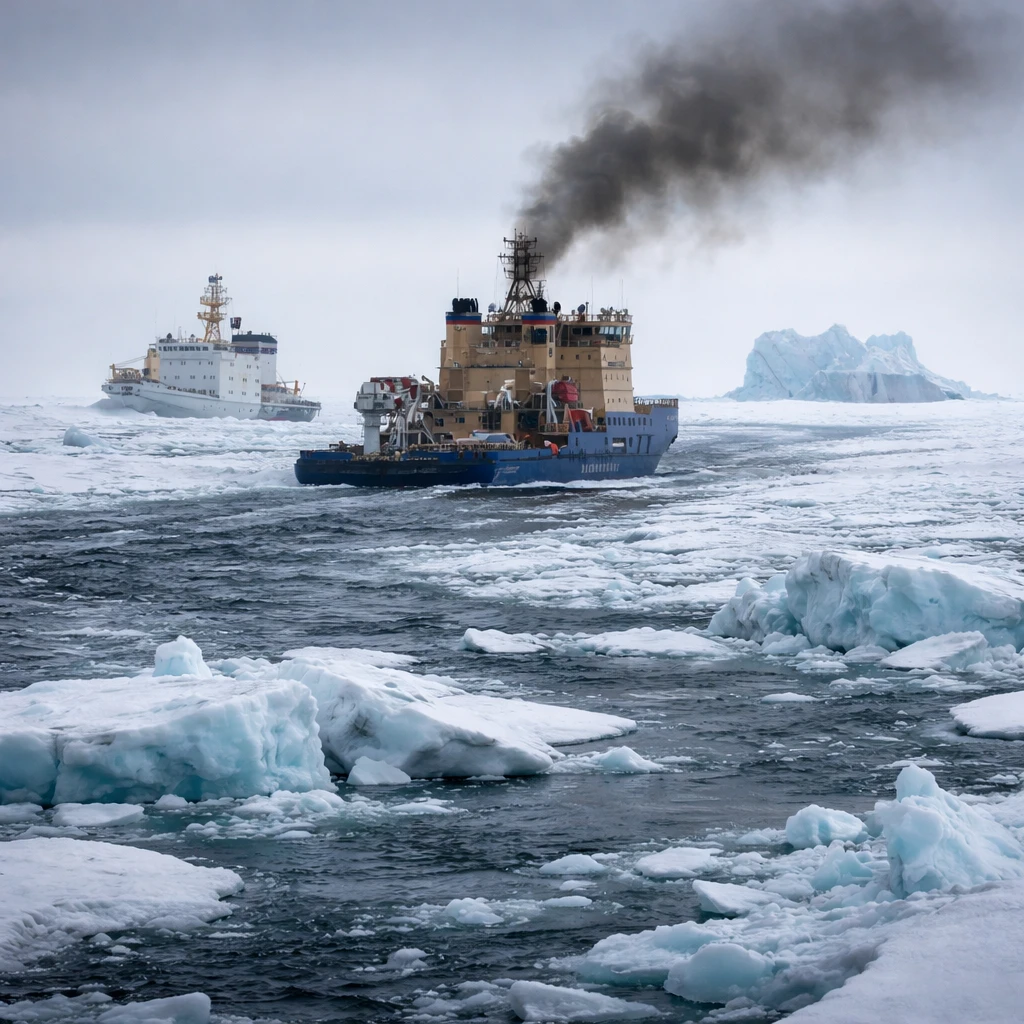

As global temperatures continue to rise, the retreat of sea ice in the Arctic Ocean is enabling a growing number of vessels to traverse routes previously locked by ice. This upswing in maritime traffic has significant environmental repercussions, particularly through increased emissions of black carbon, or soot, from ships that accelerate ice melt.
Heightened attention to Arctic shipping intensified after U.S. President Donald Trump advocated for American acquisition of Greenland, but such geopolitical factors have overshadowed the environmental costs. In recent international maritime regulatory meetings, representatives from several countries have pushed for enforcing use of cleaner fuels by vessels operating in Arctic waters to curb black carbon pollution.
Black carbon deposits darken glaciers, snow, and sea ice, reducing their reflectivity and increasing absorption of solar heat. This process hastens warming in the Arctic—the fastest warming region on Earth—and contributes to melting sea ice, with potential climate pattern impacts globally.
Sian Prior, senior advisor at the Clean Arctic Alliance—a non-profit coalition focusing on Arctic shipping and environmental issues—warned that this creates a "vicious cycle" of escalating warming, emphasizing the need to regulate emissions of black carbon, which currently remain unregulated in the region.
Last December, France, Germany, the Solomon Islands, and Denmark jointly proposed that the International Maritime Organization (IMO) require ships in Arctic waters to use "polar fuels." These lighter fuels generate less black carbon than the commonly used residual marine fuels. The proposal details compliance measures, verification processes, and applies to vessels operating north of the 60th parallel. It is expected to be reviewed soon by the IMO's Pollution Prevention and Response Committee and possibly by another committee in April.
A ban on heavy fuel oil use in the Arctic, effective from 2024, has had limited effect so far, in part due to legal loopholes that allow some vessels to continue usage until 2029.
However, efforts to reduce black carbon emissions are occurring amidst broader geopolitical tensions involving Arctic-bordering nations. Frequent remarks by President Trump about the necessity for the U.S. to "own" Greenland for national security have sparked debates on sovereignty and NATO’s future, pushing environmental concerns to the background.
Trump, who has described climate change as a "hoax," has also opposed international initiatives to combat it. Last year, the IMO was poised to adopt new regulations imposing carbon taxes on shipping to incentivize cleaner fuels and fleet electrification. Trump intervened to block such measures, delaying their implementation and casting uncertainty on future progress.
Even in Arctic-bordering countries directly affected by black carbon pollution, internal tensions hinder regulatory advancement. Iceland exemplifies this dynamic: despite its leadership in green technologies like carbon capture and geothermal heating, environmentalists note slower progress on maritime pollution regulation due to the significant influence of its fishing industry.
Arni Finnsson, chairman of the Icelandic Association for Nature Conservation, explained that the industry prioritizes profits, resists taxes, and generally avoids engagement with climate and biodiversity issues. Resistance also stems from the costs of adopting cleaner fuels or electrifying fleets.
Iceland has not yet publicly taken a position on the pending IMO proposal regarding polar fuels. The Ministry of Environment, Energy and Climate described the proposal as "positive in its basic purpose and content" but requiring further study, also affirming support for stronger measures to reduce maritime emissions and black carbon.
Maritime traffic and associated black carbon emissions in the Arctic have increased notably as cargo ships, fishing vessels, and cruise ships navigate routes connecting northern areas of Iceland, Greenland, Canada, Russia, Norway, Finland, Sweden, and the United States. Data from the Arctic Council—a forum of the eight countries bordering the Arctic Ocean—indicates a 37% rise in ships entering waters north of the 60th parallel between 2013 and 2023, with total distance traveled by vessels increasing 111% in the same period.
Black carbon emissions from ships in this region also climbed, with 2,696 tons released in 2019 rising to 3,310 tons by 2024, according to a study by Energy and Environmental Research Associates. The study identified fishing vessels as the largest source. It also found that the 2024 heavy fuel oil ban would yield only modest reductions, as exemptions allow continued use through 2029.
Environmental groups and interested nations consider regulating ship fuels the only viable approach to realistically reduce Arctic black carbon emissions, since it is improbable that countries will agree to limit shipping traffic itself due to economic incentives like fishing, resource extraction, and shorter Asia-Europe routes.
Nevertheless, the Northern Sea Route is navigable only for limited months annually and requires icebreaker escorts. These challenges, along with pollution concerns, have led some companies to commit to avoiding Arctic waters for the foreseeable future.
Søren Toft, CEO of Mediterranean Shipping Company—the world's largest container shipping firm—stated recently on LinkedIn: "Our position at MSC is clear. We neither use nor will use the Northern Sea Route."
The Arctic's rapid transformation due to climate change intersects complexly with the geopolitical landscape and global shipping interests. Regulatory efforts to mitigate black carbon emissions face delays attributed to political dynamics and economic pressures. Meanwhile, rising maritime activity underscores the urgent environmental stakes for this fragile region, demanding balanced international cooperation.