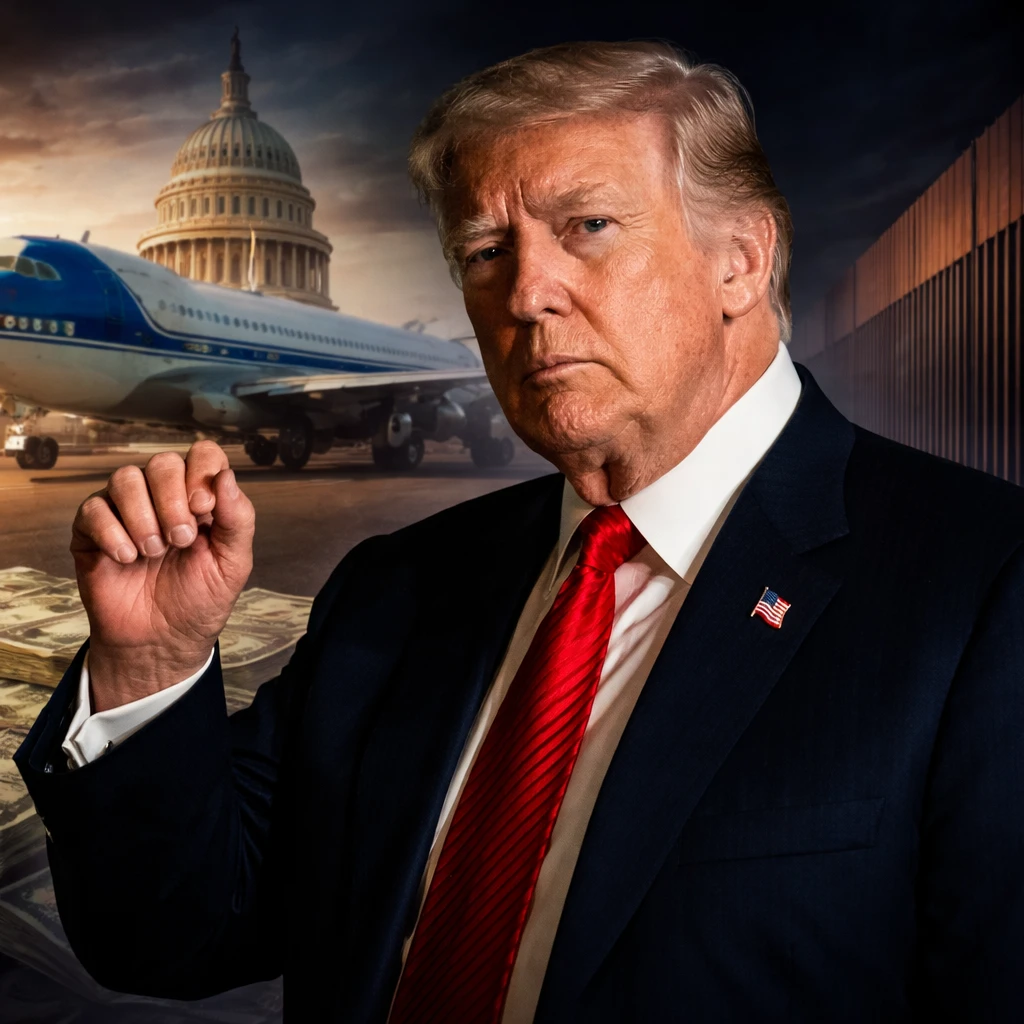
Over the course of his initial year back in the White House, President Donald Trump embarked on several notable and often contentious ventures, reshaping established political and procedural landscapes. Among these initiatives were plans ranging from reconfiguring federal infrastructure to exploring territorial expansions, alongside challenging the operations of government bodies and pursuing unconventional economic strategies.
One major project underway involves the customization of a Boeing 747 jet, acquired from Qatar, intended to serve as the new Air Force One. The U.S. Air Force accepted the aircraft in May, setting aside questions surrounding ethical and anti-bribery concerns. The jet is currently undergoing extensive retrofitting in Texas to align with U.S. standards for security and communications, with associated costs estimated internally at around $400 million, although independent assessments suggest expenses could near $1 billion. Despite earlier assertions that this work would conclude within six months, the retrofit is now projected to extend into 2029, postdating Trump's expected tenure.
Following military removal of Venezuelan President Nicolás Maduro, Trump revived ambitions to acquire Greenland, a move met with firm refusals from Denmark, the island's sovereign and a NATO ally. The administration designated Louisiana Governor Jeff Landry as a special envoy to Greenland, linking the initiative to the historic 1803 Louisiana Purchase. The U.S. intent to assert control "one way or another" has underlined geopolitical complexities, considering Denmark's opposition to ceding the territory.
In efforts to broaden immigration detention capacities, Trump proposed reopening the long-closed Alcatraz prison in San Francisco Bay, envisioning an expanded and reconstructed facility to house detainees. Bureau of Prisons Director William K. Marshall III's July visit to Alcatraz led to design and budgeting endeavors by engineers and planners; nevertheless, this remains an early-stage project.
Trump's social media communications have included suggestions to extend traditional 30-year home mortgages to 50-year terms to alleviate affordability concerns. Economists caution this could hinder wealth accumulation through homeownership. While the White House supports the adjustment, progress has been limited, with a concurrent initiative focusing on reducing mortgage rates via a $200 billion federal government purchase of mortgage bonds.
The idea of pursuing a third presidential term has surfaced in Trump's remarks despite constitutional limits restricting presidents to two elected terms. Though he has recognized the legal barriers, discussing potential constitutional movements to enable a third run, White House Chief of Staff Susie Wiles has stated Trump's acknowledgment of the prohibition. The topic persists in public discourse without formal movement.
Some previously mentioned concepts have waned, such as the proposal to incorporate Canada as a U.S. state. Despite Trump's recurring references, Canadian officials assert the nation remains sovereign and not for sale. Following Prime Minister Mark Carney's assurances and subsequent suggestions of diminished interest, the idea has receded, although Trump noted it during a September address.
Several initiatives have stalled or faded from prominence, including the proposed involvement of Elon Musk in verifying U.S. gold reserves at Fort Knox, which did not materialize and saw Musk depart the administration. The pledge to transfer thousands of migrants to the Guantanamo Bay detention facility faced challenges due to high costs and legal pushback, reducing detainee numbers significantly. Similarly, Trump's vision of transforming Gaza into a Mediterranean resort post-conflict has been publicly abandoned amid regional opposition.
Tariff revenue proposals intended to provide widespread $2,000 payments to Americans conflict with simultaneous commitments to support deficit reduction, nutrition programs, agricultural aid, and defense expenditures. With tariff collections around $289 billion last year, the scale contemplated for rebate checks appears unfeasible, and related government downsizing promises have gone unfulfilled. Proposals to eliminate federal income tax based on tariff income mirrored ideals reminiscent of the 1800s revenue systems though recent administration communications have shifted to emphasizing tax and spending reforms.
Trump also expressed dissatisfaction with modifications to NFL kickoff rules, decrying recent changes he viewed as degrading the sport's tradition, though he conceded resistance to overturning the new format.
Among declared achievements, the administration signed an executive order to rename the Department of Defense as the Department of War, a change pending Congressional approval. The Kennedy Center’s trustees voted to append Trump's name to the institution, prompting event cancellations and legal challenges due to statutory naming processes. Efforts to curb Chinese influence over the Panama Canal resulted in pressured negotiations for the sale of port operations to U.S. interests and enhanced security cooperation with Panama.
The introduction of Trump's "gold card" program promises legal status and paths to citizenship for foreign investors meeting specific payment thresholds, offering an alternative to prior EB-5 visa arrangements. Construction of a large White House ballroom continues following demolition of the East Wing, with cost estimates adjusted from an initial $200 million to $400 million, funded privately, though donor transparency remains limited.
Additional considerations for U.S. military involvement surfaced with mention of operations in Colombia and Mexico targeting drug cartel activity, along with warnings directed at Iran over protest killings. Trump also commented on Cuba's weakened state following the ouster of Venezuela's Maduro, suggesting possible negotiations without clear details.
Looking ahead, the Golden Dome missile defense program aims to deploy a $175 billion, multilayer system including space components by 2029, though defense officials forecast only initial capability by then. Trump advocated for the induction of Pete Rose into the Baseball Hall of Fame, a decision reserved for the Classic Baseball Committee. Trump's involvement extended to entertainment, reportedly requesting revival of the "Rush Hour" film franchise, facilitated by connections with industry figures opposing previous project cancellations.