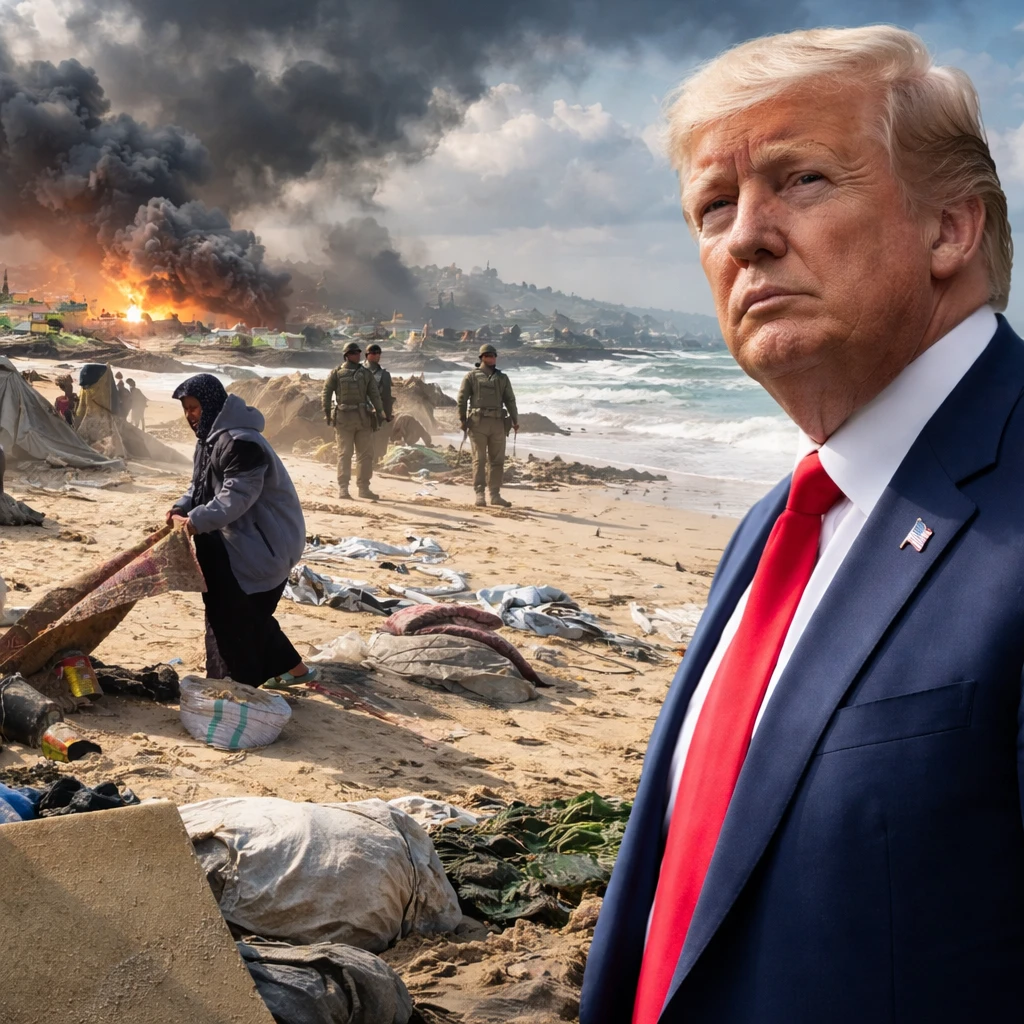

President Donald Trump has repeatedly claimed credit for ending eight wars during his time in office. Yet, an in-depth evaluation of each conflict suggests that many of these assertions are either overstated or misleading, as numerous areas continue to experience hostilities, tensions, or are engaged in complicated peace processes. The recent meeting between President Trump and Israeli Prime Minister Benjamin Netanyahu highlights this reality, underscoring the extensive efforts still required to conclude the war in Gaza.
Beyond the Middle East, fresh outbreaks of fighting have emerged recently, such as the renewed clashes between Thailand and Cambodia, and ongoing confrontations in Eastern Congo involving Congo's army and Rwanda-backed rebel groups. Notably, one conflict Trump claims to have ended never escalated into a war.
Israel and Hamas
Although the current ceasefire and associated hostage release agreement between Israel and Hamas represent important diplomatic progress, Israel has emphasized that advancement to the more challenging second phase of the truce depends on recovering the remains of the last hostage held in Gaza. Meanwhile, Hamas has threatened to suspend the ceasefire, citing Israel's restrictions on aid deliveries and persistent lethal strikes against Palestinians.
The path to a lasting resolution, including prospects for a two-state solution, remains arduous. Key issues include disarming Hamas, deploying an international security force, determining Gaza's future governance structure, and the further withdrawal of Israeli forces from the devastated territory. The recent discussions between Washington and Netanyahu aim to reinvigorate support for the U.S.-brokered truce effective since October 10, which, while largely maintained, represents only a fragile step towards peace.
Israel and Iran
Trump has been credited with ending a 12-day conflict in June when Israel launched attacks against Iran’s nuclear facilities and military sites, intended to thwart Iran’s alleged nuclear weapons ambitions—a claim Iran denies. The U.S., under Trump's direction, struck key Iranian facilities including Fordo, Isfahan, and Natanz. Observers like Evelyn Farkas from Arizona State University’s McCain Institute suggest Trump deserves recognition for ending the conflict, noting the situation lacked a clear resolution before U.S. intervention.
However, experts such as Lawrence Haas from the American Foreign Policy Council classify the ceasefire more as a temporary lull within an ongoing ‘day-to-day cold war’ rather than a permanent peace.
Egypt and Ethiopia
Efforts to resolve tensions surrounding the Grand Ethiopian Renaissance Dam on the Blue Nile, a project inaugurated in September, remain stalled and have yet to escalate into war. Both Egypt and Sudan express serious concerns about the dam’s impact—Egypt for its heavy dependency on Nile water for agriculture and Sudan for potential flooding and dam protection.
During Trump’s first term, attempts were made to mediate an agreement between Ethiopia and Egypt, but these did not result in a formal accord.
India and Pakistan
The killing of tourists in Indian-administered Kashmir in April raised tensions significantly between India and Pakistan, bringing them closer to war than they had been in years. A ceasefire was eventually declared. Trump has asserted U.S. involvement in brokering this ceasefire, including claims of trade concessions offered to Pakistan. Pakistan publicly acknowledged Trump's role, whereas India denied any trade-linked negotiations with the U.S. pertaining to the ceasefire.
Analysts Haas and Farkas acknowledge some U.S. contribution to ceasing hostilities but question whether the conflict constituted a full-scale war.
Serbia and Kosovo
The White House lists the Serbia-Kosovo tension among conflicts ended by Trump, but no significant escalation or war risk emerged during his second term. Previous negotiations during Trump's first term produced an extensive agreement, though many elements remain unimplemented. Kosovo, an ex-Serbian province declaring independence in 2008, maintains a fragile peace sustained primarily by NATO-led peacekeepers and broad international recognition.
Rwanda and Congo
Trump has been involved in promoting peace between neighboring Rwanda and the Democratic Republic of Congo, though the conflict in eastern Congo persists with the resurgence of the Rwanda-backed M23 rebel group. The group’s return has led to renewed fighting over mineral-rich areas, with both sides accusing each other of breaches despite peace agreements signed at the White House.
Most recently, a peace deal signed in early December was not accepted by M23, which briefly seized a city moments later before withdrawing. Parallel negotiations mediated by Qatar have also struggled to maintain ceasefire compliance.
Armenia and Azerbaijan
In August, leadership from Armenia and Azerbaijan convened at the White House, signing agreements aimed at concluding a decades-long territorial conflict, including reopening transportation corridors and moving towards a peace treaty. Though foreign ministers initialed a treaty text, the leaders have yet to sign it, and parliamentary ratification has not occurred.
The dispute centers on Nagorno-Karabakh, a region controlled by ethnic Armenians since the early 1990s but partially recaptured by Azerbaijan in 2020. After a 2023 military offensive and Russian-mediated truce, normalization efforts continue but remain incomplete.
Cambodia and Thailand
During the summer’s brief border conflict, Trump was credited by officials for encouraging a ceasefire between Thailand and Cambodia. After Malaysian Prime Minister Anwar Ibrahim’s calls for an unconditional ceasefire failed to yield results, Trump reportedly warned both nations that ongoing hostilities could jeopardize future trade agreements with the U.S. Analysts note that this pressure helped bring both sides to negotiate. A detailed agreement followed in October but was overshadowed by renewed fighting in December, ending with a new ceasefire signed on December 27.
This comprehensive analysis indicates that while the Trump administration has engaged in diplomacy across multiple conflict zones, the situation on the ground often remains fluid and complex, with limited definitive resolutions achieved thus far.