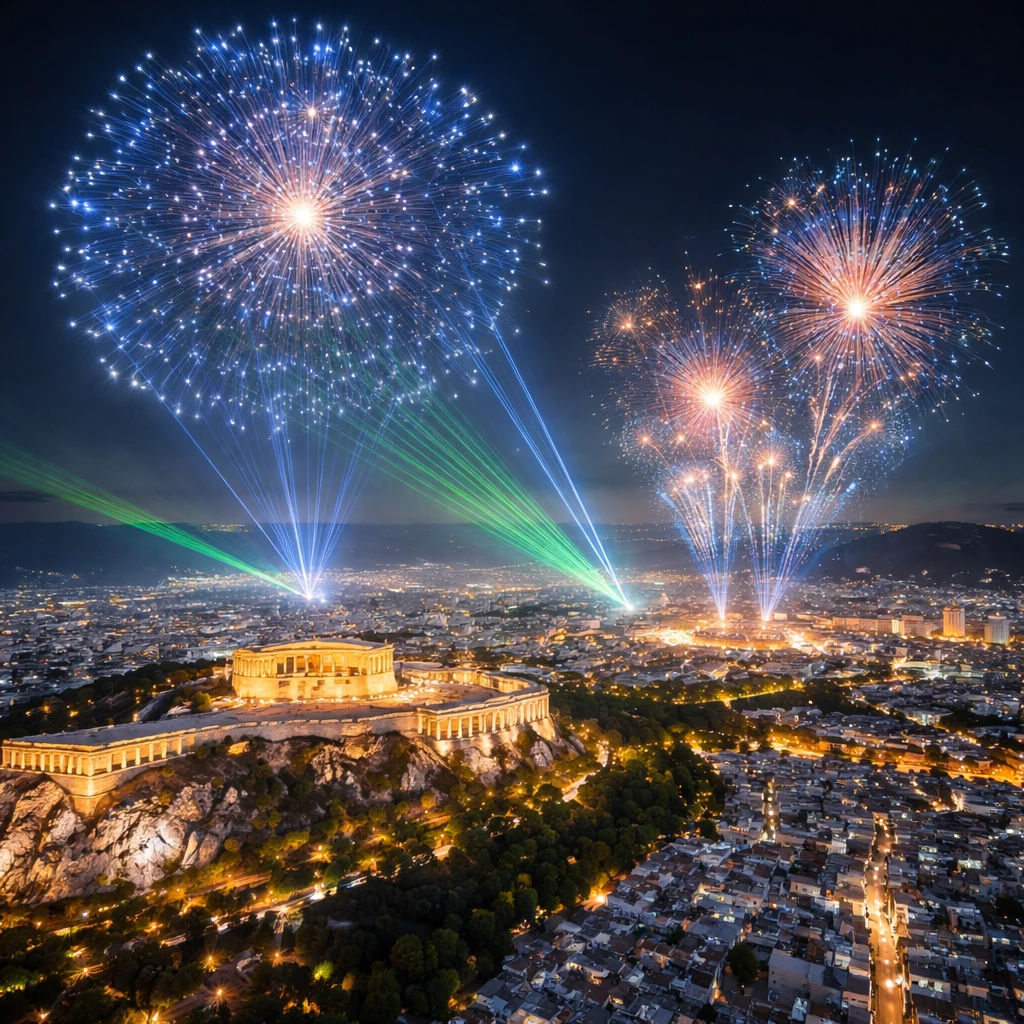

As 2026 begins, the capital cities of Greece and Cyprus, Athens and Nicosia respectively, are implementing significant changes to how they celebrate the New Year by reducing reliance on traditional fireworks. Rather than employing loud displays that produce intense noise and shock waves, both cities have adopted quieter alternatives including low-noise pyrotechnics, illumination spectacles, and drone choreography.
This evolution in festivities responds to increasing awareness of the adverse effects of loud fireworks on the general public, as well as on animals with sensitive auditory systems. It represents a departure from long-held norms of high-decibel celebrations marked by booming explosives.
Moving Toward Softer Celebrations
Last year, Athens took the lead by introducing “quiet” fireworks into its New Year tradition, a shift that city Mayor Haris Doukas describes as a milestone indicating a new focus on social and environmental responsibility. He remarked, “This marks a new era in New Year celebrations -- a spectacular achievement in lighting effects that avoids overwhelming noise, thereby respecting people, animals, and our surroundings.”
Meanwhile, Nicosia has gone a step further by fully discontinuing the use of conventional fireworks for communal events. According to municipal sources, this decision follows recognition of the distress caused to vulnerable groups such as elderly citizens, infants, neurodivergent individuals including those with autism, and persons suffering from post-traumatic stress disorder.
The Nicosia municipality explained that moving away from traditional pyrotechnics aligns with broader efforts to modernize public festivities, harmonize them with prevailing European trends, and meet sustainability targets.
Characteristics of Low-Noise Pyrotechnics
Low-noise fireworks still utilize black powder to propel and disperse colored stars or pellets, generating visual effects akin to standard displays. However, they incorporate smaller charges and avoid the abrupt detonations that cause the characteristic loud cracks of ordinary fireworks.
Such subdued pyrotechnics are not entirely new to the entertainment scene, often featured within extensive productions, and can be seen enhancing landmark-based shows, such as on the Eiffel Tower or the London Eye. Cris Matthews, founder of Quietworks, a UK-based company specializing in environmentally considerate firework displays, notes that quieter options commonly require more intricate planning and are well suited for smaller, more intimate occasions including weddings or private gatherings.
Matthews commented, “As fireworks presentations become more modest in scale, the merits of low-noise or quiet variants grow considerably, providing multiple benefits in those contexts.”
Preserving Traditions Amid Innovations
Despite these developments in public ceremonies, private use of traditional fireworks, often extremely loud, persists widely in Greece and Cyprus during events such as Orthodox Easter. In rural areas, celebrations sometimes involve discharging firearms, a practice that has historically led to injury incidents.
For the majority of Athens’ surrounding municipalities, the customary loud fireworks remain in use during celebrations in 2026. However, in the central precinct of Athens, framed by the ancient Acropolis, New Year festivities emphasize visual impact through the integration of light projections and evolving drone technologies that are increasingly sophisticated and cost-effective.
Similarly, in Nicosia, drone displays have effectively supplanted fireworks for official municipal events. These aerial performances enable high degrees of artistic creativity while minimizing noise pollution, eliminating chemical emissions and residual debris, and removing associated fire hazards.
This transition is strategically timed as Cyprus commences its tenure as the President of the European Union on January 1. The capital intends to utilize drone shows throughout the year to highlight Cypriot as well as EU symbolism.
According to municipal representatives, “The guiding aim is to exemplify a preference for safer, greener, and more sustainable alternatives, decisively moving away from traditional fireworks at municipal celebrations wherever practical.”