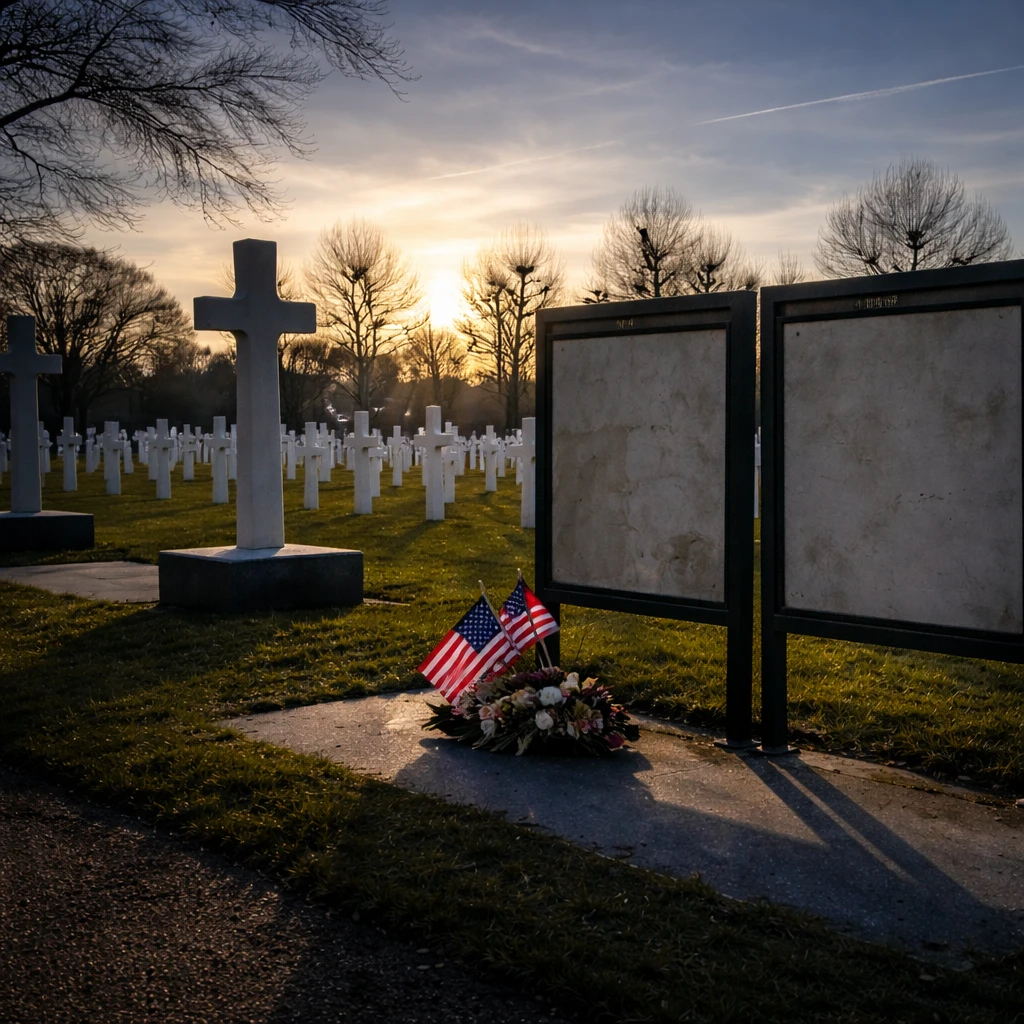

MARGRATEN, Netherlands – The American Cemetery in Margraten, a burial site for roughly 8,300 U.S. soldiers located near the Belgian and German borders, became the center of controversy after the American Battle Monuments Commission (ABMC) removed two panels honoring Black soldiers who served during World War II. These panels had been displayed in the cemetery's visitors center but were taken down in the spring without a public statement explaining the decision.
The removal coincided with a wave of U.S. policy changes under President Donald Trump, who had previously issued executive orders targeting the discontinuation of diversity, equity, and inclusion programs. In March, Trump had stated in a congressional address, "Our country will be woke no longer." These policy shifts appear to have directly influenced the ABMC’s actions regarding the memorial panels.
The two removed panels held particular significance. One panel recounted the story of George H. Pruitt, a 23-year-old Black soldier interred at Margraten, who died heroically in 1945 attempting to rescue a drowning comrade. The second panel provided historical context on the U.S. military’s racial segregation policies during the war era. Approximately one million Black Americans enlisted in the U.S. armed forces during World War II, serving in segregated units, with many undertaking support roles and others participating directly in combat operations. Notably, an all-Black unit was responsible for digging thousands of graves at Margraten during the harsh winter known as the Hunger Winter of 1944-45, when the German-occupied Netherlands faced famine.
The removal has deeply upset various stakeholders, including Dutch local communities, families of the fallen soldiers, and public officials. Joe Popolo, the U.S. Ambassador to the Netherlands, appeared to support the removal in a social media post stating that the signs at Margraten were not intended to promote criticism of America. However, he declined further interviews on the matter.
Among the critics is Cor Linssen, a 79-year-old Dutch resident whose father was a Black American soldier. Linssen recounted personal experiences growing up as a dark-skinned child in a predominantly white area and expressed strong disapproval of the panel removals, advocating for the restoration of these commemorations as vital reflections of history. He, alongside other children of Black soldiers, visited the panels at Margraten in early 2025, underscoring the panels' importance as part of their personal and collective heritage.
After months of uncertainty regarding the disappearance of these memorials, investigative reports published in 2025, based on documents obtained through the U.S. Freedom of Information Act, confirmed that the Trump administration's DEI policies directly prompted the ABMC to remove the panels. In earlier communications, the ABMC had told media that the panel on segregation did not align with their commemorative mission, while the panel about Pruitt was described as being "rotated" out and replaced with a panel honoring Leslie Loveland, a white soldier also buried at Margraten.
The Black Liberators foundation, led by Dutch Senator Theo Bovens, advocated strongly for the presence of the panels. Bovens indicated his organization was not notified about the removals and expressed confusion over the ABMC’s revised stance, calling it “strange” given the panels had only been installed in 2024. Bovens also noted a broader societal shift in the United States affecting these memorial decisions. Local Dutch citizens, including Bovens, actively tend the graves at Margraten as a form of remembrance, with many graves adopted by families who provide ongoing care and tribute on special occasions.
Both municipal and provincial governments in the Netherlands where Margraten lies have called for the reinstallation of the panels. A Dutch television program recreated the removed displays in November and temporarily installed them outside the cemetery; however, the police subsequently removed them, and the program continues to seek a permanent venue. Additionally, the Black Liberators are pursuing the establishment of a dedicated memorial for the Black soldiers who sacrificed their lives for Dutch liberation. A small park in front of the Eijsden-Margraten city hall honors Jefferson Wiggins, a Black American soldier who at age 19 dug many of the graves at Margraten. In his posthumously published memoirs, Wiggins reflected on the irony of burying his white comrades while facing segregation himself during active service.
Linda Hervieux, author of the book "Forgotten," chronicling Black soldier experiences during D-Day and related struggles with segregation, remarked that the Netherlands was among the countries where Black soldiers found acceptance and respect during the war. Hervieux criticized the removal of the panels as part of a recurring tendency to erase the histories of people of color in the United States.