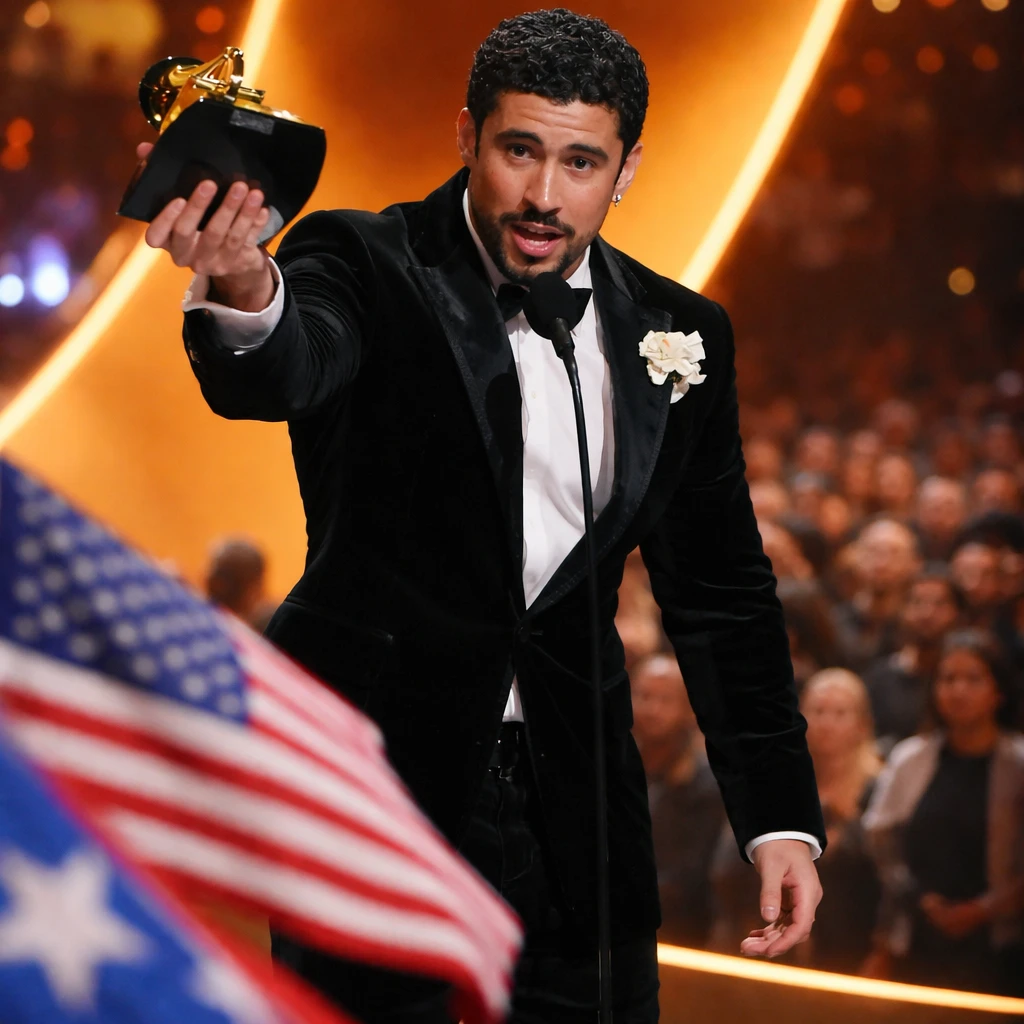

The 2026 Grammy Awards held in Los Angeles brought an unprecedented spotlight on Latino contributions to music and an explicit engagement with immigration topics by prominent artists. Puerto Rican singer Bad Bunny earned the Album of the Year accolade for "Debí Tirar Más Fotos," a work lauded by industry insiders as highly deserving yet not expected to clinch the top prize in a traditionally conservative awards setting.
Adding to this, the ceremony featured several artists using their acceptance speeches as platforms to express opposition to the actions of Immigration and Customs Enforcement (ICE), with nearly half of the televised awards incorporating immigration discourse. These elements signal a notable shift from the Grammys’ historically apolitical and less diverse nature.
For years, the Grammys faced criticism for insufficient representation, particularly underscoring the marginalization of artists of color, women, rappers, Latino artists, and those within R&B genres in major categories. However, recent years have seen the Recording Academy implement substantial reforms aimed at diversifying its voting membership. In 2025 alone, 3,800 new members joined, with a significant portion under 40 years of age (50%), people of color (58%), and women (35%). This diversification includes the invitation extended to all Latin Grammy voting members the previous year, although the uptake in Grammy voting membership from that group remains unclear.
The effects of these membership changes were evident during the ceremonies in 2025—where Beyoncé and Kendrick Lamar secured influential awards—and this trend sustained momentum in 2026 through Bad Bunny’s recognition.
Bad Bunny’s victory places him among a select group of Latino artists honored with Album of the Year, joining acts like Santana, recognized in 2000 for "Supernatural," and Stan Getz and João Gilberto for "Getz/Gilberto" in 1965. Vanessa Díaz, co-author of "P FKN R: How Bad Bunny Became the Global Voice of Puerto Rican Resistance," points out that the win illuminates the previously overlooked richness of Latin music, contributing to the significance of this moment.
The album "Debí Tirar Más Fotos" dominated global streaming metrics in 2025, attesting to its widespread appeal beyond commercial success. Artistically, it intricately blends traditional Borinquen musical forms such as bomba, plena, salsa, and música jíbara with modern genres like reggaeton, trap, and electronic pop. The Recording Academy historically appreciates such melding of retro and contemporary sounds, yet this marks an unprecedented accolade for a completely Spanish-language production.
Politically, the album resonates beyond Puerto Rican or Latino particularities. Albert Laguna, associate professor at Yale specializing in ethnicity, race, migration, and American studies, notes its themes address universal struggles. The track "Lo que le pasó a Hawaii" illustrates a call for cultural sovereignty amid neocolonial dynamics.
Unlike past Grammy winners receiving awards years after their most influential releases, Bad Bunny was recognized in the eligibility year of this career-defining album. This contrasts with Beyoncé’s 2025 win for "Cowboy Carter," viewed by some as rectifying previous omissions regarding her influential albums "Lemonade" and "Renaissance."
Bad Bunny’s accolade aligns with contemporary pop culture relevance: he is set to headline the Super Bowl halftime show imminently—an event anticipated to celebrate Latino cultural prominence. This recognition arrives as some Latino communities in the United States navigate heightened unease amid increasing restrictions and negative rhetoric regarding Spanish language use and immigration.
According to Laguna, the album provides a "sonic language" through which audiences can interpret and find some solace amid current complexities. The music offers both a vehicle for political critique and pleasurable engagement, which is particularly valued during challenging times.
Immigration enforcement emerged as a dominant subtext during the Grammy broadcast. Notable stars including Bad Bunny, Billie Eilish, and first-time Grammy recipient Olivia Dean explicitly criticized ICE. Eilish declared, "No one is illegal on stolen land," and used an expletive directed at ICE. Dean identified herself as an immigrant descendant and emphasized celebrating immigrant bravery.
Even before the televised event, at the Premiere Ceremony where 86 awards were presented, immigrant narratives were highlighted. Shaboozey, emotional upon his first Grammy win, thanked his immigrant mother and dedicated his award to immigrants’ cultural contributions. Similarly, Kehlani expressed disdain for ICE, and backstage comments from SZA underscored fears relating to immigrant rights and the importance of community support. Gloria Estefan expressed distress over children held in detention centers and her sense of alienation from her own country’s current state.
Among these voices, Bad Bunny’s remarks were particularly poignant. After humorously addressing Puerto Rico’s ambiguous status under United States governance—a commonwealth arrangement widely critiqued as colonial—he emphatically told the audience, "ICE out," asserting the humanity and American identity of immigrants. His reference to terms like "animals" and "aliens" directly echoes pejorative language previously used by then-President Donald Trump to characterize migrants amid nationwide increases in immigration enforcement.
Bad Bunny's political stance is consistent with his past critiques of Trump-era policies and his decision to avoid touring the continental U.S. due to concerns over Latino deportations. The context includes recent intensive immigration raids in Puerto Rico itself. Historically, the depiction of Puerto Ricans in U.S. media during the early 20th century was often denigrating, applying stereotypes that hearkened back to colonial-era prejudices.
This award, therefore, carries strong symbolic weight. Vanessa Díaz highlights how this celebration of Spanish-language culture serves as a "light" amid ongoing targeting of Latino communities—an affirmation of identity and resilience that sustains hope regarding their place within American society.