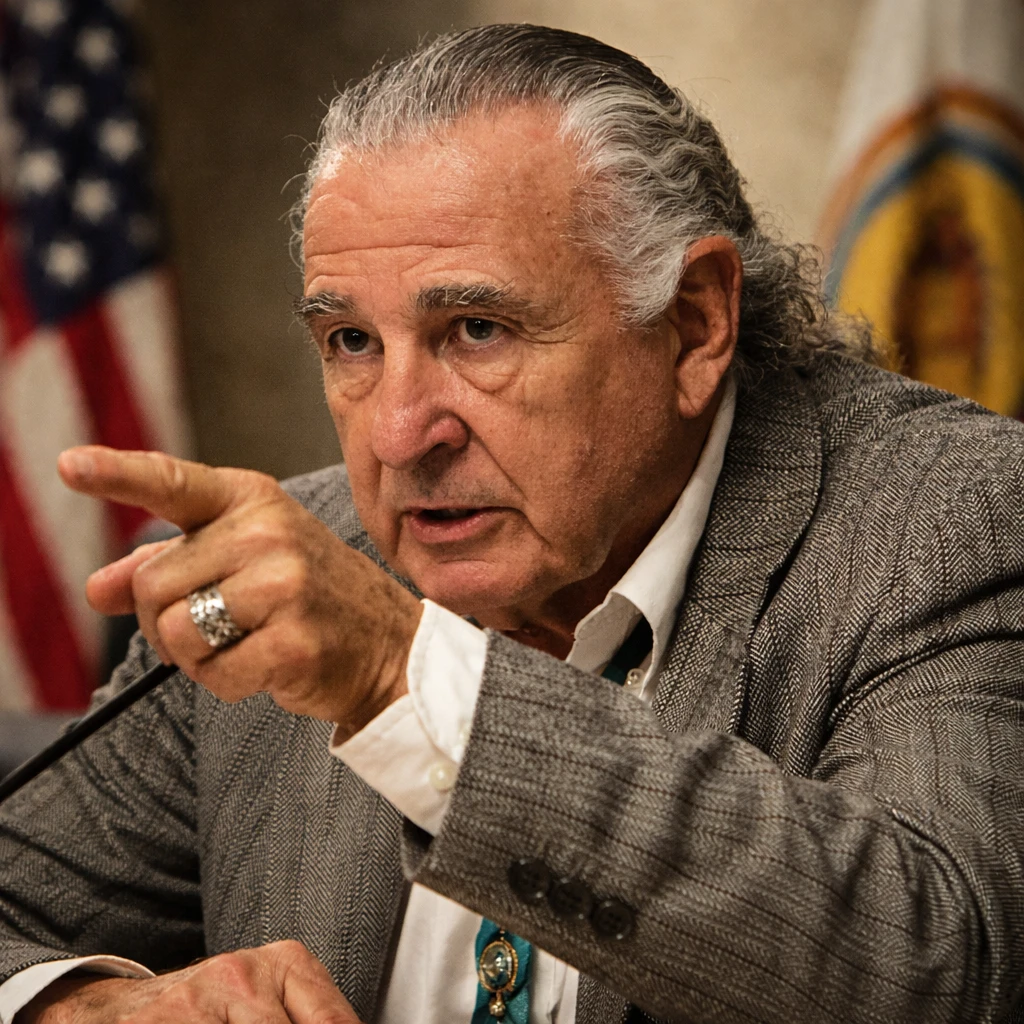
Ben Nighthorse Campbell, a prominent political figure from Colorado admired for his steadfast dedication to Native American interests, died peacefully at 92, his family confirmed. His daughter, Shanan Campbell, stated that he passed away of natural causes, surrounded by loved ones.
Campbell's political journey was marked by distinctiveness both in his personal presentation and his ideological stance. As a U.S. representative and then senator, he was notable for his traditional Native American heritage and sartorial choices — including cowboy boots, bolo ties, and a ponytail — which made him visually recognizable among his congressional peers. His advocacy ranged across topics such as children’s rights, support for organized labor, and fiscal conservatism.
A member of the Northern Cheyenne tribe, Campbell frequently spoke about his heritage. He referenced a tragic historical event in which over 150 Native Americans, primarily women, children, and elderly men, were killed by U.S. soldiers while camped under a flag of truce on November 29, 1864.
Serving first in the U.S. House from 1987 over three terms, he was then elected to two Senate terms from 1993 to 2005. Among his legislative achievements, Campbell sponsored the measure elevating Colorado's Great Sand Dunes National Monument to national park status, recognizing its environmental and cultural significance.
Reflecting on Campbell’s legacy, Colorado Senator John Hickenlooper highlighted his artistic talents and kindness, noting his renown as a master jeweler whose work transcended regional boundaries.
Prior to changing his party affiliation, Campbell was already recognized as a maverick. He garnered a reputation for independence long before his notable party switch in March 1995, when displeased with Democrats opposing a balanced-budget amendment, he joined the Republican Party — an unexpected move that caused significant reaction on both sides.
Campbell acknowledged facing criticism from extreme factions within politics, stating a pragmatic view that no politician can satisfy all constituents regardless of party.
Despite being a strong candidate for a third Senate term, Campbell withdrew from his 2004 re-election bid after a serious health scare. He described the experience of believing he had suffered a heart attack and reconsidering the toll public service took on personal life. His choice to retire was motivated by a desire to spend more time with family, having missed much of his children's upbringing.
Post-politics, Campbell focused on his jewelry craft, which had brought him financial success and was displayed at the Smithsonian Institution's National Museum of the American Indian. He also partnered with outdoor gear company Kiva Designs and served as a senior policy adviser for the law firm Holland & Knight, specializing in federal matters related to Native American affairs and natural resources.
Campbell established Ben Nighthorse Consultants, emphasizing federal policy consulting. He also participated in transporting the Capitol Christmas Tree to Washington, D.C. multiple times, showcasing his continued engagement with public events.
Colorado Representative Diana DeGette referred to Campbell as a unique individual, expressing condolences to his family.
Campbell entered politics somewhat by chance in 1982. Stranded by poor weather while traveling to deliver jewelry, he attended a local Democratic meeting in Durango, Colorado, where he unexpectedly gave a speech supporting a sheriff candidate. The Democrats then solicited him to run against a Republican legislative candidate. His initial opponent was a well-regarded community leader, but Campbell’s vigorous grassroots campaigning led to an upset victory. He subsequently maintained an undefeated record in elections moving upward from the Colorado House to the U.S. House and eventually the Senate.
Born on April 13, 1933, in Auburn, California, Campbell served in the U.S. Air Force during the Korean War from 1951 to 1953. He earned a bachelor's degree from San Jose State University in 1957, studied at Meiji University in Tokyo from 1960 to 1964, captained the U.S. judo team in the 1964 Olympics, and won a gold medal at the Pan American Games.
Known for his outspoken nature, Campbell once criticized then-Interior Secretary Bruce Babbitt, whom he accused of duplicity related to a water project benefiting Southern Ute and Ute Mountain Ute tribes near Ignacio, Colorado. Campbell often found himself at odds with environmental advocates over issues including mining laws, grazing reforms, and land designations.
Despite occasional controversies, Campbell maintained strong support among voters. In the 1998 Senate race, he decisively defeated Democrat Dottie Lamm despite having switched political parties.
He emphasized that his core principles did not shift with his party change; he maintained a record of supporting labor, minorities, and women’s rights throughout his career.
His early life experiences — time spent in an orphanage during his youth due to family hardships — informed his passion for children’s issues. His blue-collar background including truck driving and involvement with the Teamsters, combined with service as a sheriff’s deputy in California, shaped his views on organized labor and law enforcement.
Campbell clarified that his retirement was unrelated to an ethics investigation involving his former chief of staff and a former technology company tied to his office. The matter was referred to the Senate Ethics Committee, and though his former aide pleaded guilty to a minor federal income reporting charge, Campbell expressed disappointment without further elaboration, noting the constant emergence of new political challenges.
This article has been updated to correct the location of a referenced massacre, specifying it occurred at the Sand Creek Massacre National Historic Site rather than the Great Sand Dunes National Monument.
December 30, 2025
News & Politics
Ben Nighthorse Campbell, Colorado's Trailblazing Native American Senator, Passes at 92
Renowned for his distinctive style and dedicated advocacy, Campbell's legacy spans politics and Native American arts

Nina Shah
Financials Analyst
Summary
Ben Nighthorse Campbell, a distinguished former U.S. senator and representative from Colorado, passed away at 92 from natural causes. Known for his compelling advocacy for Native American causes and a distinctive personal style that set him apart in Congress, Campbell's political career spanned over a decade and a half. He was a unique figure in American politics who embodied a blend of social liberalism and fiscal conservatism, and he left a lasting impact through his legislative contributions and cultural endeavors.
Key Points
Ben Nighthorse Campbell distinguished himself as an advocate for Native American rights and children’s causes alongside his fiscally conservative stance, impacting social policy discourse.
His bipartisan approach and party switch in 1995 symbolized ideological complexity, reflecting broader trends in political realignment that affect legislative behaviors and party dynamics.
Campbell’s career transition from politics to business and policy advisory roles highlights the intersection between public service and economic engagement in Native American affairs and natural resource management.
Risks
- The presence of ethics investigations, such as the one involving Campbell’s former chief of staff, illustrates ongoing governance risks that can impact public trust and legislative effectiveness.
- Political shifts and realignments like Campbell’s party switch may cause volatility in policy priorities and party cohesion, affecting market regulators and sectors sensitive to regulatory changes.
- Controversies regarding land use, environmental reforms, and tribal water rights emphasize risks in natural resource sectors which require careful navigation of political and cultural interests.
Disclosure
The article contains a correction specifying the factual location of a historical massacre relevant to Campbell’s heritage, clarifying previous inaccuracies.