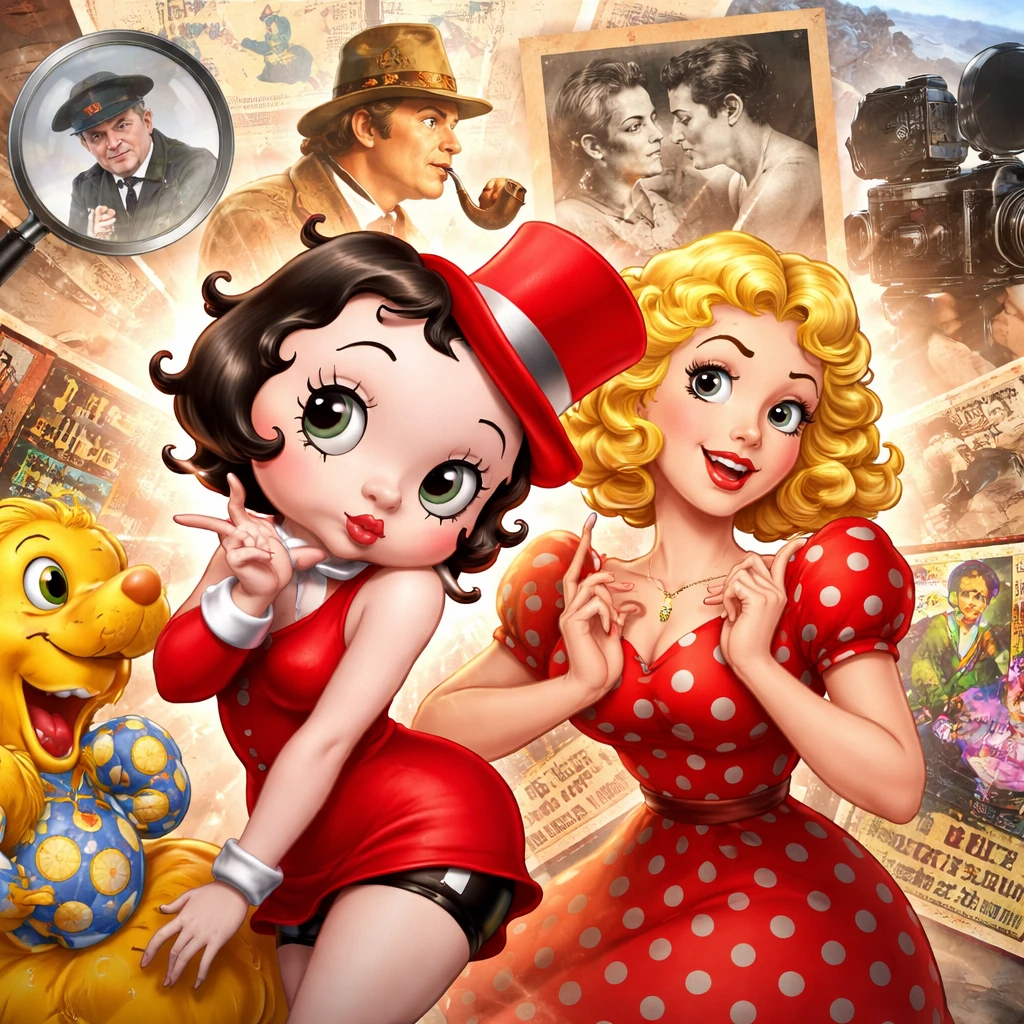

As the calendar flips to 2026, a notable group of vintage American intellectual properties will become part of the public domain, joining cultural icons like Mickey Mouse and Winnie the Pooh whose copyrights also recently expired. Among these are the earliest incarnations of Betty Boop and Blondie, both of whom debuted in 1930 and have since secured their places as enduring staples of American pop culture.
The legal threshold governing copyrights in the United States allows for protection of creative works up to 95 years, after which these works lose exclusive rights and enter the public domain. This status permits artists, filmmakers, writers, and other creators to reuse, adapt, and build upon these works freely, without the need to obtain permission or compensate original rights holders.
Following a two-decade hiatus in new public domain entries due to congressional extensions of copyright terms, the period starting from 2019 has seen a steady increase in the number of significant works becoming publicly accessible. Jennifer Jenkins, a law professor at Duke University and director of its Center for the Study of the Public Domain, described 2026 as "a big year," emphasizing the familiar cultural resonance of these newly available works and their reflection of the historical era between the world wars and the Great Depression.
Betty Boop’s Original Form
Among the newly freed creations is Betty Boop, originally appearing in the 1930 short film "Dizzy Dishes." Contrary to her later iconic flapper image, this first Betty Boop character was more canine in design, featuring poodle ears and a small black nose, traits that would soon evolve into the familiar humanized character with dangling earrings and a tiny white nose.
Betty Boop’s initial role was minor and unnamed, characterized by her catchy "boop boop, a doop" vocalizations during a song-and-dance routine. She served as a sort of playful companion to the anthropomorphic dog Bimbo, though she ultimately eclipsed him in popularity. The character was crafted by Fleischer Studios and distributed by Paramount Pictures, inspired partly by singer Helen Kane and her 1929 hit song incorporating similar vocal stylings. Legal disputes over the character and catchphrase were historically notable, with implications for intellectual property rights related to cultural expressions.
The early Betty Boop cartoons entering the public domain provide new avenues for creative use, exemplified by Jenkins’ lighthearted suggestion of a storyline involving a radioactive dog impacting her backstory. However, it is important to note that while the copyrights on these early films have lapsed, the trademark rights held by Fleischer Productions for the Betty Boop character remain active. This distinction affects commercial uses such as merchandising, which may still require licensing.
Blondie’s Enduring Appeal
Alongside Betty Boop, Blondie Boopadoop, the central character of Chic Young’s long-running newspaper comic strip, will also enter the public domain. Debuting in 1930 as a spirited flapper, Blondie’s adventures alongside her boyfriend Dagwood Bumstead eventually evolved into a more domestic-themed strip famous for comedic elements like the iconic Dagwood sandwich.
Blondie’s presence spans diverse media formats, including a film series and radio shows, with continuing publication in certain newspapers, illustrating the character’s sustained cultural relevance beyond the 1930 debut material now entering public domain status.
Additional Cartoon Characters and Literature
Also joining the ranks are nine new Mickey Mouse cartoons from 1930, arriving a couple of years after the original "Steamboat Willie" was released from copyright restrictions. The canine companion Pluto, initially known as Rover in 1930 before adopting his familiar name, becomes publicly available as well.
The literary domain expands notably, featuring the debut full novels of famous detectives: Nancy Drew’s earliest stories by Mildred Benson (using the pseudonym Carolyn Keene), Dashiell Hammett’s "The Maltese Falcon" introducing Sam Spade, and Agatha Christie’s first Miss Marple mystery, "Murder at the Vicarage." This enriches the public domain with significant works in the mystery and detective fiction genres.
Moreover, William Faulkner’s "As I Lay Dying" comes into the public fold following the 2025 release of "The Sound and the Fury," while foundational reading materials such as the "Elson Basic Readers," which introduced Dick and Jane, also join the public domain collection.
Iconic Films and Music Pieces
The cinematic world gains the Marx Brothers’ "Animal Crackers," a film showcasing the legendary comedic brothers amid 1930’s high society, complementing the prior public domain debut of their "The Cocoanuts" film.
Additional movies entering public access include "The Blue Angel," starring Marlene Dietrich, "King of Jazz" with Bing Crosby’s first screen appearance, and two early Academy Award-winning films, "All Quiet on the Western Front" and "Cimarron." These titles mark an impending period of golden age Hollywood features becoming accessible in the public domain, with 2027 expected to be particularly noteworthy.
Musically, the transition features classics from the Great American Songbook, including four compositions by George Gershwin with lyrics by Ira Gershwin — "Embraceable You," "I’ve Got a Crush on You," "But Not for Me," and "I Got Rhythm." Other significant songs entering include "Georgia on My Mind" by Hoagy Carmichael and Stuart Gorrell and "Dream a Little Dream of Me" by Gus Kahn and collaborators.
Although different rules govern sound recordings, notable 1925 recordings such as Rodgers and Hart’s "Manhattan," Marian Anderson’s "Nobody Knows the Trouble I’ve Seen," and Bessie Smith’s "The St. Louis Blues," featuring Louis Armstrong, also enter public domain status this year.
This extensive release of intellectual property presents myriad opportunities for various sectors including media, entertainment, publishing, and merchandising, underscoring the ongoing intersection of culture, law, and commerce inherent in evolving copyright regimes.