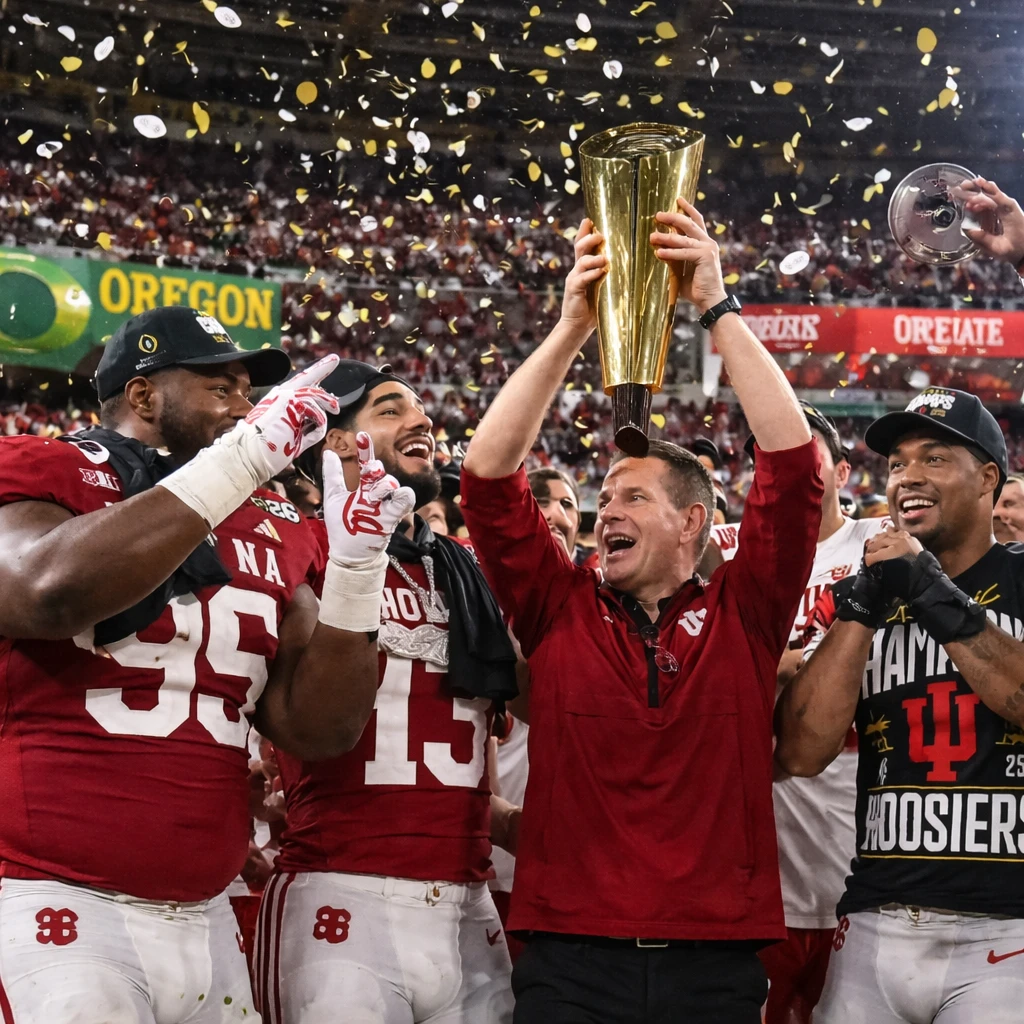

In a landmark conclusion to a season filled with historic milestones, the Indiana Hoosiers clinched the national championship and secured the No. 1 position in the final Associated Press Top 25 college football poll. This achievement followed their perfect 16-0 run, capped by a victory against Miami in the College Football Playoff title game, establishing Indiana’s place at the summit of college football for the current season.
With this latest feat, the Hoosiers became the third consecutive Big Ten program to finish the season ranked No. 1, joining Ohio State in 2024 and Michigan in 2023 as successive conference champions. Indiana’s rise highlighted the Big Ten’s continuing dominance in the sport.
The number two spot in the final poll was claimed by Miami, which improved eight places to end with a 13-3 record. This marked Miami’s highest final ranking since 2002, a year when they were second behind Ohio State. Notably, prior to this year, Miami's last finish within the top 10 was in 2003.
Mississippi, holding steady at No. 3 with a 13-2 record, achieved its highest final ranking since 1962. This ranking reflected a postseason run that included victories over Tulane and Georgia before falling to Miami in the College Football Playoff semifinals, an impressive journey especially considering head coach Lane Kiffin’s departure to LSU earlier in the season.
Rounding out the top five were Oregon at No. 4 and Ohio State at No. 5. Oregon maintained its status in the top 10 for the third straight year with a 13-2 record. Ohio State extended an impressive streak, marking its 12th consecutive season finishing within the final top 10, further illustrating the Big Ten's consistent high-level performance. The presence of three Big Ten teams in the final top five ranking marked the second consecutive year this has occurred, reinforcing the conference's strength in college football.
Other teams completing the top ten included Georgia (No. 6, 12-2), Texas Tech (No. 7, 12-2), Texas A&M (No. 8, 11-2), Alabama (No. 9, 11-4), and Notre Dame (No. 10, 10-2). Georgia secured its No. 6 spot for the second year in a row and has remained in the top 10 since 2017. Texas Tech, meanwhile, earned a top-10 final ranking for the first time. Texas A&M returned to the final top 10 for the first time since 2020, recalling the tenure of head coach Jimbo Fisher. Alabama re-entered the top 10 after dropping to No. 17 last year, ending a long-standing streak of top-10 finishes from 2008 through 2023.
Notre Dame experienced a remarkable regular season comeback, winning 10 consecutive games following a two-loss start. Despite this run, the team was excluded from the playoff and chose not to participate in a bowl game, finishing one position lower but continuing a streak of nine consecutive final poll rankings.
Indiana’s ascent within the polls was equally notable. Starting the season ranked No. 20 after an 11-2 record in Curt Cignetti’s inaugural season as head coach, they moved up to No. 3 after an early win against Oregon at 6-0. The Hoosiers then rose to No. 2, maintaining that position for seven consecutive polls prior to claiming the No. 1 ranking after a narrow 13-10 victory over Ohio State in the Big Ten Championship Game, setting the stage for their playoff triumph.
In addition to the top teams, the final poll recognized notable rankings for other programs. Iowa was ranked for the first time this season at No. 17 after winning three straight games including a bowl victory over Vanderbilt. Houston moved up to No. 22, marking its first ranking in four polls following wins over Baylor and LSU. TCU returned to the rankings at No. 25 after a trio of late-season victories over Houston, Cincinnati, and USC, reclaiming a spot it had lost since September. Conversely, Arizona, Georgia Tech, and Missouri all dropped out of the final rankings.
The Southeastern Conference (SEC) sustained its presence with seven teams in the final Top 25 for the second year running, a feat last achieved in 2013. Vanderbilt achieved its highest final ranking since 1948, finishing at No. 15, while James Madison and North Texas garnered their first-ever final poll appearances at No. 19 and No. 24 respectively.
Breaking down the final poll by conference, the SEC placed seven teams: No. 3 Mississippi, No. 6 Georgia, No. 8 Texas A&M, No. 9 Alabama, No. 12 Texas, No. 13 Oklahoma, and No. 15 Vanderbilt. The Big Ten had six ranked teams: No. 1 Indiana, No. 4 Oregon, No. 5 Ohio State, No. 17 Iowa, No. 20 Southern California, and No. 21 Michigan. The Big 12 followed with five: No. 7 Texas Tech, No. 11 BYU, No. 14 Utah, No. 22 Houston, and No. 25 TCU. Other conferences included the American with three teams (No. 18 Tulane, No. 23 Navy, No. 24 North Texas), the ACC with two (No. 2 Miami, No. 16 Virginia), the Independent No. 10 Notre Dame, and the Sun Belt with No. 19 James Madison.