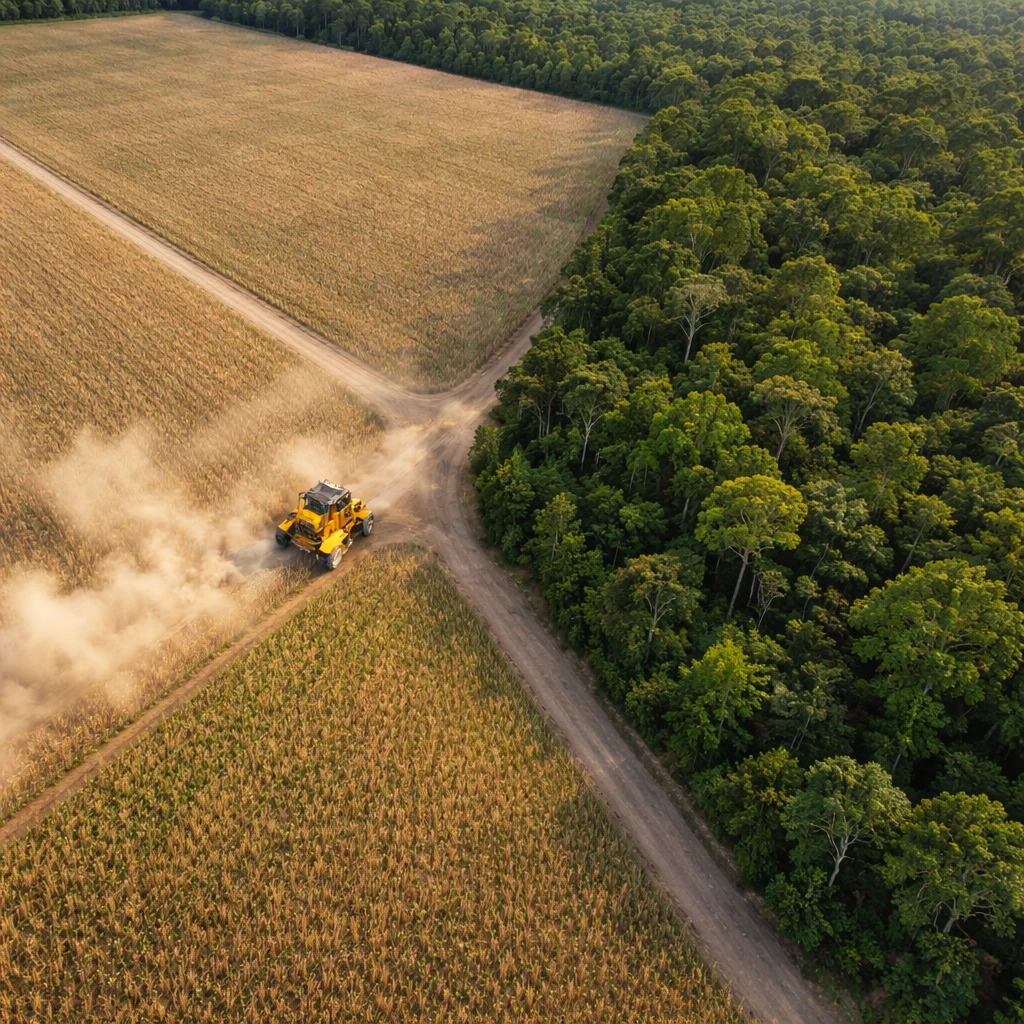

Brazil, the top global producer of soybeans, has witnessed a significant shift this week as its leading soy trading companies announced their withdrawal from the soy moratorium, a voluntary agreement designed to prevent the purchase of soybeans grown on recently deforested Amazonian lands. This pact, effective for almost 20 years, has been instrumental in reducing rainforest destruction in the region.
The Brazilian Association of Vegetable Oil Industries (ABIOVE), encompassing heavyweight soy traders such as Cargill, Cofco International, Bunge, Amaggi, and JBS, declared on Monday their disengagement from the agreement. Although the moratorium has yet to be officially dissolved by any participant, environmentalists and government authorities perceive this action as effectively ending the pact.
According to André Lima, the Ministry of the Environment's secretary responsible for deforestation control and land-use planning, the withdrawal signifies the agreement's conclusion. He highlighted that if one party leaves a pact, it no longer constitutes such a binding arrangement. Lima also noted that although the moratorium is ending, buying soy from illegally deforested lands remains prohibited, with penalties in place.
Brazil accounts for approximately 40% of the world’s soybean production, with an estimated output of 171.5 million metric tons during the 2024–25 season, as reported by the U.S. Department of Agriculture. The Amazon rainforest plays a vital role in global climate regulation, impacting regions as distant as the U.S. Midwest and Europe. Scientists caution that ongoing deforestation risks exacerbating global warming and disrupting agricultural systems internationally.
The soy moratorium began in 2006, in response to international pressure from environmental groups and buyers, establishing a ban on purchasing soybeans sourced from Amazonian forest lands cleared after July 2008. The agreement was renewed indefinitely in 2016, contingent upon the collective consent of its members for continuation.
The monitoring system for the moratorium relied on satellite surveillance alongside government farm registries to detect new deforestation activities in the Amazon biome. Buyers were required to halt purchases linked to any farms violating the criteria, with annual audits conducted by independent reviewers.
Data from Imaflora, a Brazilian agriculture and conservation group, indicates that municipalities monitored under the moratorium experienced a 69% decrease in deforestation between 2009 and 2022. Simultaneously, soybean cultivation in the Amazon region increased by 344%, predominantly due to transitioning lands formerly used for cattle ranching.
The decision by the major soy traders to exit the moratorium followed a legislative change in Mato Grosso, the leading soy-producing state in Brazil, which terminated tax incentives for companies adhering to the pact as of January 1. The Mato Grosso Soy Producers Association's president, Lucas Beber, explained that participants in the agreement previously benefited from roughly 4 billion reais ($743.5 million) annually in tax incentives.
Lima described the moratorium as having fulfilled a successful 20-year tenure, emphasizing that companies remain legally barred from purchasing soy originating from illegally deforested plots. He clarified that the moratorium's conclusion would permit soy farming on lands legally deforested in prior years.
ABIOVE issued a statement acknowledging the moratorium's legacy and Brazil's status as a global exemplar in sustainable production over the past two decades. The association committed to upholding stringent market demands individually and relying on Brazilian authority frameworks to enforce environmental compliance moving forward.
Soy producers have contended that the moratorium imposed stricter measures than the Brazilian legal environmental standards, which require landholders in the Amazon to maintain 80% forest cover, allowing clearance of the remaining 20%. The moratorium, however, prohibited any deforestation, even if legally permitted.
Beber noted the agreement was primarily driven by European market requirements, which now represent less than 14% of Brazil's soy exports. He also criticized the moratorium for overriding national legislation and selectively targeting soy farmers.
Environmental advocates expressed concerns that the cessation of the moratorium could lead to increased deforestation through multiple avenues, including new conversion of native vegetation, expansion of agriculture, or speculative land acquisition. Observa-MT’s Ana Paula Valdiones described the state law ending tax incentives as a significant setback to conservation efforts.
Greenpeace warned that without the commitment, unchecked soy expansion in the Amazon could accelerate deforestation rates and increase Brazil's greenhouse gas emissions. A preliminary analysis by the Amazon Environmental Research Institute suggested that ending the moratorium might increase deforestation in the Amazon by up to 30% by 2045, potentially jeopardizing Brazil’s environmental objectives.
Responding to this estimate, Lima challenged its assumptions, noting a lack of clarity about whether it accounted for commitments by individual companies or international regulations affecting market access for deforestation-linked products. He projected that while soy sector growth might push legal deforestation—which comprises 10% to 15% of total forest loss—effective government enforcement could sustain a general downward trend in deforestation, albeit at a slower pace.