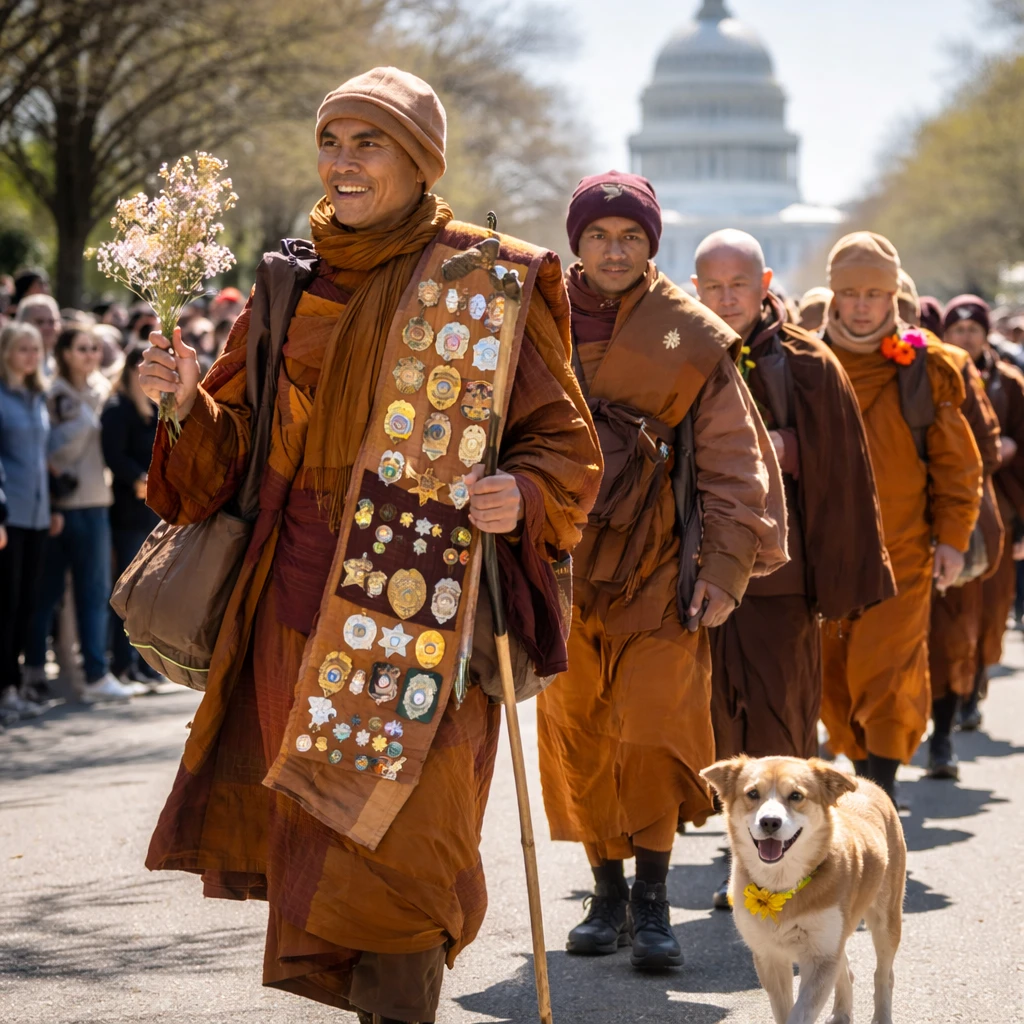
After more than three months on the road, a group of 19 Buddhist monks arrived in Washington, D.C., on Tuesday, completing a significant pilgrimage that began in late October 2025 from Fort Worth, Texas. Donning traditional saffron robes, the monks traced a path across the southern United States as part of their Walk for Peace initiative, which has garnered national interest through social media and public gatherings.
This journey, totaling approximately 2,300 miles, was spearheaded by Venerable Bhikkhu Pannakara, vice president of the Huong Dao Vipassana Bhavana Center in Fort Worth, Texas. The monks, alongside their companion dog Aloka—a rescue Indian Pariah whose name translates to "divine light" in Sanskrit—have used this trek to promote mindfulness, compassion, and peace amid the fragmented cultural and political landscape of the U.S.
At numerous stops, including churches and city halls along their route, the monks imparted teachings centered on Vipassana meditation, an ancient practice taught by the Buddha aimed at cultivating awareness of the mind-body connection. Their efforts resonated across different communities, reaching millions via online platforms and drawing thousands who lined roadsides in quiet respect of their single-file procession.
"My hope is that after this walk concludes, those we encountered will continue practicing mindfulness and discover inner peace," Pannakara expressed, underscoring the journey’s spiritual dimensions. Their itinerary in the nation’s capital included outdoor appearances at prominent sites such as the Washington National Cathedral and the Lincoln Memorial, where they were honored at an interfaith reception hosted by Washington Episcopal Bishop Mariann Budde. The bishop remarked that the pilgrimage encourages a collective commitment to compassion and peace-building efforts.
During their stay in Washington, the monks intended to submit a proposal to Congress advocating for Vesak, the celebration of Buddha’s birthday, to be recognized as a national holiday. However, temple spokesperson Long Si Dong clarified that such initiatives were ancillary and that the primary purpose remained a spiritual invitation to embody peace in everyday life, rather than political activism or legislation.
Despite the serene nature of their journey, the monks faced tangible challenges. Notably, an accident near Houston in November involved their escort vehicle colliding with a truck, resulting in injuries to two monks and necessitating the amputation of one individual's leg. Additionally, many monks chose to walk barefoot or in socks for prolonged periods to maintain presence and connection with the earth, adjusting to harsh conditions including cold and snow by occasionally wearing winter footwear.
Traveling on foot facilitated a direct engagement with mindfulness principles, emphasizing living in the present moment. The spiritual significance of their walk was amplified by its duration—108 days—a number holding deep meaning across Buddhism, Hinduism, and Jainism as a symbol of completeness, cosmic harmony, and existential wholeness.
As their journey in Washington concluded, plans were set for a less strenuous return, including a bus trip to Maryland’s Capitol followed by a bus ride back to Texas. The monks anticipated completing the final leg of their pilgrimage on foot with a six-mile walk in Fort Worth leading to their origin temple, symbolically closing their extensive peace mission.
Mark Duykers, a retired engineer and practitioner of mindfulness from Ann Arbor, Michigan, attested to the broad appeal of the monks’ walk. He plans to travel over 500 miles to witness the culmination firsthand, sharing that the interfaith embrace witnessed in conservative regions like the Bible Belt offered inspiration in times marked by social and political discord.
In essence, the monks’ Walk for Peace reflects a sacred tradition within Theravada Buddhism, extending beyond religious boundaries to touch various populations, while reinforcing the principles of awareness, compassion, and the transformative impact of peaceful living.