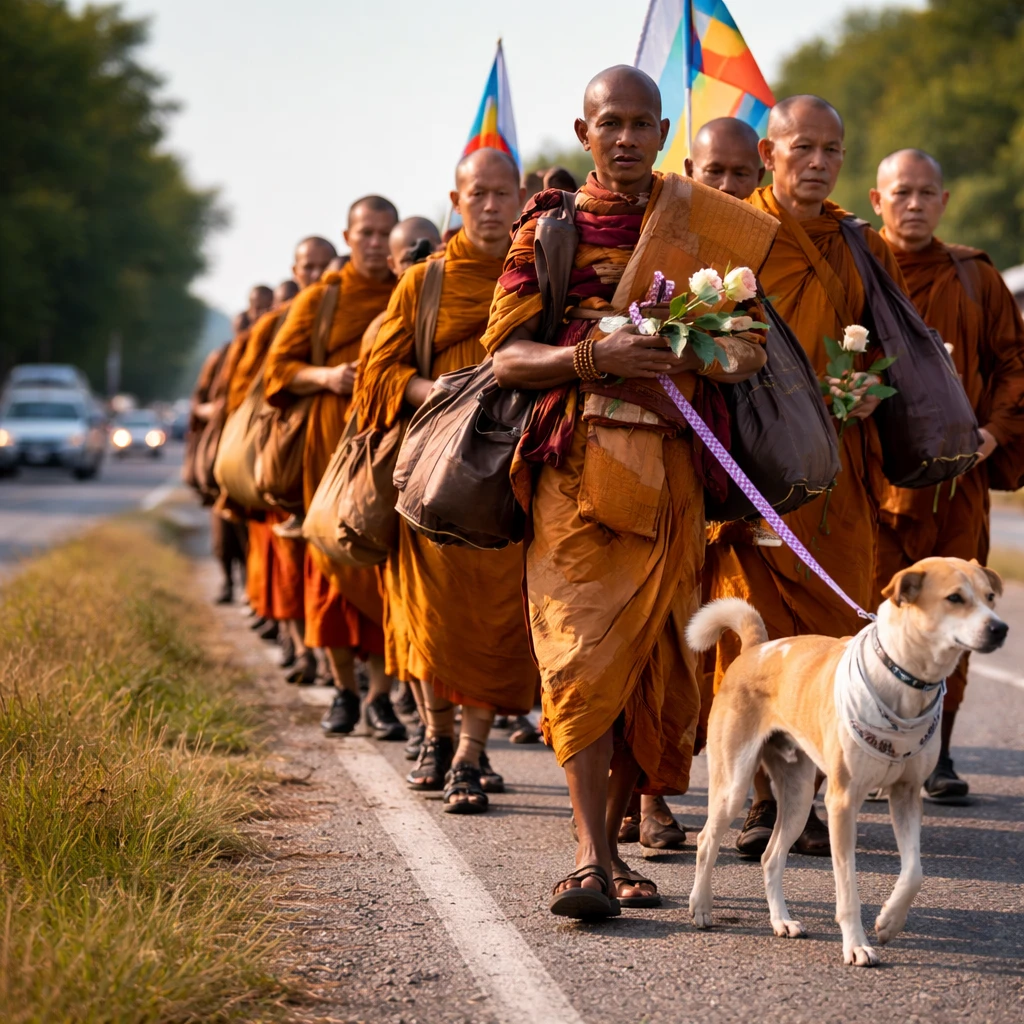

A group of Theravada Buddhist monks, distinct in their vibrant saffron and ocher robes, have been journeying on foot through rural roads and highways in the southern United States since October 26, 2025. Accompanied by a rescue dog named Aloka, their purpose is to walk for peace, a meditative practice deeply rooted in South Asian spiritual traditions. This pilgrimage, unusual in the U.S., is gaining attention for offering a peaceful, reflective counterpoint to the nation's current political strife and social tensions.
The march began at the Huong Dao Vipassana Bhavana Center, a Vietnamese Buddhist temple located in Fort Worth, Texas. The monks' planned arrival in mid-February in Washington, D.C., will culminate in a formal request to the U.S. Congress to designate Vesak—commemorating the Buddha's birth and enlightenment—as a federal holiday. While this legislative advocacy is significant, the monks emphasize that their overriding mission is to touch lives along their route and inspire mindfulness practices that foster personal peace and healing.
Leading the group is the Venerable Bhikkhu Pannakara, who undertakes the journey barefoot, embodying the mindfulness and simplicity central to their teachings. At each stop, he imparts lessons on forgiveness and healing, attempting to cultivate a sense of calm and reflection amid the diverse audiences they encounter.
The monks' mode of travel involves sleeping in tents outdoors each night, underscoring their commitment to simplicity and endurance. They have been met with considerable community interest across six states, drawing crowds in public parks, churchyards, city halls, and town squares. Social media documentation of their trek, including the presence of Aloka—their Indian Pariah dog companion—has attracted millions of followers globally, reflecting widespread resonance with their message.
For instance, in Columbia, South Carolina, thousands gathered at the State House to hear the monks chant and to see them honored with a proclamation from Mayor Daniel Rickenmann. The physical demands of the journey have been considerable. In Saluda, South Carolina, Audrie Pearce, who traveled four hours to witness the monks, remarked on their serene demeanor despite the intense physical toll. Pearce, not formally religious but spiritual, reflected on the nation's ongoing hardships and found solace in the monks' peaceful presence.
The original contingent comprised 19 monks from Theravada monasteries worldwide, but after their escort vehicle was struck by a distracted truck driver near Dayton, Texas, on November 19, one monk lost a leg and the group continues with 18 members. This peril underscores the risks associated with such an ambitious foot journey across a vast and sometimes hazardous landscape.
Bhikkhu Pannakara’s experience includes extensive walks through South Asia, notably a 112-day trek across India in 2022 where he first came across Aloka, who had been a stray dog at the time. Pannakara cared for the dog during a critical illness, and since then, Aloka has been a source of motivation throughout the current journey. Pannakara explained his choice to name the dog 'Aloka,' meaning divine light in Sanskrit, symbolizes a quest for wisdom.
The journey is challenging physically—the leader’s feet bear bandages from contact with rocks, nails, and glass. The monks note differences in the U.S. compared to prior walks in Asia, such as the inability to bypass roads via farmland due to private property law. Nonetheless, hospitality from local populations has been a source of encouragement and has enriched their experience.
Communities along the route have shown warm reception through hosting by churches, families, and local towns. On Christmas night, Reverend Patrick Hitchman-Craig welcomed the monks to his United Methodist Church in Opelika, Alabama. Contrary to expectations of a modest assembly, about 1,000 people arrived, creating a communal and diverse gathering. Reverend Hitchman-Craig likened the monks' arrival to the appearance of the Magi, noting how sacrificial dedication to peace transcends religious differences. The subsequent day, at a farm in Cusseta, Alabama, around 200 people gathered, many strangers to one another, united by the peaceful presence of the monks.
The Fort Worth temple spokesperson Long Si Dong outlined that upon reaching Washington, the group intends to appeal for Vesak's recognition as a national holiday to promote reflection, compassion, and unity beyond faith divisions. The temple’s plans for a $200 million project to erect monuments inscribed with Buddha's teachings on their site are unrelated to the peace walk.
The monks impart Vipassana meditation teachings, an ancient practice focused on mindfulness of breathing and bodily sensations to understand impermanence and suffering—as taught by the Buddha himself. Walking barefoot, as done by some monks including Pannakara, facilitates a direct connection with the earth and the present moment. They explicitly clarify that their endeavor is non-proselytizing and designed to inspire peaceful reflection rather than conversion.
Religious studies professor Brooke Schedneck elucidated that these peace walks emerged in Theravada Buddhist practice in the 1990s as gestures of national healing in Cambodia, where monks led marches through dangerous areas after periods of intense conflict. These actions intend to inspire through visible sacrifice and presence rather than through direct preaching.
Among the individuals drawn to the monks’ journey is Becki Gable from Cullman, Alabama, who drove nearly 400 miles to witness them in Saluda. Having endured significant personal losses, she sought emotional relief and guidance from the monks' teachings on peace, beginning a personal ritual of affirming each day as peaceful, as suggested by Pannakara.