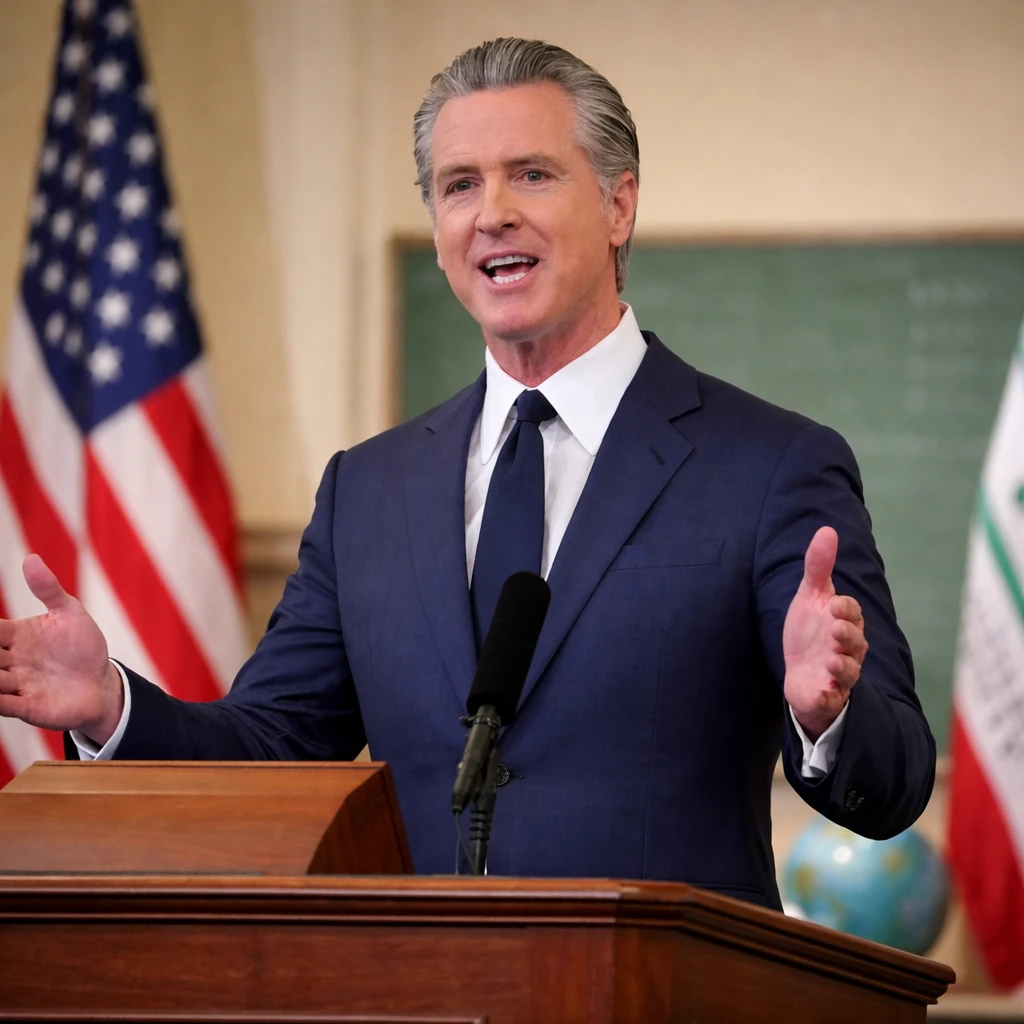

California Governor Gavin Newsom introduced a proposal on Thursday aiming to reorganize the K-12 education governance system by lessening the duties of the elected State Superintendent of Public Instruction and reallocating greater authority to the State Board of Education. Newsom highlighted the pressing need for change, referencing a century of recommendations emphasizing the streamlining of governance to create a more effective and coherent system. "California can no longer postpone reforms that have been recommended regularly for a century," Newsom stated, underscoring the anticipated enhancement of accountability and clarity in serving students and schools.
The proposed structure would place the California Department of Education under the jurisdiction of the State Board of Education, an 11-member panel appointed by the governor. Meanwhile, the superintendent’s role would pivot to focusing on fostering coordination and alignment of educational policies across a continuum from early childhood through postsecondary education. Further specifics about this broad restructuring were not detailed in the proposal.
California’s current governance framework for public K-12 schools is complex, involving distributed power among multiple entities at both the state and local levels. Policy-making responsibilities are shared among the governor, state superintendent, State Board of Education, and Legislature, with shifts occurring frequently based on political changes. Operational execution of these policies is managed by the Department of Education under the superintendent’s guidance.
On the local level, a combination of school boards and county offices of education exercise authority, particularly regarding school districts which have enjoyed increased fiscal autonomy following state funding reforms implemented roughly a decade ago. County offices also have oversight responsibilities, including monitoring district budgets.
California is distinctive in its approach to school leadership, being one of only nine states that elects its chief school officer. In contrast, most states vest appointment authority for this position either in the governor or the education board, as identified by Education Commission of the States.
This governor's proposal aligns with a December report published by Policy Analysis for California Education (PACE), which called for a comprehensive overhaul of the state’s school governance. The report emphasized that the need for cohesive governance is critical, as schools confront multiple challenges including fiscal constraints, inequities, opportunity gaps, and ongoing effects of the COVID-19 pandemic on student learning and well-being.
The urgency is compounded by diminishing federal involvement in K-12 education. Efforts by former President Donald Trump to dissolve the federal Department of Education and transfer responsibilities to states and other agencies have prompted concerns about federal funding sustainability and heightened state responsibility.
PACE outlined solutions consistent with Newsom’s plan, proposing that the Department of Education be managed by an administrator appointed by the State Board of Education. Under this framework, the superintendent would serve as an independent accountability advocate, with most school governance power shifting to the governor.
Attempts to alter the superintendent’s role are not new. Previous ballot measures aimed at changing the superintendent position from elected to appointed have been introduced but failed to pass. For example, ACA 9 in 2023, authored by former Assemblyman Kevin McCarty, sought to make the superintendent gubernatorial appointee; however, it was withdrawn amid opposition from prominent organizations such as the California Teachers Association and the California School Boards Association.
Newsom’s proposal references similar calls for reform in reports dating back to 1920 and 2002, underscoring the persistent, unresolved nature of governance challenges in California education.
Currently, the state superintendent is Tony Thurmond, who is concluding his second term. His tenure has included efforts to expand literacy programs, community schools, and student wellness initiatives. However, he has also faced scrutiny related to alleged side employment and accusations of creating a toxic work environment. Thurmond, who will complete his term in 2026, is campaigning for the governorship.
Newsom’s restructuring plan has garnered endorsements from diverse education stakeholders including the Association of California School Administrators, California Association of School Business Officials, Californians Together which advocates for English learners, and EdTrust-West, an equity-focused research and advocacy group. Christopher Nellum, executive director of EdTrust-West, praised the governor for addressing the longstanding fractured governance system that disproportionately affects low-income students, students of color, and multilingual learners.