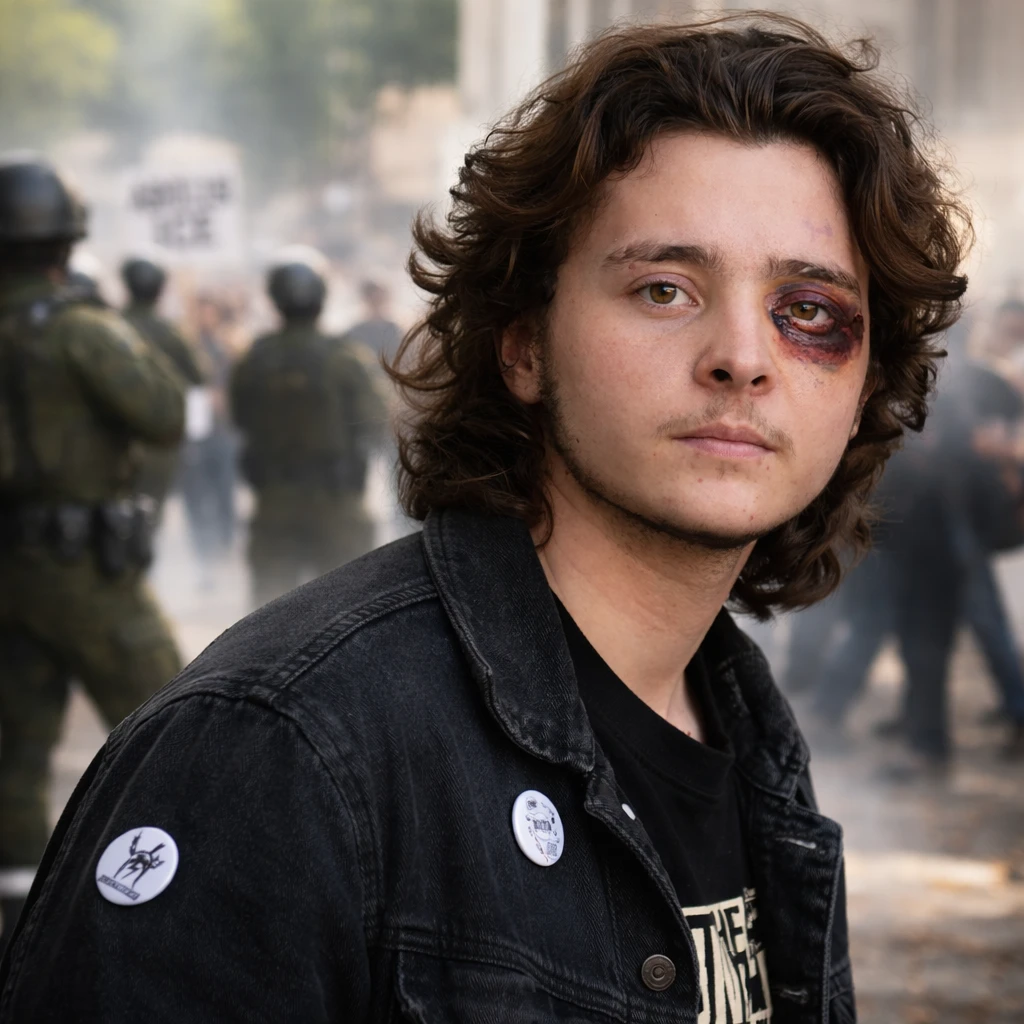

Kaden Rummler, a 21-year-old college student, suffered permanent blindness in his left eye after being struck by a projectile fired by a federal officer during a protest in Southern California on January 9. The demonstration was held to oppose the fatal shooting of a woman by an Immigration and Customs Enforcement (ICE) officer in Minneapolis. Rummler described experiencing severe pain and underwent a six-hour operation to address his injury. As a result, he has lost depth perception and is no longer able to drive.
His legal representative indicated that fragments of metal and a plastic piece approximately the size of a nickel remain embedded in his skull. Rummler is contemplating filing a lawsuit in relation to the incident. He expressed that this injury will profoundly affect all facets of his future life and ambitions, including his aspiration to pursue a career in forestry.
Another protest participant, Britain Rodriguez, 31, reported sustaining blindness in one eye from a similar projectile fired by federal agents during the same event. Rodriguez recounted standing on the steps of the federal immigration building in Orange County when he was struck in the face. He described the sensation as an explosion in his eye as he fell to the ground.
The Department of Homeland Security (DHS) has not specified the nature of the projectile used. Assistant Secretary Tricia McLaughlin stated that protesters engaged in violent actions resulting in injuries to two officers but did not detail their conditions. DHS confirmed that one protester was hospitalized with a cut, a reference believed to be to Rummler, and dismissed his claims regarding the severity of his injuries as "absurd."
Rummler faces a misdemeanor charge of disorderly conduct. Additionally, another protester was detained for several days and charged with assaulting, resisting, or impeding a federal officer.
Rummler's attorney, John Washington, conveyed concern regarding potential toxicity from the materials constituting the projectile. Efforts to obtain information from DHS have been unsuccessful. Preliminary investigations by Washington's team suggest the projectile was a capsule made of metal and plastic containing pepper spray.
The incident is part of a broader pattern of violent confrontations between federal agents and community members amid protests against the Trump administration's intensified immigration enforcement. In Minneapolis, federal immigration agents' use of force has attracted heightened scrutiny following a fatal shooting.
On January 9 in Santa Ana, California, hundreds marched to protest the shooting of Renee Good, later gathering near the federal immigration office. Video footage by OC Hawk shows demonstrators shouting through megaphones at the ICE officers stationed outside. The footage reveals a small group of riot-gear-clad officers urging the crowd to retreat, then deploying crowd-control projectiles after an orange cone rolls onto the plaza.
The same video captures an officer seizing a protester by the arm while Rummler and others engage vocally. Subsequently, an officer fires a crowd-control weapon that strikes Rummler from several feet away. He immediately clutches his face and collapses. Another officer drags him back toward the building, as visual evidence shows him being handcuffed face down on the ground.
Rummler explained his motivation for protesting, citing his distress at witnessing families being separated by immigration authorities. Despite his injuries, he stated his commitment to activism remains firm, expressing he would participate again to avoid regret over inaction.
Washington emphasized the severity and potential lethality of the force used, noting that trained officers would know never to shoot someone in the face with such a weapon, particularly at close range. The attorney underscored how the circumstances nearly led to a fatal outcome.
Geoffrey Alpert, criminology professor at the University of South Carolina, remarked on the necessity of a thorough review into the excessive use of force in this case, highlighting that proper training excludes firing projectiles at close proximity.