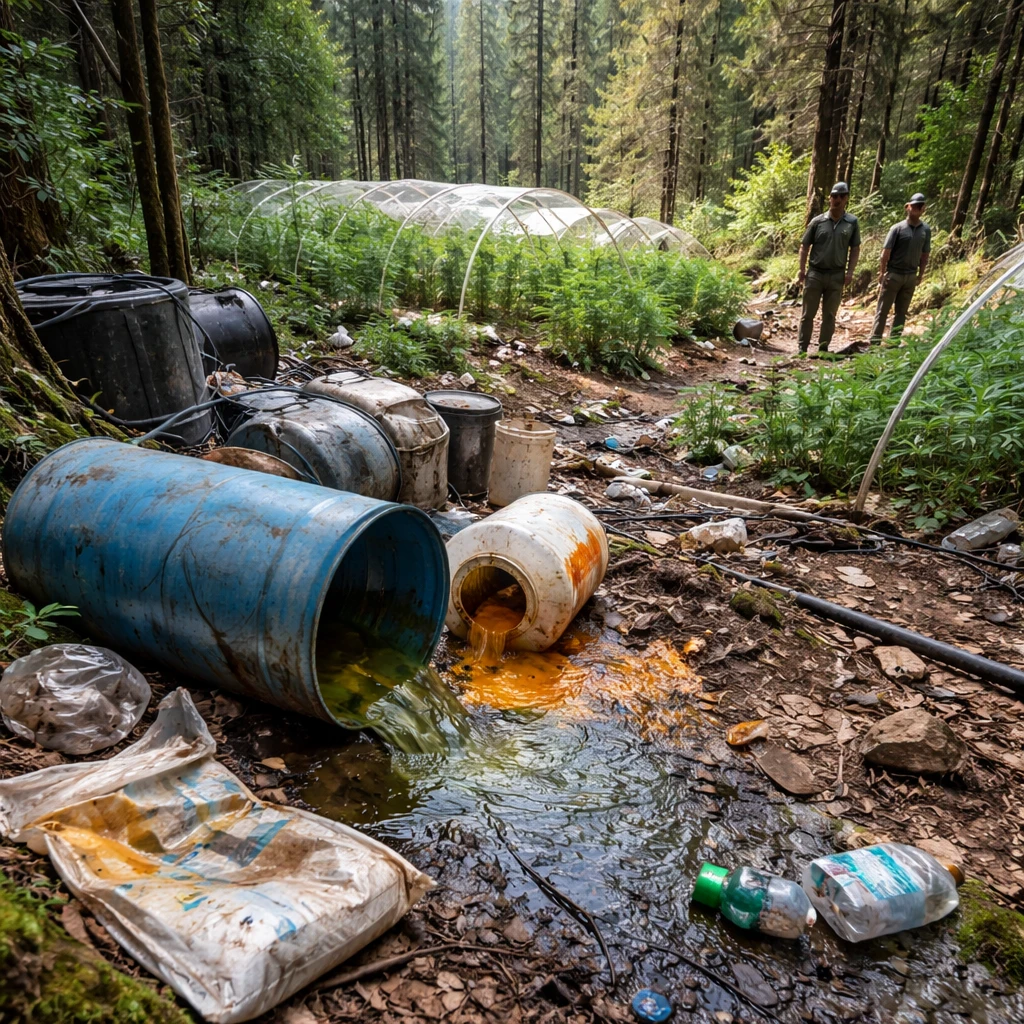

Months after law enforcement executed a raid on an illicit cannabis cultivation within Shasta-Trinity National Forest, remnants of the unauthorized farming lingered visibly. On a makeshift kitchen surface, decayed potatoes awaited processing, illustrating the abrupt abandonment. Ecologist Greta Wengert, co-founder of the Integral Ecology Research Center devoted to studying the environmental damages caused by cannabis grows on public land, surveyed a hillside scarred by discarded pesticide sprayers. Wild animals had punctured these pressurized containers, releasing toxic substances into the surrounding landscape.
"They’re essentially miniature death traps, posing risks to any wildlife curious enough to interact with them," Wengert explained, her tone conveying concern beneath professional detachment. For over a decade, she and her organization have alerted the public and authorities to the ecological hazards posed by unauthorized cannabis farms, which contaminate California’s forests, watersheds, and wildlife habitats with lasting consequences.
More recently, the group has raised alarms about insufficient federal investment, ineffective inter-agency coordination, and dwindling capacities at both state and federal levels, which collectively contribute to the escalating backlog of contaminated grow sites. These sites are strewn across public forests and are characterized by hazardous leftovers such as pesticides, fertilizers, trash, and irrigation equipment that continue polluting ecosystems.
Details from the sites reveal troubling environmental footprints. Bags of fertilizer had leaked harmful blue liquid onto the forest bed, while irrigation tubing snaked through empty planting holes, reinforcing the sense of an operation left in sudden abandonment yet poised for potential resumption. The debris included discarded items like beer cans and used clothing, exacerbating pollution in these protected areas.
Wengert’s records identify approximately 7,000 such abandoned cannabis cultivating locations on public land in California, a figure she regards as likely conservative. Only a fraction, roughly 587 of these sites, have undergone partial remediation. The absence of comprehensive governmental counts reflects a gap in oversight and data sharing, with several agencies deferring queries back to her organization’s unofficial tally.
The majority of these illegal grows exist within national forests where funding and trained personnel for cleaning up hazardous materials are scarce. A U.S. Forest Service representative acknowledged these constraints in correspondence, noting that no specific federal funds have been allocated for cleanup operations. The resultant backlog leaves the forests vulnerable to ongoing environmental degradation.
While the federal government owns nearly half of California’s vast 100-million-acre landscape, state authorities have taken a leading role in mitigation efforts. The California Department of Fish and Wildlife (CDFW) commits to eradicating illegal grows within its managed wildlife areas, though it assists federal entities primarily upon request and generally at state expense. According to CDFW’s cannabis program director Amelia Wright, this assistance falls outside the department’s formal mandate.
Revenue generated from fees and taxes on the state’s legal cannabis industry supports these conservation efforts. The funds sustain CDFW’s cannabis program and provide millions in grants for restoration and sustainable cultivation projects that sometimes extend to related conservation activities such as fish protection. Over nearly ten years, the department has extracted close to 350,000 pounds of trash and over 920 pesticide containers from public grow sites.
Despite these endeavors, former Assemblymember Jim Wood has criticized the pace of cleanup, highlighting an urgent need given the risks posed to watersheds and reliant communities. Legislative action in 2024, spearheaded by Wood prior to his departure, mandates a comprehensive study by CDFW to develop a statewide strategy for cleanup of cannabis grows, both on public and private lands. The law also requires ongoing legislative reporting on the status of illegal cultivation and associated restoration work.
Wright views the study as a critical framework for organizing future efforts, emphasizing the innovative nature of the program and the necessity of building a "playbook" for effective management. However, the study led by Wengert’s organization is not expected to be completed until the following year.
The proliferation of illegal grows on private property has intensified since cannabis legalization in 2016, creating a persistent challenge similar to a "whack-a-mole" scenario, according to environmental program manager Scott Bauer. The California Department of Justice confirms a recent surge in these illicit operations, with a multi-agency task force reporting that approximately 9% of eradicated sites lie on or near public lands, an increase from previous averages of 3 to 4%.
Wood characterizes the enduring problem as a "ticking environmental time bomb," noting that legalization did not eliminate the challenges posed by unauthorized cultivation operations. Scientific investigations corroborate the persistent contamination caused by such illegal grows.
On-site observations during a cold November expedition led by ecologist Mourad Gabriel reveal the lasting impacts. Co-founder and co-director of the Integral Ecology Research Center alongside Wengert, Gabriel brings a mix of concern and engagement with the forest ecosystem while guiding his team through hazardous former grow sites in the Shasta-Trinity National Forest. The group’s purpose was documentation rather than cleanup, constrained by limited funding, contributing data to a U.S. Forest Service study on wildlife exposure to contaminants from cultivation.
Gabriel indicated the site would remain contaminated until sufficient resources for remediation become available, underscoring the absence of immediate solutions without data-driven interventions. Wengert and Gabriel’s fieldwork has uncovered fatalities among wildlife caused by poisoning, detection of dangerous pesticides months after site seizures, and complex pollutant pulses involving plastics, pharmaceuticals, personal care products, cannabis-related chemicals, and pesticides within soils and waterways.
Although pollutant concentrations diminish over time, their presence in sensitive habitats remains a significant concern due to potential ecosystem disruption. At one documented location in the South Fork Trinity River watershed—a critical environment for protected fish species like salmon—the team identified substantial volumes of fertilizer residue and containers, with liquid fertilizer leaching into the soil, threatening water quality and aquatic life through nutrient overload and algae blooms.
A 2018 federal audit criticized the U.S. Forest Service for inadequate documentation and cleanup of these trespass grows, emphasizing risks to the environment and public health. Despite some eradication successes, cleanup pace and capacity have not improved markedly, hampered by insufficient funding and personnel trained to handle hazardous waste, perpetuating a growing backlog with unclear scope.
Attempts by Congressional representatives to increase funding have met limited success. Furthermore, reductions in Forest Service staffing—due in part to voluntary separation programs under recent administrations—have degraded operational capability, with officials describing the agency as effectively understaffed and unable to fully address the crisis.
Cleanup operations at large illegal grows, such as the extensive 6-acre site previously examined, reveal extensive infrastructure and waste, including irrigation systems diverting streams and scattered debris. Occasionally, state agencies intervene; for example, the California Department of Fish and Wildlife removed large quantities of trash and pesticide containers from such sites using helicopters, operating independently and financed through their budget.
However, discrepancies in cleanup practices raise safety concerns. While state crews reported lacking evidence of banned pesticides during their operations and wore protective equipment, Gabriel’s team identified pesticide residues on site consistent with hazardous substances like carbofuran. This mismatch underscores a need for standardized procedures and training in hazardous material handling to ensure the safety of cleanup workers and the public.
In conclusion, while individual cleanup successes occur, thousands of contaminated illegal cannabis cultivation sites remain scattered across California’s forests. Addressing this persistent environmental hazard requires increased funding, comprehensive planning, inter-agency collaboration, and adherence to scientific best practices.