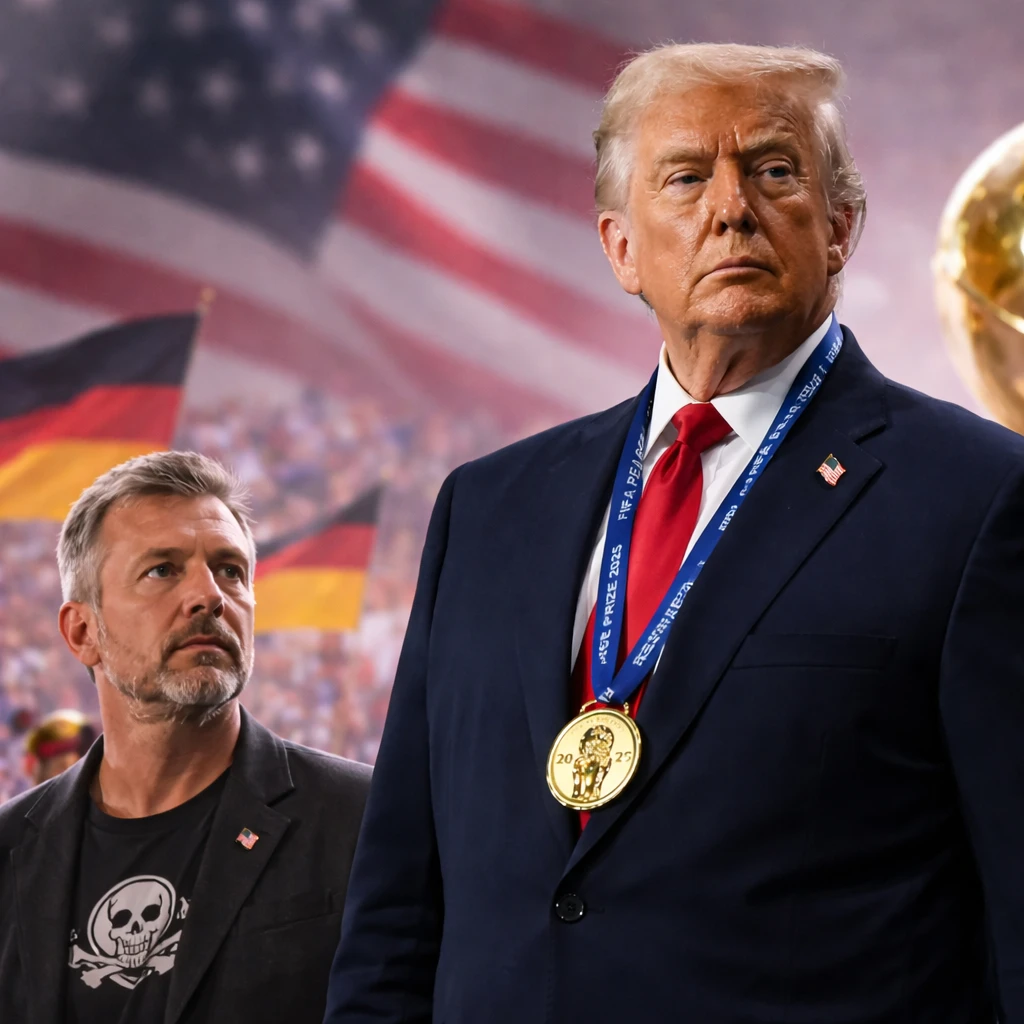
In Berlin, Oke Göttlich, a prominent figure within German soccer, has voiced a compelling suggestion for Germany to seriously evaluate the prospect of boycotting the 2026 FIFA World Cup due to the political actions taken by U.S. President Donald Trump. Göttlich, who holds the role of president at the Bundesliga club St. Pauli and serves as one of the ten vice presidents of the German Football Association (DFB), highlighted this stance in an interview with the Hamburger Morgenpost on Friday.
He stated emphatically that the moment has arrived to "seriously consider and discuss" the option of a boycott in light of the recent geopolitical tensions initiated by Trump. These tensions have unfolded notably with Trump's attempt to acquire Greenland—a semi-autonomous region under the sovereignty of Denmark, a NATO member. Furthermore, Trump escalated the situation by threatening to impose tariffs on eight European countries that opposed this prospective acquisition. The fallout has prompted grave warnings from several of America's closest allies about a potential rupture with the United States that could jeopardize the cohesion of the NATO alliance.
Reflecting on historical precedents, Göttlich drew parallels to previous Olympics boycotts of the 1980s, querying, "What were the justifications for those boycotts?" He suggested that current risks posed by the U.S. government's provocative policies could be considered even greater today, indicating a pressing need for open dialogue within sporting communities around these geopolitical concerns.
The 2026 FIFA World Cup is set to take place jointly across the United States, Canada, and Mexico from June 11 to July 19. However, apprehensions linger among supporters regarding the event's inflated ticket prices. Additionally, travel restrictions enacted by the Trump administration have excluded certain fans from participating, thereby fueling debates about inclusivity and the broader impact of U.S. policies on international sporting events.
Göttlich’s position is particularly significant given his long-standing advocacy for upholding core values within sports and society at large. Nonetheless, his appeal for consideration of a boycott is expected to face substantial opposition from influential figures within German and international soccer, including DFB president Bernd Neuendorf and FIFA president Gianni Infantino.
He also criticized the German Football Association's contrasting attitudes towards politically charged sporting events. Following Germany’s disappointing performance at the previous World Cup in Qatar—an event marked by criticism over political issues—Germany reportedly sought to distance itself from political entanglements. "Qatar was too political for everyone and now we’re completely apolitical? That’s something that really, really, really bothers me," said Göttlich. He stressed that societal entities and sports organizations are losing the ability to establish and defend essential taboos and values, such as denouncing threats and attacks that lead to loss of life. Göttlich posed pointed questions about how and when certain lines are crossed, urging both political and sports leadership, including Donald Trump, Bernd Neuendorf, and Gianni Infantino, to clarify their stance on these ethical thresholds.
St. Pauli, based in Hamburg and known for its left-leaning political activism and cultural identity interwoven with sport, lends further gravity to Göttlich’s statements. The club’s emblem—a pirate skull and crossbones—originated as a symbol among local squatters and was later embraced by punk-inspired fans, illustrating the club’s longstanding blend of sports and politics.
Addressing concerns that a boycott might adversely affect St. Pauli’s players who are also part of national teams, Göttlich dismissed this notion. He underscored that the professional pursuits of players such as Australia’s Jackson Irvine and Connor Metcalfe, and Japan’s Joel Chima Fujita, should not outweigh the imperative to prioritize the safety and dignity of individuals in regions affected by threats or aggression linked to the World Cup host nation.