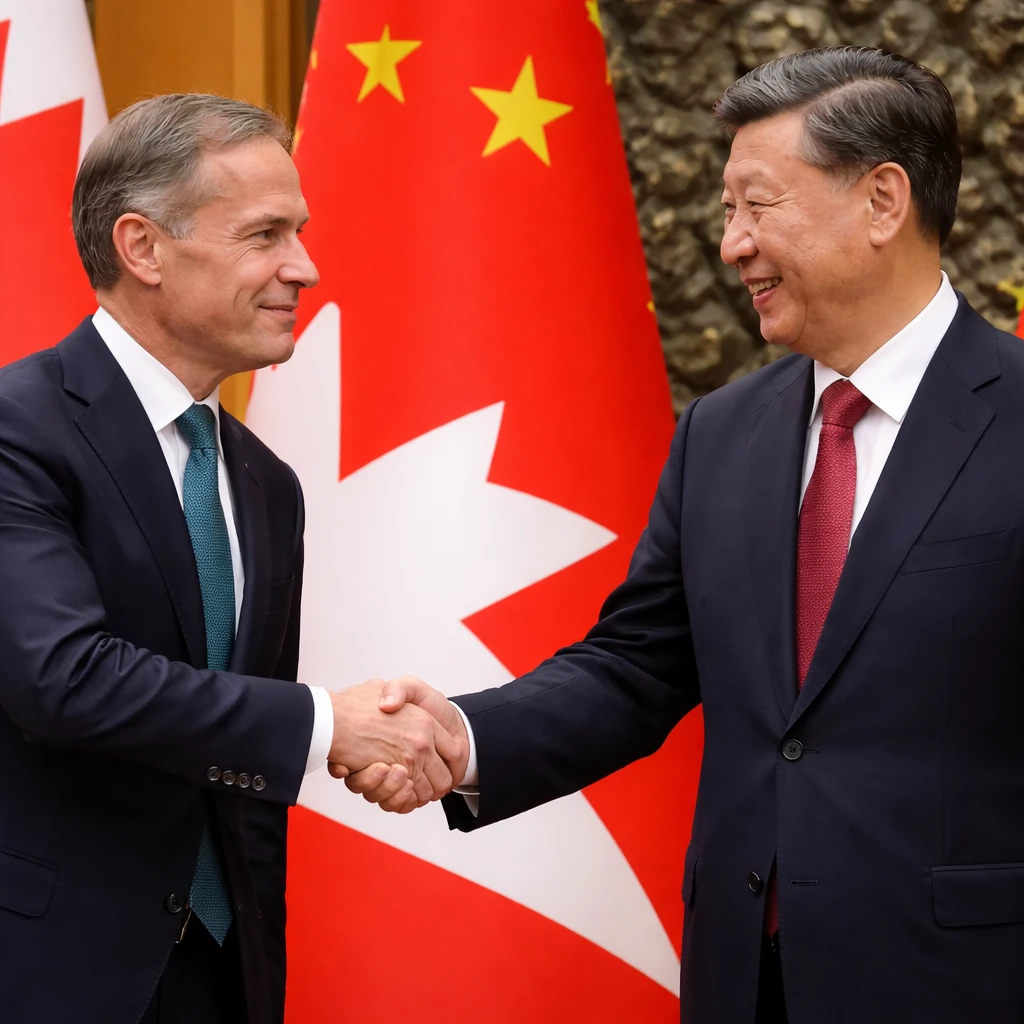

In a significant diplomatic engagement this week, Canadian Prime Minister Mark Carney met with Chinese President Xi Jinping in Beijing to address the strained relations that have characterized Canada-China interactions over the past decade. While their discussions paved the way for the renewal of ties, the impact of U.S. President Donald Trump’s policies and rhetoric loomed large, influencing both the context and content of these talks.
Though President Trump was absent from the meetings, his administration’s approach to international relations and outspoken comments about Canada continued to shape the dynamics at play between Canada and China, situated some 8,000 miles apart. The unpredictability of Washington's stance on trade and diplomacy compelled Canada to reconsider its global positioning, fostering a desire for what Chinese media described as “strategic autonomy.” This approach underscores Canada's intent to cultivate diversified international partnerships beyond its historically close alliance with the United States, especially amid recent hesitations in Washington-Ottawa relations.
Prime Minister Carney articulated this vision of strategic autonomy during his visit, recognizing that while Canada and China are closely linked economically—China ranks as Canada’s second-largest trading partner behind the U.S.—there remain fundamental differences in culture and governance philosophies. He notably referenced variations in cultural “ways of life” and human rights perspectives, implicitly acknowledging the political and ideological boundaries between the two nations.
During his stay in Beijing, Carney engaged with leading Chinese enterprises and underscored Canada’s objective to evolve an economy less dependent on the United States, particularly amid global trade uncertainties catalyzed by shifting policies. He remarked, “The security landscape continues to change. We face many threats. You manage those threats through alliances.” These remarks highlight Canada’s strategic recalibration to balance economic interests with geopolitical realities.
The visit yielded tangible commercial agreements. Canada consented to eliminate its previous 100% tariff on Chinese electric vehicles, concurrently instituting an initial cap of 49,000 EVs annually at a lower tariff rate of 6.1%, set to rise to around 70,000 units over a five-year span. In exchange, China agreed to reduce tariffs on Canadian canola seed exports substantially, from 84% to approximately 15%. While Canadian officials provided these specifics, the Chinese government disclosed less detailed outcomes.
Beyond the specifics of these agreements, the broader significance lies in Canada’s strategic maneuvering following a year of strained U.S.-Canada trade relations. The absence of a resolution on disruptive tariffs between Canada and the United States, coupled with President Trump’s candid suggestions about potentially incorporating Canada as the 51st state, have spurred Ottawa to seek alternative avenues to fortify its economy and international diplomacy. Some analysts from both China and Canada interpreted the recent developments as strategically advantageous for both parties, particularly given prevailing political climates, although Carney emphasized the preliminary nature of these arrangements.
China stands to benefit in multiple dimensions from the renewed engagement with Canada. The sizable Chinese-Canadian population—nearly 2 million individuals as of 2021, alongside numerous Chinese nationals residing or visiting Canada—establishes deep socio-cultural connections, especially evident in cities like Vancouver where Chinese cultural influence is prominent. This demographic link ensures Chinese policies and diplomatic efforts will be closely observed within Canadian borders.
More broadly, China continues to position itself as a global counterweight to what it describes as American “hegemony,” a narrative that has strengthened parallel to its expanding economic might and international infrastructure investments through initiatives such as the Belt and Road. Such strategic outreach, extending to regions including Africa and Latin America, reflects China’s ambitions to amplify its global influence.
The official Xinhua News Agency articulated the importance of stable China-Canada relations amid what it labels a period of “heightened uncertainty,” referencing economic fragmentation, geopolitical tension, and rising protectionism as shared challenges mainly attributed to the unpredictable priorities of the Trump administration. Both leaders maintained cautious rhetoric. President Xi characterized the prior year’s engagement as opening “a new chapter” for bilateral improvement, while Carney, mindful of balancing relations between two global powers, described Canada’s relationship with the U.S. as “much more multifaceted” than that with China. Yet he added that recent Canadian-Chinese interactions have been “more predictable,” a statement left intentionally ambiguous regarding whether this refers to improved predictability compared with past ties to China or relative to the current U.S. relationship.
Rapprochement in this context demands delicacy. Stability is highly prized in international diplomacy, particularly in an era stoked by populist movements that disrupt longstanding post-World War II global norms. Observers such as University of Toronto’s Robert Bothwell suggest divergent desires between Canada’s partners: while China likely seeks a coherent, economically robust Canada that maintains friendlier ties, President Trump's purported preference leans toward a fragmented Canada more susceptible to leverage.
Nonetheless, Trump publicly endorsed Carney’s trade accord with China, stating, “That’s what he should be doing and it’s a good thing for him to sign a trade deal. If you can get a deal with China, you should do that.”
The long-term impact of Carney’s Beijing visit remains to be seen, especially given the volatility of Washington’s policy directions. What is clear is that China has gained a more consistent ally in North America, a development that Beijing likely regards as advantageous amid ongoing global uncertainties.