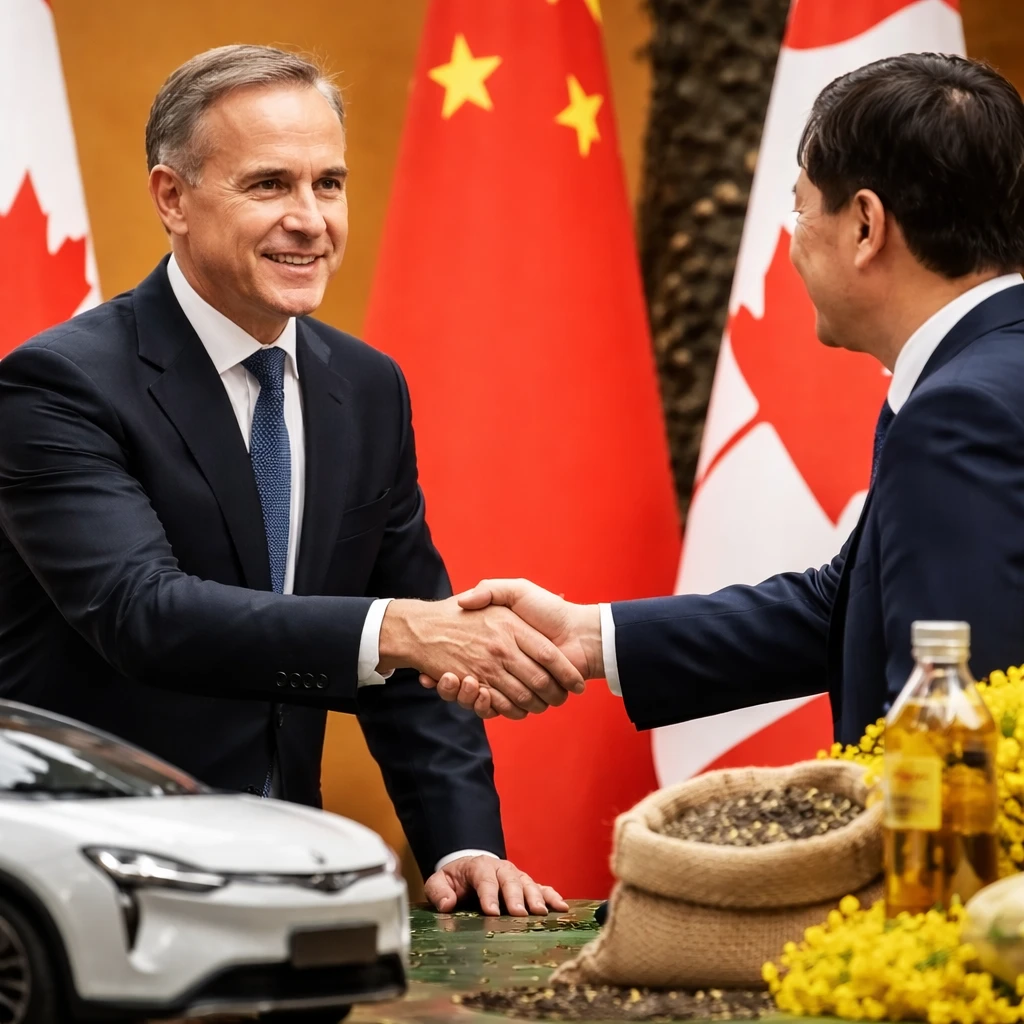

In a move diverging from the United States' stance, Canada has consented to decrease the 100% tariff imposed on Chinese electric vehicles as part of a reciprocal agreement where China will slash tariffs on Canadian agricultural exports. Canadian Prime Minister Mark Carney announced this development on Friday after concluding two days of discussions with Chinese officials in Beijing.
The agreement outlines an initial annual restriction of 49,000 Chinese EVs allowed into Canada, with this cap expected to rise to approximately 70,000 vehicles over the next five years. Concurrently, China plans to cut its tariff on Canadian canola seeds—a key Canadian export commodity—from a prohibitive 84% down to about 15%, Carney detailed at a press briefing.
Carney described the bilateral relationship as having recently become more stable and results-oriented, highlighting recent progress. "Our relationship has progressed in recent months with China. It is more predictable and you see results coming from that," he stated.
Despite these advances, Carney reported that efforts to negotiate tariff reductions with U.S. President Donald Trump have stalled. Trump has previously voiced contentious views about Canada, including remarks suggesting it could become the United States' 51st state, complicating Canada-U.S. trade relations.
Earlier in the day, Carney and Chinese President Xi Jinping committed to enhancing mutual relations following years marked by tension. In their meeting at the Great Hall of the People, Xi expressed a willingness to continue rebuilding ties, referencing ongoing dialogues that began with their initial meeting in October during a regional economic summit in South Korea.
Carney, the first Canadian prime minister to visit China in eight years, emphasized that stronger relations between Canada and China could contribute positively to global governance, which he described as facing significant pressure. He suggested the current global economic framework might increasingly be replaced by a series of bilateral or regional agreements rather than multilateral systems that have historically supported international economic growth post-World War II.
He reflected on this shift: "The question is: What gets built in that place? How much of a patchwork is it?" This dynamic is influenced heavily by the U.S. administration's 'America-first' policies, which have included the implementation of tariffs impacting both the Canadian and Chinese economies.
Carney, having met with key Chinese business leaders in Beijing, underscored the Canadian government's goal of building an economy less dependent on the United States during this period of global trade uncertainty.
Jacob Cooke, CEO of WPIC Marketing + Technologies, a company advising exporters on the Chinese market, characterized Carney's visit as transformational. He noted that it reestablishes crucial channels of communication, mutual respect, and a cooperative framework between Canada and China—elements he said were absent for years.
Prior to this agreement, Canada aligned with the U.S. in applying steep tariffs, including a 100% tariff on electric vehicles imported from China and 25% tariffs on steel and aluminum during former Prime Minister Justin Trudeau's administration. In retaliation, China significantly increased tariffs on Canadian agricultural goods, imposing duties of 100% on canola oil and meal, and 25% on pork and seafood. Additionally, a 75.8% tariff was placed on canola seeds in August. These escalations effectively closed off the Chinese market to Canadian canola exports, leading to a 10.4% decrease in overall Canadian exports to China last year, down to $41.7 billion according to Chinese trade data.
Addressing concerns from Canadian automakers and workers, Carney clarified that the initial Chinese EV import quota equates to roughly 3% of the 1.8 million vehicles sold annually in Canada. He indicated that as part of the agreement, China is anticipated to invest in Canada's automotive industry within three years. "We're building a new part of our car industry, building cars of the future in partnership, bringing affordable autos for Canadians at a time when affordability is top of mind, and doing it at a scale that allows for a smooth transition in the sector," Carney said.
He framed the agreement as a strategic exchange involving a small segment of the Canadian market in return for an investment commitment from China aimed at fostering innovation and growth within the automotive sector. "It’s an agreement that will create the future for our industry," he remarked.
However, Ontario Premier Doug Ford, representing Canada's most populous province and home to its automotive industry, strongly criticized the deal. In a social media post, Ford warned that Chinese access to the Canadian market could be exploited to the detriment of Canadian workers. He expressed concern that reduced tariffs on Chinese EVs might undermine Canadian automakers' access to the American market, Canada's leading export destination.
China appears to perceive U.S. trade policies under President Trump as an opportunity to encourage Canada to pursue a foreign policy more independent from the United States. Although Trump has suggested integrating Canada as a U.S. state, Carney emphasized the complexity of the Canada-U.S. relationship, highlighting its depth and multifaceted nature. He acknowledged significant systemic differences between Canada and China, including varying positions on human rights, which establish limits on the extent of their bilateral cooperation despite mutual interests.
Following his departure from China, Carney planned to visit Qatar, engaging with business leaders and investors to promote trade and investment, before attending the World Economic Forum annual meeting in Switzerland. These visits reflect Canada's broader strategy to diversify international economic partnerships amid ongoing global trade challenges.