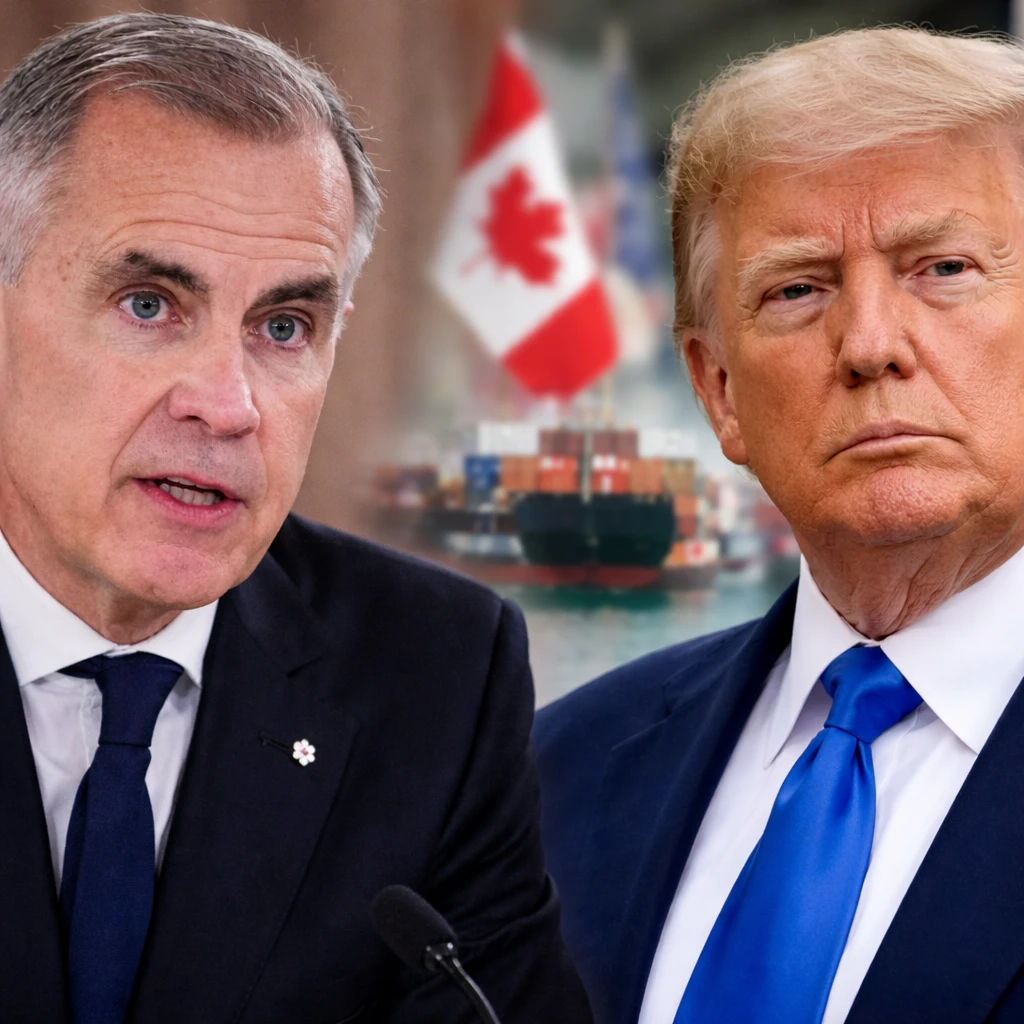

On Sunday, Canadian Prime Minister Mark Carney publicly reiterated that Canada has no intentions of establishing a free trade agreement with China. His declaration came in direct response to U.S. President Donald Trump's warning that he would implement a 100% tariff on Canadian imports should Canada move forward with such a deal with Beijing.
Carney clarified that a recent accord with China was limited to reducing tariffs in specific industries recently penalized by tariff hikes, countering assertions made by Trump. The U.S. president took to social media to allege that "China is successfully and completely taking over the once Great Country of Canada," lamenting the situation and hoping that Canadian national icons such as ice hockey would remain unaffected.
The Canadian prime minister referenced obligations under the United States-Mexico-Canada Agreement (USMCA), which binds member countries to notify each other before engaging in free trade negotiations with nonmarket economies. He emphasized, "We have no intention of doing that with China or any other nonmarket economy. What we have done with China is to rectify some issues that developed in the last couple of years." This statement underscores the official position that Canada will adhere to the commitments outlined in USMCA.
In 2024, Canada imposed a 100% tariff on Chinese electric vehicles (EVs) and 25% on steel and aluminum imports, mirroring the United States’ tariff structure. In retaliation, China placed 100% import taxes on Canadian canola oil and meal, along with a 25% tariff on pork and seafood.
Distinct from the U.S., Carney announced that during a recent visit to China, Canada agreed to reduce the 100% tariff on Chinese electric vehicles in exchange for lower Chinese tariffs on selected Canadian agricultural exports. This deal introduced an initial annual quota of 49,000 Chinese EVs allowed into Canada at a 6.1% tariff level, expected to increase to approximately 70,000 vehicles over a five-year span. Prior to 2024, no such cap existed.
Carney highlighted that the initial quota comprises roughly 3% of Canada's annual vehicle sales of 1.8 million units. He also suggested that, in return, China is anticipated to begin investments in Canada's automotive sector within three years, signaling a long-term cooperative intention between the two nations.
Meanwhile, President Trump shared a video featuring the Canadian Vehicle Manufacturers’ Association chief executive, warning that Canada’s auto manufacturing industry is heavily reliant on access to the U.S. market and that the Canadian market alone is insufficient to support large-scale manufacturing by Chinese companies.
Trump took to social media to denounce the deal, calling it "a disaster for [Canada]" and "one of the worst deals, of any kind, in history," asserting that Canadian businesses are relocating to the United States. He emphasized his commitment to seeing Canada "survive and thrive" but warned against Canada becoming a vehicle for Chinese goods to enter the U.S. market.
Further expressing concern, Trump's Saturday post cautioned that if Carney believes Canada could become "a ‘Drop Off Port’ for China to send goods and products into the United States," such a move would be a miscalculation. U.S. Treasury Secretary Scott Bessent echoed these concerns on ABC’s "This Week," noting the importance of maintaining the integrity of the USMCA and expressing uncertainty about Canada’s recent trade actions, which he described as "virtue-signaling" to global elites.
The tension between the two leaders arises amid broader geopolitical strains, including President Trump's contentious attempt to acquire Greenland, which has caused friction within the NATO alliance. Carney has positioned himself as a champion for middle powers to collaborate in response to pressure from dominant global forces. During remarks in Davos, ahead of Trump, Carney warned that nations lacking a voice at the global table risk being marginalized, implicitly critiquing coercive practices without explicitly naming the U.S. president.
Trump’s ongoing challenges to Canadian sovereignty, including suggestions that Canada could be annexed as the 51st U.S. state, have amplified tensions. Recently, Trump posted an altered map on social media, depicting Canada along with Venezuela, Greenland, and Cuba as U.S. territories.