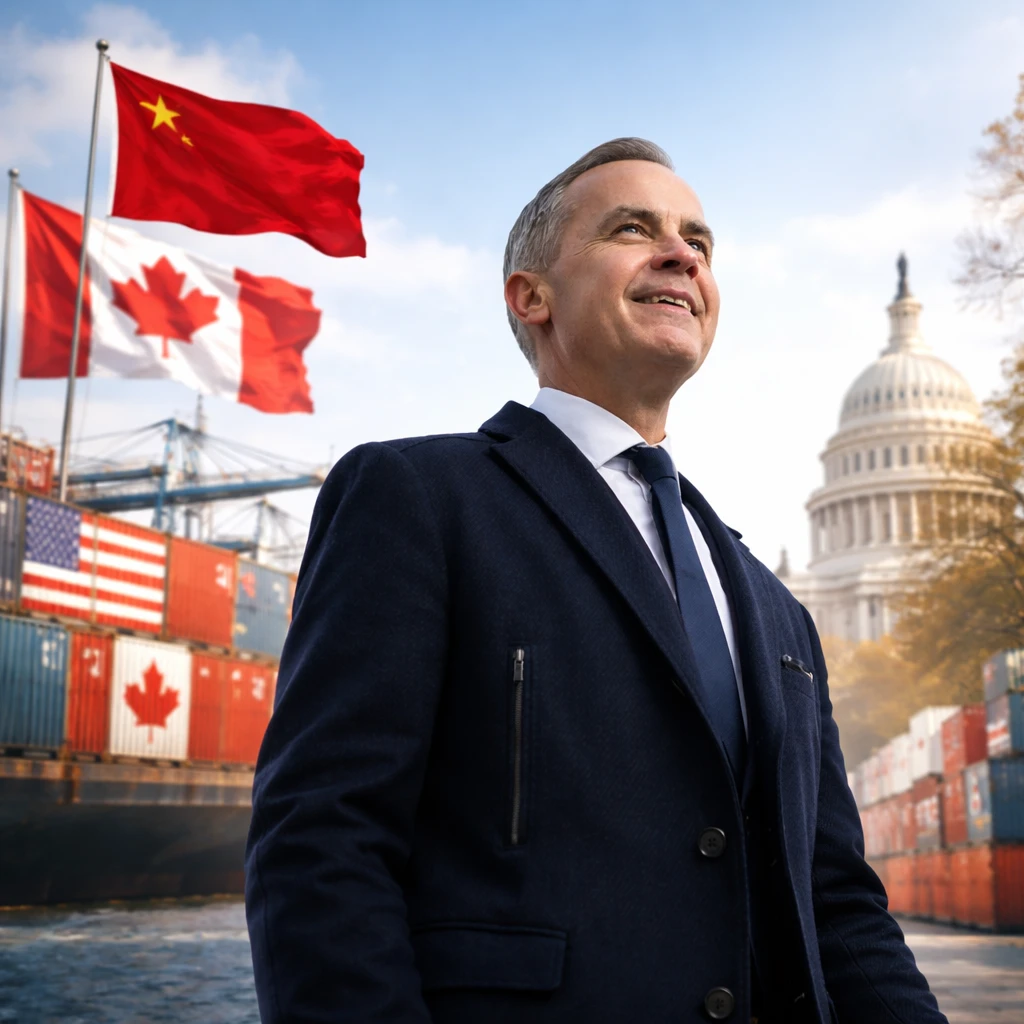

In an unmistakable shift in international trade dynamics, Canada has recently renegotiated its tariff policies, moving to intensify economic ties with China while responding to the escalating trade tensions spearheaded by U.S. President Donald Trump. The Canadian government agreed to eliminate its 100% import tariff imposed on Chinese electric vehicles (EVs), counterbalanced by a reduction in Chinese tariffs on Canadian agricultural products such as canola seeds.
Edward Alden, a senior fellow specializing in trade issues at the Council on Foreign Relations, described this development as a "huge declaration of realignment in Canada’s economic relations." Alden emphasized that Canadians increasingly perceive the economic risk posed by the United States as more significant than that from China, underscoring the substantial implications of this trade pivot.
Historically, Canada has been subjected to unpredictable punitive measures from the Trump administration. For example, in October, President Trump announced a 10% tariff on Canadian goods as retaliation for a provincial advertisement critical of his tariff policies, though this tariff hike never fully materialized. Nonetheless, key sectors such as steel and aluminum continue to face American tariffs.
This latest agreement with China emerges at a sensitive moment for Canada’s Prime Minister Mark Carney, as it potentially invites U.S. reprisal just before critical discussions to renew the North American trade pact that underpins Canadian commerce.
Widening Global Trade Partnerships Amid U.S. Tariff Enforcement
Canada’s strategic repositioning is reflective of a broader trend among America's leading trade partners who are seeking alternative markets as President Trump implements extensive tariffs aimed at compelling production to return to U.S. soil.
Parallel to Canada’s adjustments, the European Union is on the cusp of finalizing a trade agreement with the Mercosur bloc, covering major South American economies such as Brazil and Argentina, and is simultaneously negotiating with India.
Meanwhile, China, significantly impacted by U.S.-imposed tariffs since the early Trump administration, has actively diversified its export markets away from the U.S., bolstering its trade relationships in Europe and Southeast Asia. This strategic export realignment has yielded significant results, with China reporting a record trade surplus of $1.2 trillion in 2025, despite weakened exports to America.
Reversal of Long-Standing U.S. Trade Policies
Since resuming office in January, President Trump has reversed seven decades of U.S. commitments to freer trade, imposing substantial tariffs on imports from nearly every global trading partner and targeting specific sectors like steel and automotive with specialized levies.
Trump advocates assert these tariffs will generate revenue, protect domestic industries, and attract investment back into the United States. In a recent example, Taiwan committed to investing $250 billion in the U.S. in exchange for a tariff reduction from 20% to 15% on its products.
However, the administration’s tariff impositions have often appeared arbitrary. Countries such as Brazil have been targeted in response to political developments involving key figures like former president Jair Bolsonaro, while threats to impose tariffs have extended to nations not supporting U.S. territorial ambitions, including efforts to acquire Greenland from Denmark.
Canada’s Evolving Relationship with China
The trade agreement signed in Beijing signifies a notable departure from Canada’s previous stance. In 2024, Canada aligned with U.S. tariffs by imposing 100% tariffs on Chinese electric vehicles, motivated by concerns over the potential dominance of economical Chinese EVs over North American auto manufacturers.
Yet the new deal offers clear benefits for Canadian industries. Notably, Canadian canola farmers stand to gain from a dramatic drop in Chinese tariffs from 84% down to 15%, a change widely welcomed as it promises to rejuvenate canola exports, a major sector for the country.
Furthermore, economic experts, such as Mary Lovely of the Peterson Institute for International Economics, argue that the U.S. administration’s preference for fossil fuels over green technologies hinders North American EV production. Canada’s move to engage with China is seen as a bid to keep pace with advancing battery and electronics technologies, which have benefited from China’s rapid progress.
Prime Minister Carney acknowledged China's dominant position in the EV market, noting that it produces highly affordable and energy-efficient vehicles. He views the agreement as instrumental for Canada to foster a competitive EV industry domestically by leveraging partnerships, supply chains, and stimulating local demand.
However, this rapprochement with Beijing involves significant political risk. The strained history between the countries, including the 2018 detention of two Canadians by China as retaliation related to the arrest of a Huawei executive, along with allegations of Chinese interference in Canadian elections, complicates diplomatic relations.
Criticism also arises domestically. Ontario Premier Doug Ford condemned the deal, warning that China’s expanded access to the Canadian EV market could jeopardize Canadian autoworkers and restrict access to the lucrative American market, Canada's largest export destination.
Responding to these concerns, Carney pointed to limitations within the deal that cap Chinese EV exports subject to reduced tariffs at 49,000 units, inching to about 70,000 over five years, indicating an attempt to balance market openness with domestic industry protection.
Implications for North American Trade Agreements
A primary uncertainty emanates from Canada’s southern neighbor. The North American trade pact, USMCA, crucial for duty-free exchanges across the U.S., Canada, and Mexico, is due for renewal within the year. President Trump is expected to seek modifications to incentivize manufacturing within the U.S. and could potentially threaten withdrawal if displeased by Canada’s pivot toward China.
Trade expert William Reinsch warns that Canada’s engagement with China complicates USMCA negotiations, likely eliciting retaliatory measures from the U.S., particularly targeting Canada’s automotive industry.
Despite these challenges, President Trump publicly acknowledged the practicalities of Canada's deal, stating that securing agreements with China is beneficial where possible. Carney indicated the agreement's preliminary nature offers room to adjust in order to mitigate conflicts with the U.S. Importantly, many American stakeholders, including automakers, farmers, and tech companies, have vested interests in maintaining USMCA due to the integral role it plays in cross-border commerce, production networks, and digital trade liberalization.
Economist Mary Lovely interprets Canada’s strategic move as a clear message of economic resilience and alternatives, implying a readiness to challenge USMCA terms if these disproportionately favor American interests at the expense of Canadian economic sovereignty.
As North America braces for the upcoming round of trade negotiations, Canada’s recalibration towards China signals a nuanced and deliberate approach to navigating the complex global trade environment shaped by escalating tariff conflicts and shifting alliances.