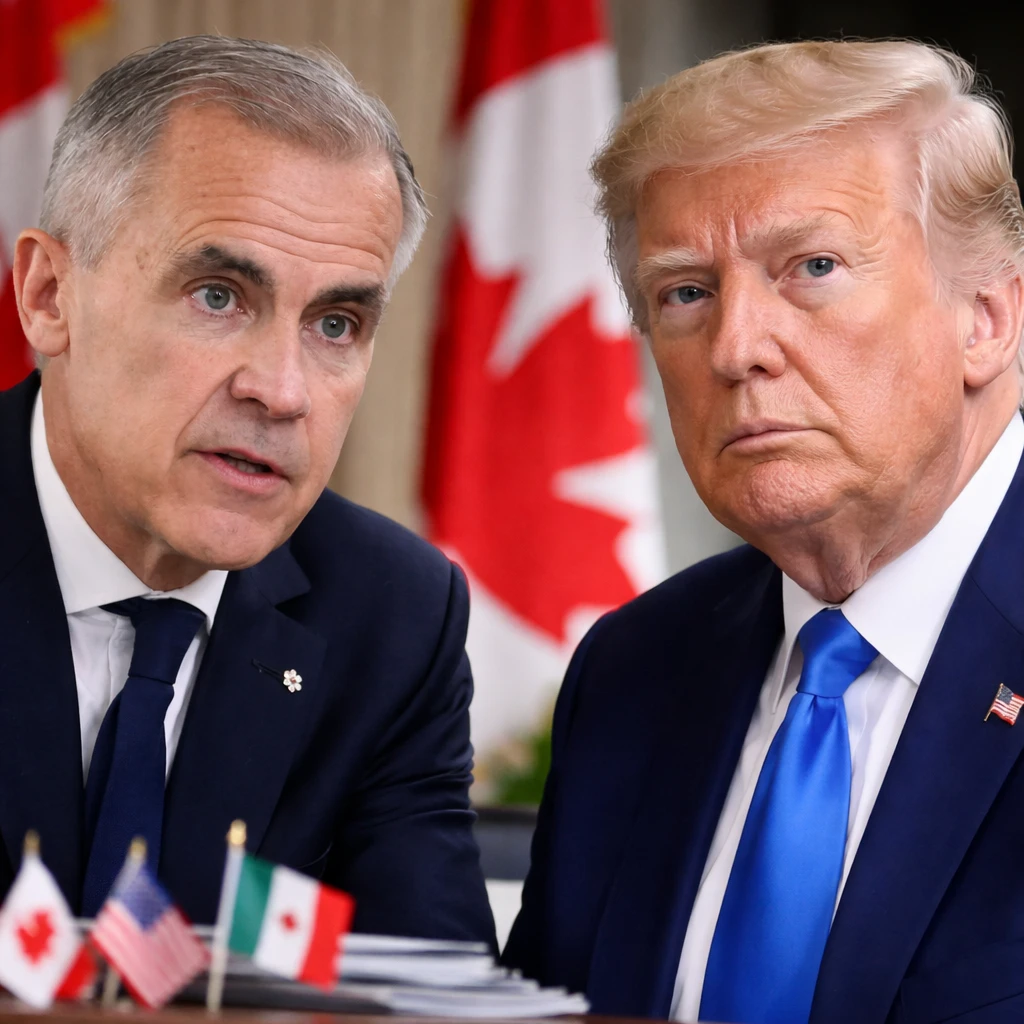
TORONTO - On Monday, Canadian Prime Minister Mark Carney addressed statements made by U.S. President Donald Trump regarding potential tariff measures against Canadian imports. Carney characterized these declarations as tactical maneuvers ahead of the scheduled 2024 review of the United States-Mexico-Canada Agreement (USMCA) between the respective nations.
"We are on the cusp of a thorough examination of the USMCA this year," Carney remarked, adding, "President Trump is a formidable negotiator, and his recent comments should be interpreted within the broader context of the negotiation process."
During recent days, President Trump threatened to apply a 100% tariff on Canadian goods should Canada advance with a trade deal involving China. However, Carney has firmly stated that Canada harbors no intention to enter into a comprehensive free trade agreement with Beijing.
Following discussions between Carney and Trump, U.S. Treasury Secretary Scott Bessent noted in an interview with Fox News that Carney had actively distanced himself from previous remarks made at the World Economic Forum in Davos, which were perceived as critical of some aspects of the U.S. administration’s approach.
Attempts to obtain further comment from Carney’s office regarding the conversation with President Trump were not immediately successful.
Canadian Minister responsible for Canada-U.S. trade, Dominic LeBlanc, conveyed that he had spoken with U.S. Trade Representative Jamieson Greer on Sunday and emphasized Canada’s intent to pursue only a narrow trade arrangement with China, concentrating primarily on select sectors of the Canadian economy.
LeBlanc drew a parallel with an agreement reached last summer between President Trump and Chinese President Xi Jinping in South Korea, wherein the U.S. agreed to reduce some tariffs on China in exchange for increased Chinese exports of rare earth elements and a reduction of restrictions on U.S. soy purchases.
Regarding the upcoming discussions on trade, LeBlanc highlighted that the focus is a mandated periodic review of the USMCA rather than a broad renegotiation akin to the comprehensive overhaul conducted earlier in President Trump’s first term. "This isn’t like six years ago. We’ve discussed this; this is simply a review that was embedded into the agreement from the outset," he stated.
LeBlanc also indicated Canada’s readiness to proceed expeditiously with the review process in 2024.
In a mirror of U.S. policy, Canada earlier this year enacted a 100% tariff on electric vehicles imported from Beijing, alongside a 25% duty on Chinese steel and aluminum. In response, China imposed retaliatory tariffs of 100% on Canadian canola oil and meal, plus a 25% tariff on Canadian pork and seafood products.
However, Carney broke ranks with the U.S. stance by agreeing to reduce Canada’s 100% tariff on Chinese electric vehicles. In return, China lowered tariffs on several Canadian goods, marking a strategic partnership established in the prior week. Carney noted that this partnership will facilitate access to tens of thousands of affordable electric vehicles within Canada.
The arrangement sets an initial annual cap of 49,000 Chinese electric vehicles eligible for import at a 6.1% tariff rate, increasing to approximately 70,000 over five years. This volume represents about 3% of the 1.8 million vehicles sold annually in Canada.
Carney also mentioned that China is expected to commence investment in the Canadian automotive sector within three years as part of this trade relationship.
The backdrop to Trump’s tariff threats includes a widening conflict between him and Carney, exacerbated by the U.S. President’s controversial attempt to purchase Greenland, which has generated tensions within the NATO alliance.
Carney has positioned himself as a leading voice encouraging middle powers to collaborate more closely in response to U.S. policies under President Trump. Speaking at the Davos World Economic Forum ahead of Trump’s arrival, Carney asserted, "Middle powers must act together because if you are not at the table, you are on the menu." His remarks received significant attention and acclaim.
President Trump’s contentious proposal to acquire Greenland followed repeated provocations aimed at Canada’s sovereignty, including public suggestions that Canada should be integrated into the United States as a 51st state. Notably, Trump shared on social media an altered map depicting the United States including Canada, Greenland, Venezuela, and Cuba within its territory.