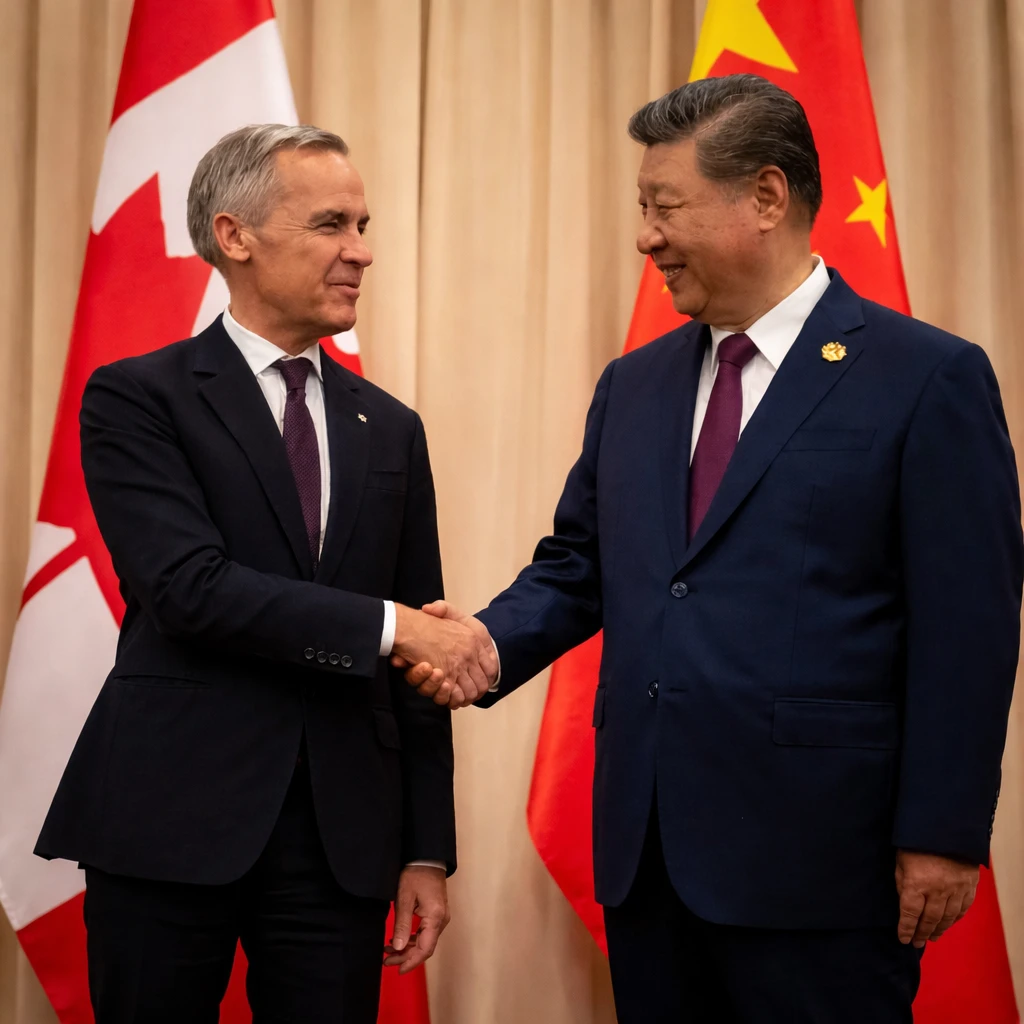

Canadian Prime Minister Mark Carney has confirmed that he will be traveling to China the week of January 13-17 to meet with Chinese President Xi Jinping. This marks the first time in more than eight years that a Canadian prime minister has visited China. The invitation to China was extended by President Xi during a meeting at an Asia-Pacific summit last October, signaling a mutual interest in restoring and enhancing diplomatic and economic relations between the two nations.
Carney emphasized that his government's goal is to build new international partnerships in an effort to lessen Canada's extensive economic reliance on a single market - the United States. "We’re forging new partnerships around the world to transform our economy from one that has been reliant on a single trade partner, to one that is stronger and more resilient to global shock," he stated in an official press release issued Wednesday.
Following his visit to China, Carney is also scheduled to attend the World Economic Forum Annual Meeting in Davos, Switzerland, from January 19 to 21.
This diplomatic outreach occurs against a backdrop of strained trade relations with the United States, especially under former President Donald Trump's administration. Trump had imposed tariffs on Canadian goods and controversially suggested that Canada could become the "51st state," a notion perceived as a threat to Canada's economic sovereignty.
The renewed engagement with China aligns with Canada's strategic objective to double its exports to markets outside the U.S. over the coming decade. This goal coincides with an anticipated review of the free trade agreement involving Canada, the U.S., and Mexico slated for this year. Currently, over three-quarters of Canadian exports are directed to the United States.
China holds the position of Canada's second-largest trading partner. However, bilateral relations have experienced significant turmoil since late 2018. Tensions escalated following the arrest of a senior executive from Huawei in Canada, pursuant to the country's extradition agreement with the U.S. Subsequently, China retaliated by detaining two Canadian citizens, further exacerbating diplomatic strains.
More recently, complications have arisen due to Canada's imposition of a 100% tariff on electric vehicles, batteries, and related products originating from China, effective in 2024. This tariff implementation was coordinated with the U.S. government.
The retaliatory tariffs instituted by China have notably impacted Canadian agricultural sectors including canola producers, seafood exporters, and pork farmers, who are facing increased export taxes. In response, China has indicated its willingness to remove some of these import tariffs on Canadian goods contingent upon the removal of Canada’s electric vehicle tariffs.