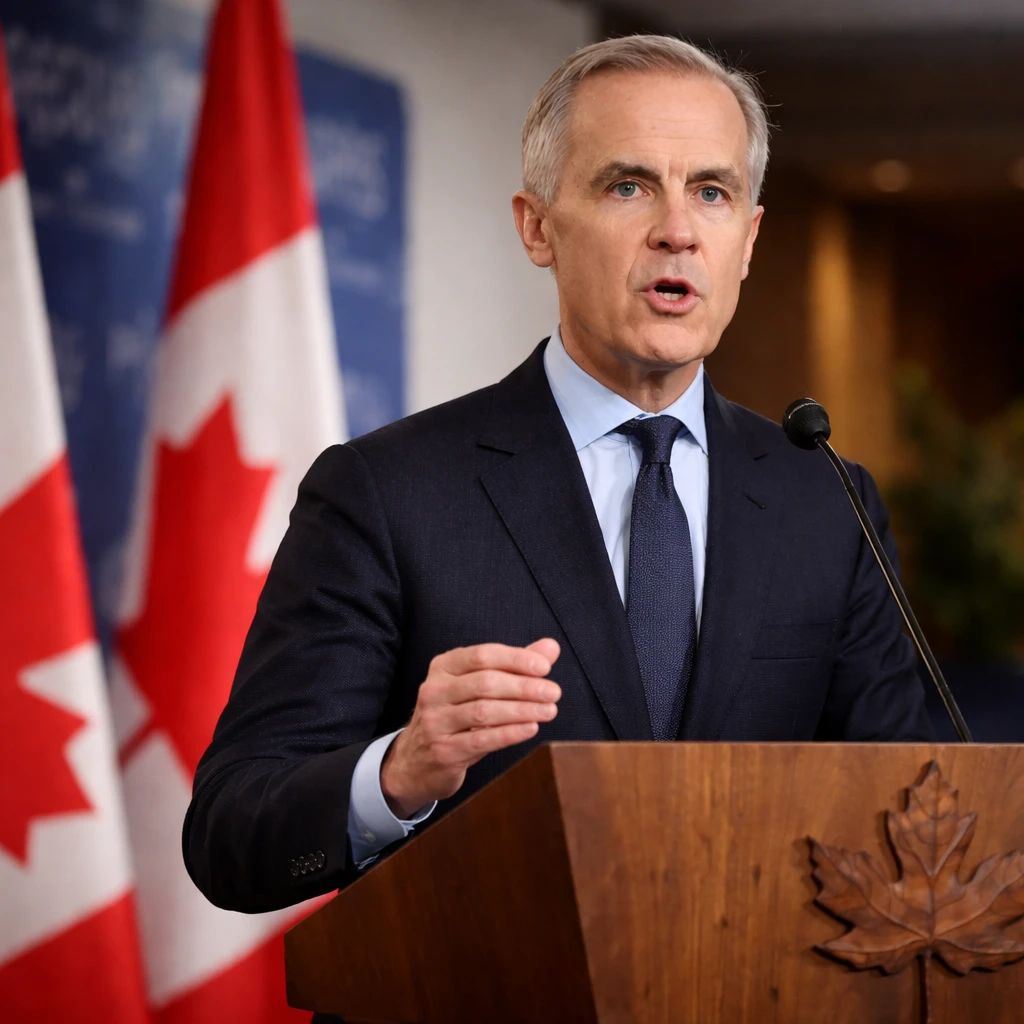
Canadian Prime Minister Mark Carney directly addressed remarks made by U.S. President Donald Trump regarding the relationship between Canada and the United States during and following the World Economic Forum in Davos.
During the forum, Trump stated, "Canada lives because of the United States," an assertion Carney directly challenged after returning to Canada. Carney emphasized that Canada's prosperity is rooted in its own values rather than dependence on the U.S., responding, "Canada doesn’t live because of the United States. Canada thrives because we are Canadian." This statement underscored a fundamental assertion of Canadian sovereignty and identity.
In Davos, without naming Trump, Carney condemned great powers for coercing smaller nations, articulating a vision of a future not dominated by autocratic governance. Once back in Canada, he articulated the importance of maintaining Canada's values and autonomy in global affairs, emphasizing the country’s ability to serve as a global example. He stated, "We can show that another way is possible, that the arc of history isn’t destined to be warped toward authoritarianism and exclusion; it can still bend toward progress and justice." Carney also declared, "Canada must be a beacon—an example to a world at sea," reinforcing his view of Canada as a leader in pluralistic democracy.
Carney acknowledged the close partnership Canada shares with the United States in economic, security, and cultural domains, yet stressed Canada’s right to self-determination: "We are masters in our home, this is our own country, it’s our future, the choice is up to us." This came amid ongoing discussions about a multibillion-dollar missile defense system dubbed "Golden Dome," which Trump mentioned as a key security initiative involving Canada.
Following these exchanges, Trump withdrew an invitation extended to Carney to join his newly inaugurated Board of Peace, referring to it as "the most prestigious Board of Leaders ever assembled." Trump announced this withdrawal publicly on social media, marking a significant diplomatic rebuke.
Carney had left Davos prior to Trump's Board of Peace inauguration to engage in efforts aimed at maintaining a ceasefire in the ongoing war between Israel and Hamas, indicating the prioritization of international security efforts amidst these diplomatic tensions.
Throughout the forum and in subsequent comments, Trump characterized Canada as receiving numerous "freebies" from the U.S. and insisted the country "should be grateful." He criticized Carney’s Davos speech as evidence of ingratitude and reiterated his vision for Canada’s involvement with U.S.-led defense systems.
Back home, in a speech at a cabinet retreat in Quebec City, Carney expanded on his message about the importance of maintaining Canadian values amid rising global populism and nationalism. He argued that Canada’s diversity is a source of strength, distinguishing the country by its pluralistic society and democracy focused on protecting vulnerable populations. Carney described Canada as "the greatest country in the world to be a regular person," highlighting the nation’s inclusivity regardless of wealth, heritage, religion, or color.
The response to Carney’s speech was mixed. U.S. Commerce Secretary Howard Lutnick dismissed the address, suggesting Canada has "the second best deal in the world" and expressing frustration at Carney’s perceived complaints. Nevertheless, prominent voices such as California Governor Gavin Newsom praised Carney’s stance and courage, underscoring the broader U.S. political debate regarding the nation's future direction and foreign policy.
Newsom also pointed to Carney’s successful negotiation of low-cost, high-quality electric vehicles from China to Canada—contrasting with the ongoing Trump administration’s foreign policy—and labeled such actions as emblematic of the challenge to long-term alliances.
This diplomatic friction between two neighboring countries reflects deeper uncertainties in their economic and security relations, especially as the Canada-U.S.-Mexico Agreement (USMCA) faces mandatory review this year. Carney's remarks and Trump’s responses highlight the challenges and risks for trade, defense cooperation, and diplomatic engagement between the countries amid shifting political landscapes.