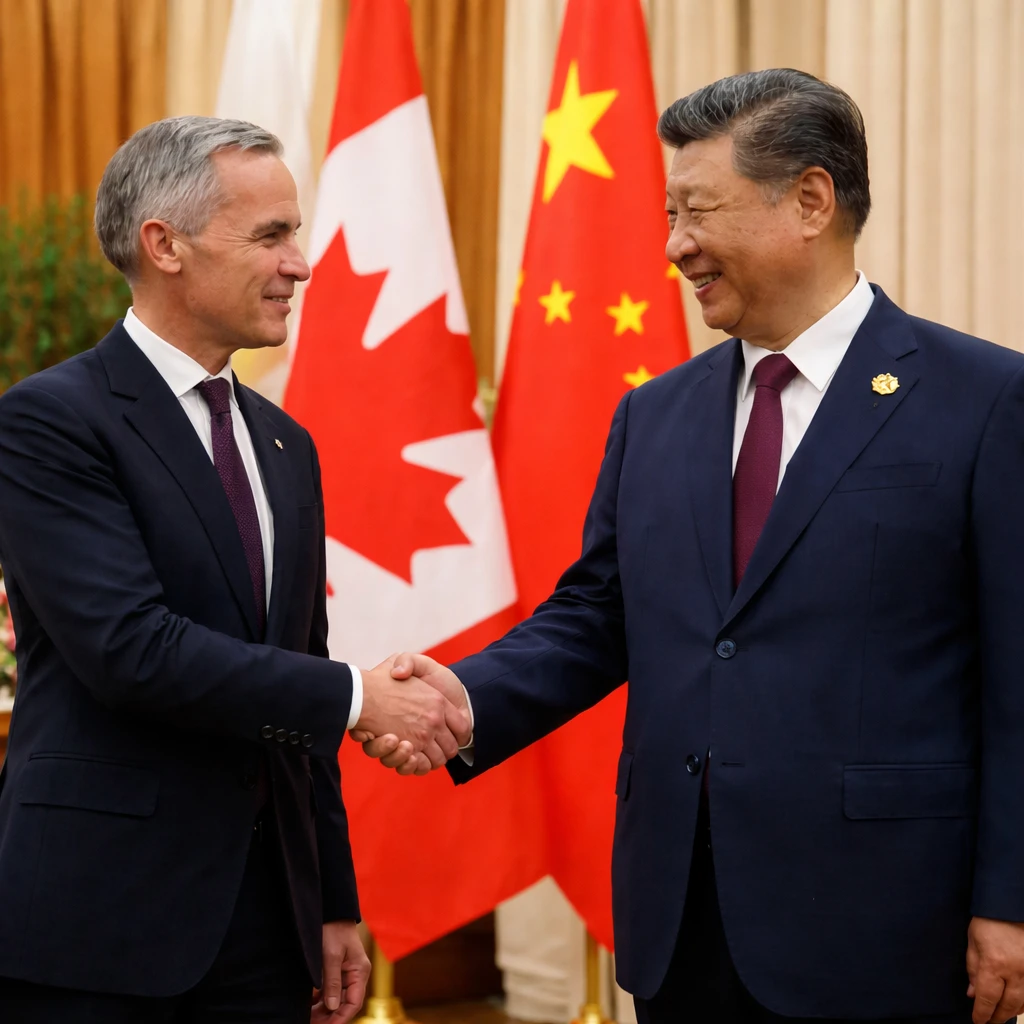

In a significant diplomatic initiative, Canadian Prime Minister Mark Carney arrived in Beijing to revive Canada's economic partnership with China after nearly a decade without high-level visits. This mission seeks to address and mend relations strained by recent geopolitical developments and to lessen Canada's heavy dependence on the United States, its largest trading partner.
Carney, who assumed office less than a year ago succeeding Justin Trudeau, is focused on expanding Canada's trading horizons. He articulated an ambition to double Canadian exports to countries other than the U.S. within the next decade, a strategy motivated chiefly by the tariffs imposed under the administration of U.S. President Donald Trump and the contentious notion expressed by Trump that Canada could be considered "the 51st state."
Highlighting the need for economic resilience amid global trade disruptions, Carney stated, "Canada is focused on building a more competitive, sustainable, and independent economy. We’re forging new partnerships around the world to transform our economy from one that has been reliant on a single trade partner." During his visit, Carney is scheduled to meet with President Xi Jinping and other senior Chinese officials to discuss escalating trade issues and potential cooperation.
Canadian governmental representatives, during a preparatory briefing, framed the visit as an effort to reinvigorate a previously dormant strategic partnership with China. They underscored that the geopolitical context also includes wide-reaching U.S. involvement in matters such as Venezuela, which influences diplomatic calculations.
While Canada and China anticipate some progress on resolving trade irritants, officials cautioned that a comprehensive removal of tariffs imposed by both nations remains unlikely at this stage. Carney’s trip will conclude with visits to Qatar and attendance at the World Economic Forum in Davos, underlining Canada's broader engagement with global economic forums.
China’s perspective on the visit is cautious but welcomes the opportunity for renewed dialogue. Zhu Feng, dean of the School of International Studies at Nanjing University, observed that Carney’s engagement reflects "new space for further development in China-Canadian relations" amid current U.S. trade protectionism. However, he also remarked on the enduring close alliance between Canada and the U.S., underscoring cultural, geographic, and historical ties that continue to influence Canada’s foreign economic policies.
Carney’s initiative mirrors similar diplomatic resets by other nations. Australia, under Premier Anthony Albanese since 2022, has been progressively restoring trade relations with China following prior restrictions. Likewise, U.K. Prime Minister Keir Starmer has sought to patch bilateral ties with China after his party’s ascension in 2024, despite ongoing political and human rights discussions.
Canada’s recent history with China has been marked by tension, notably since 2018 when the arrest of Huawei Technologies executive Meng Wenzhou at U.S. request triggered retaliatory detentions of two Canadians, Michael Kovrig and Michael Spavor. This episode, along with ensuing tariffs on electric vehicles, steel, aluminum from China, and Chinese counter-tariffs on Canadian agricultural exports, has defined a challenging trade landscape.
Chinese authorities signaled receptiveness to Carney’s visit. A commentary in the state-run Global Times characterized the engagement as a new starting point and urged Canada to remove "unreasonable tariff restrictions" to advance pragmatic collaboration. Chinese Foreign Ministry spokesperson Mao Ning expressed anticipation that the visit would help sustain positive momentum in bilateral relations.
Alongside efforts to engage China, Canada's diplomatic strategy includes attempts to restore ties with India, following a deterioration triggered by accusations of Indian involvement in the 2023 killing of a Sikh activist in Canada and subsequent diplomatic reprisals. Progress in this area includes some consular restorations and resumed diplomatic dialogue, with trade discussions poised for acceleration.
Looking ahead, Carney plans to continue his outreach by visiting India later this year, signaling Canada's intent to diversify its trade relationships amid ongoing international trade frictions. His diplomatic itinerary reflects an emphasis on economic partnerships across emerging and established markets in the face of evolving global economic and geopolitical challenges.