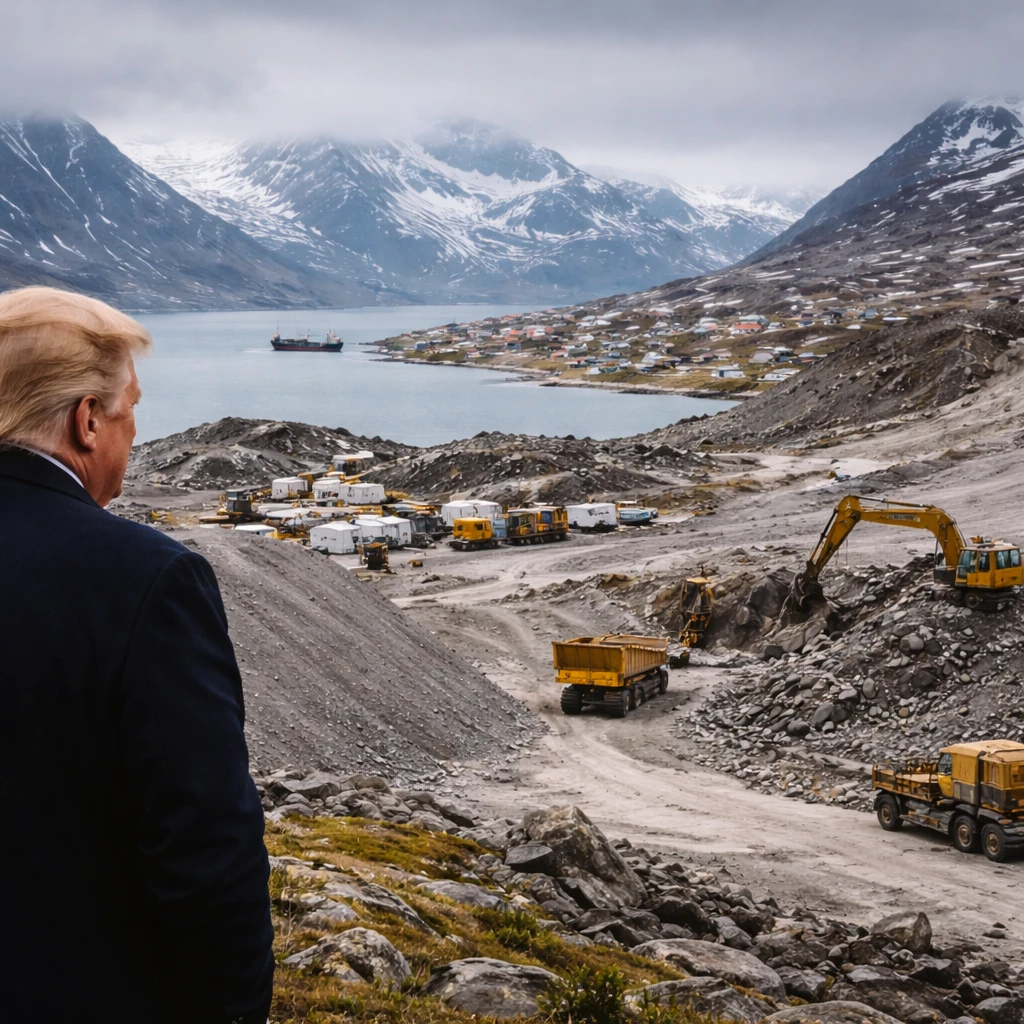

Efforts to establish mining operations for rare earth elements in Greenland have been hindered by the island's formidable environmental conditions, scant infrastructure, and challenging geology. These factors have thus far thwarted attempts to develop mines capable of extracting the rare earth minerals essential for a wide range of advanced technologies. Even if the United States were to successfully seize control of Greenland, these inherent difficulties would persist.
Since China tightened export controls on rare earths following U.S.-imposed tariffs last year, the Trump administration has made reducing China's dominance over the supply chain a priority. The administration has invested significant funds and taken equity stakes in mining companies to diversify the supply. President Trump has further suggested that taking political control of Greenland from Denmark could play a role in this strategy.
On a recent occasion, the president asserted, “We are going to do something on Greenland whether they like it or not.” However, Greenland's rare earth resource development remains years away from fruition, if it ever materializes. While several companies continue exploration activities to tap into the estimated 1.5 million tons of rare earth elements embedded in Greenland's rock formations, these projects have seldom advanced beyond preliminary surveying.
Trump's ongoing interest appears intertwined with broader geopolitical concerns, particularly curtailing Russian and Chinese influence in the Arctic region, in addition to addressing supply chain vulnerabilities. The rare earth elements at issue, such as neodymium and terbium, are critical for manufacturing high-performance magnets used in electric vehicles, wind turbines, robotics, and military aircraft.
Experts emphasize that the focus on Greenland is largely driven by geopolitical strategy rather than immediate technological or economic feasibility. Tracy Hughes, director of the Critical Minerals Institute, commented, “The fixation on Greenland has always been more about geopolitical posturing — a military-strategic interest and stock-promotion narrative — than a realistic supply solution for the tech sector. The hype far outstrips the hard science and economics behind these critical minerals.”
At the White House, the president highlighted these strategic concerns, saying, “We don’t want Russia or China going to Greenland, which if we don’t take Greenland, you can have Russia or China as your next door neighbor. That’s not going to happen.”
Mining conditions in Greenland pose severe challenges. Diogo Rosa, a geological researcher, outlined the primary obstacle as remoteness. "Even in the south where it’s populated, there are few roads and no railways, so any mining venture would have to create these accessibilities," he said. Establishing power generation on-site and importing specialized labor would also be necessary. Environmental considerations add complexity, especially given Greenland's efforts to develop tourism.
Patrick Schröder of Chatham House noted the pollution risks associated with extracting rare earths, particularly from the chemicals used in processing and the presence of radioactive uranium in conjunction with the minerals.
Additionally, Greenland's geography results in extreme conditions year-round, with extensive ice coverage and frozen fjords. The rare earth elements discovered there are primarily locked in eudialyte, a complex rock type lacking a profitable extraction method, unlike carbonatites typically exploited elsewhere. David Abraham, an expert on rare earths, noted, "If we’re in a race for resources — for critical minerals — then we should be focusing on the resources that are most easily able to get to market." Although a recent announcement by Critical Metals to establish a pilot plant in Greenland caused its stock price to surge, these initiatives remain distant from operational mining and require substantial capital investment.
Producing rare earths is challenging even under optimal conditions. Price volatility, exacerbated by China's occasional market dumping to suppress competitors, further complicates profitability. Currently, most rare earth processing occurs in China, underscoring the urgency for alternative supply chains. The U.S. is working to expand domestic and allied sourcing during a limited reprieve from intensified Chinese restrictions negotiated last year.
Companies already producing rare earths and magnets outside Greenland can ramp up output more rapidly. In contrast, Greenland's development timeline places it far behind established producers. Ian Lange from the Colorado School of Mines described Greenland ventures as regressive in this context, stating, "Everybody’s just been running to get to this endpoint. And if you go to Greenland, it’s like you’re going back to the beginning."
Many industry participants advocate focusing resources on proven operations within the U.S. and allied countries such as Australia. The U.S. government has invested in the sole American rare earth mine, MP Materials, as well as firms engaged in lithium mining and rare earth recycling. Scott Dunn, CEO of Noveon Magnetics, emphasized that these investments better address reliance on China but acknowledged the longstanding global dominance of Chinese rare earth production.
"There are very few folks that can rely on a track record for delivering anything in each of these instances, and that obviously should be where we start, and especially in my view if you’re the U.S. government," Dunn said. Noveon Magnetics already produces over 2,000 metric tons of magnets annually in Texas from non-Chinese sources.