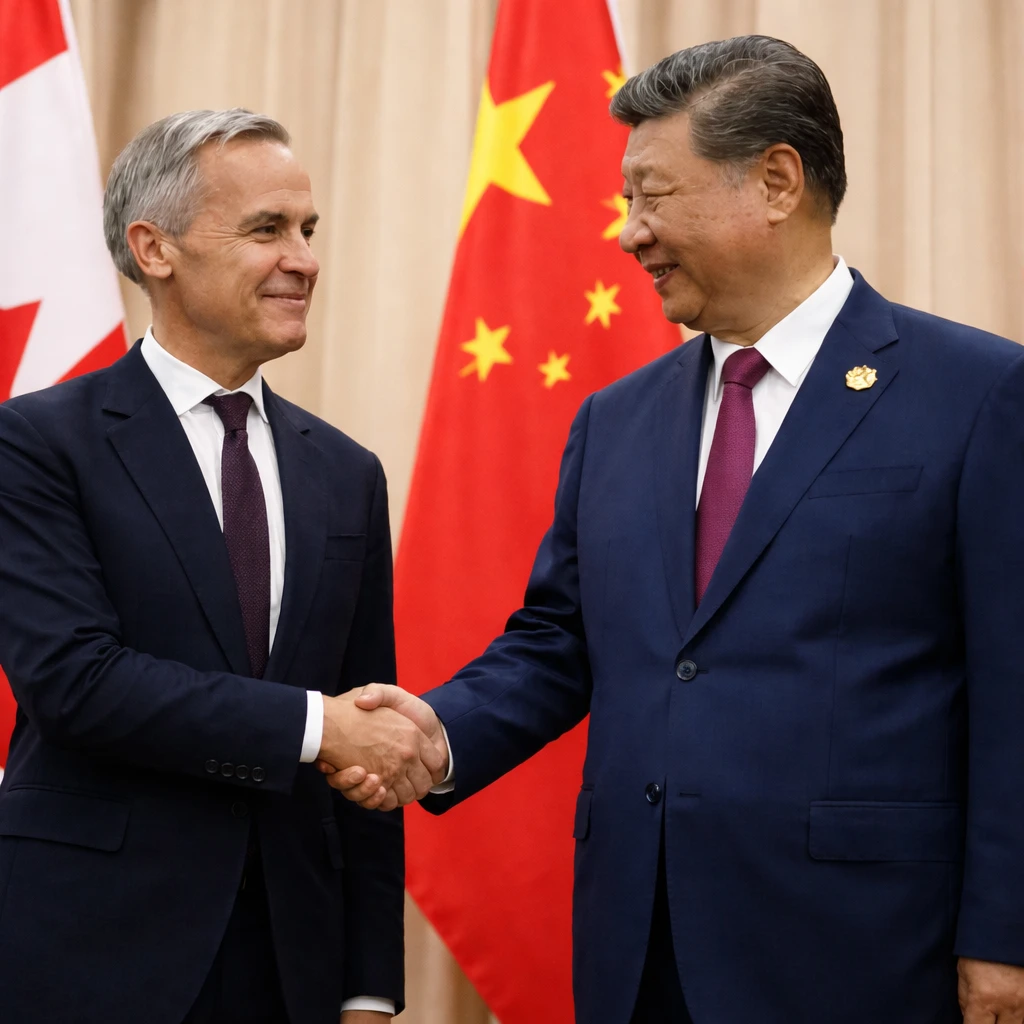

Mark Carney’s arrival in Beijing on Wednesday has sparked renewed discourse in Chinese state media urging Canada to carve out a more autonomous foreign policy path, distinct from its close alignment with the United States. The concept of “strategic autonomy” has been highlighted as a means for Canada to assert itself independently of Washington’s direction, a move Beijing hopes might weaken the traditional US-Canada alliance, particularly against the backdrop of ongoing US-China rivalries.
Canada has historically been a close ally of the United States, both geographically and diplomatically. However, with recent US economic measures and military posturing targeting several nations, including China, Beijing perceives an opening to encourage countries like Canada to reconsider their foreign relationships. This shift in sentiment follows former President Joe Biden’s efforts to intensify cooperation among allied partners such as Europe, Australia, India, and Canada to counterbalance China’s influence. Nonetheless, Chinese analysts remain prudent regarding the likelihood and extent of any fundamental change in Canada’s alignment.
Carney has emphasized trade as a central issue during his visit, framing this engagement as part of Canada’s broader strategy to reduce its economic dependence on the US market. This follows a period of trade tensions, including tariffs imposed by former President Donald Trump on Canadian goods entering the United States, and proposals positioning Canada metaphorically as a US extension. These dynamics underscore Ottawa’s interest in diversifying its international economic partnerships.
Since taking office last year, Canadian Prime Minister Justin Trudeau has sought to mend relations with China, which had deteriorated significantly during his predecessor's tenure. The downturn began after the 2018 arrest of a Chinese technology executive on American request and deepened after Canada imposed a 100% tariff on Chinese-made electric vehicles in 2024, demonstrating solidarity with US policy under Biden’s administration. China retaliated with tariffs targeting Canadian exports such as canola, seafood, and pork, as well as maintaining its own tariffs on steel and aluminum.
State-run Chinese outlets have openly criticized past Canadian policies as excessively accommodating to US interests. An editorial in China Daily suggested that Ottawa should recognize the causes of the bilateral setbacks and avoid repeating the same approach that led to strained relations by embracing strategic autonomy. It cautioned that adherence to US directives on China-related matters would undermine any efforts to restore ties with Beijing. Similarly, the Global Times framed Canada’s tariff experience as a costly lesson that may have prompted a growing awareness of the need for policy independence.
Despite these calls, Canadian officials have tempered expectations, indicating that while progress on trade issues is a goal of Carney’s visit, the complete removal of tariffs is unlikely in the immediate term.
Experts in China have identified potential areas for Canada and China to find shared positions, such as skepticism regarding American military interventionism exemplified by recent actions in Venezuela, where the US legally compelled the Venezuelan president to face charges abroad, as well as discussions over US interests in Greenland, a Danish territory. Such moves have contributed to a sense of unease within Canada concerning the US’s expansionist tendencies, sparking debate over sovereignty concerns.
Analyst Cui Shoujun from Renmin University remarked that Canada’s apprehension about US assertions over territories like Greenland could fuel a desire for enhanced strategic independence, paralleling Latin American countries’ efforts to resist American interference. Nonetheless, Chinese commentators acknowledge the limitations of potential realignment due to both nations’ profound historical, cultural, and economic connections to the US, as well as significant divergences with China on trade competition, human rights, and Taiwan.
Zhu Feng, dean of the School of International Studies at Nanjing University, advised prudence against overestimating the implications of Carney’s visit, underscoring that Canada remains not only a neighbor but also an ally of the US. While the strain on US partnerships caused by former President Trump’s policies might create some openings for China to strengthen relations with allied countries, complete detachment from US economic and military influence is unlikely in the foreseeable future.
In summary, although China seeks to encourage Canada towards a more independent foreign policy stance, deeply entrenched ties and mutual concerns regarding China’s growing global influence impose significant constraints on any fundamental shift. The outcome of Carney’s diplomatic engagement will be closely watched for indications of change but is expected to reflect a cautious balancing of interests on both sides.