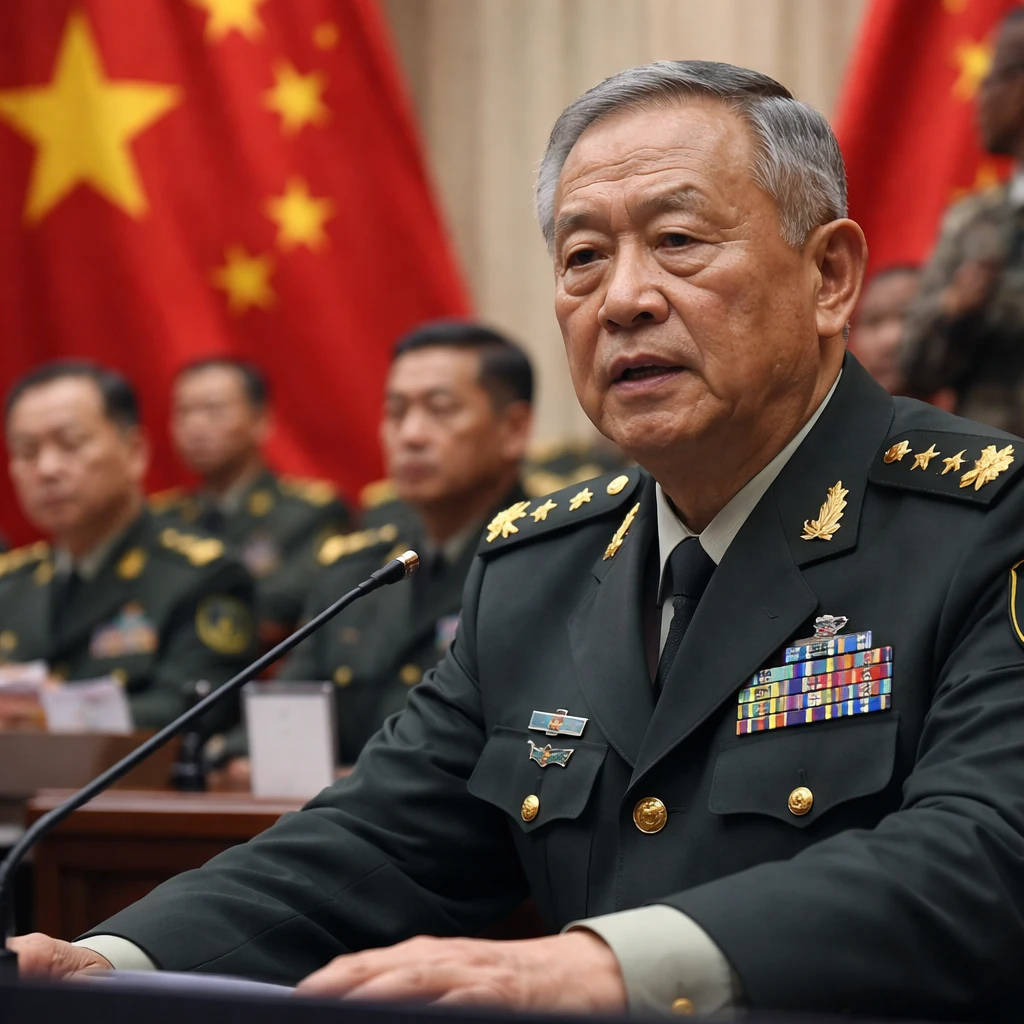

China's Defense Ministry disclosed on Saturday that Zhang Youxia, one of the two vice chairs of the Central Military Commission (CMC), is currently under investigation for suspected serious breaches of discipline and law. Zhang's case marks the latest development in an extensive series of military purges aimed at restructuring the leadership cadre.
The CMC, recognized as the supreme military authority in China and chaired by President Xi Jinping, holds significant influence over the People's Liberation Army (PLA). These investigations are widely interpreted by analysts as mechanisms designed to ensure the military's allegiance to Xi Jinping, alongside advancing reforms within China's armed forces.
According to the Defense Ministry's statement, Liu Zhenli, serving as the chief of staff for the CMC’s Joint Staff Department and another commission member, has also come under investigation by the ruling Communist Party for unspecified violations. The ministry did not elaborate on specific allegations against either official.
Zhang Youxia, age 75, has a long-standing career with the PLA, having joined in 1968 and holding the rank of general within the ground forces. His position as vice chair of the CMC situates him among the highest ranks in China's military establishment. This investigation follows the Communist Party's expulsion last October of the other vice chair, He Weidong, who was succeeded by commission member Zhang Shengmin.
The ongoing purge corresponds with a broader anti-corruption campaign initiated under Xi Jinping's leadership since 2012. This campaign has implicated more than 200,000 officials across various levels of government and military hierarchies. In 2024 alone, two former defense ministers were ousted due to corruption accusations, underscoring the campaign's reach and intensity.
Amid heightened regional tensions, China's military posture remains a focal point of international scrutiny. Recent military drills around Taiwan, intended as demonstrations against external interference, signal Beijing's strategic resolve.
Reflecting global apprehensions, the United States recently released a National Defense Strategy acknowledging China's growing military capabilities and emphasizing the necessity of deterrence to prevent regional domination. The strategy advocates for maintaining peace under terms that are favorable to American interests yet acceptable to China, explicitly rejecting the notion of regime change as a prerequisite for stable relations.