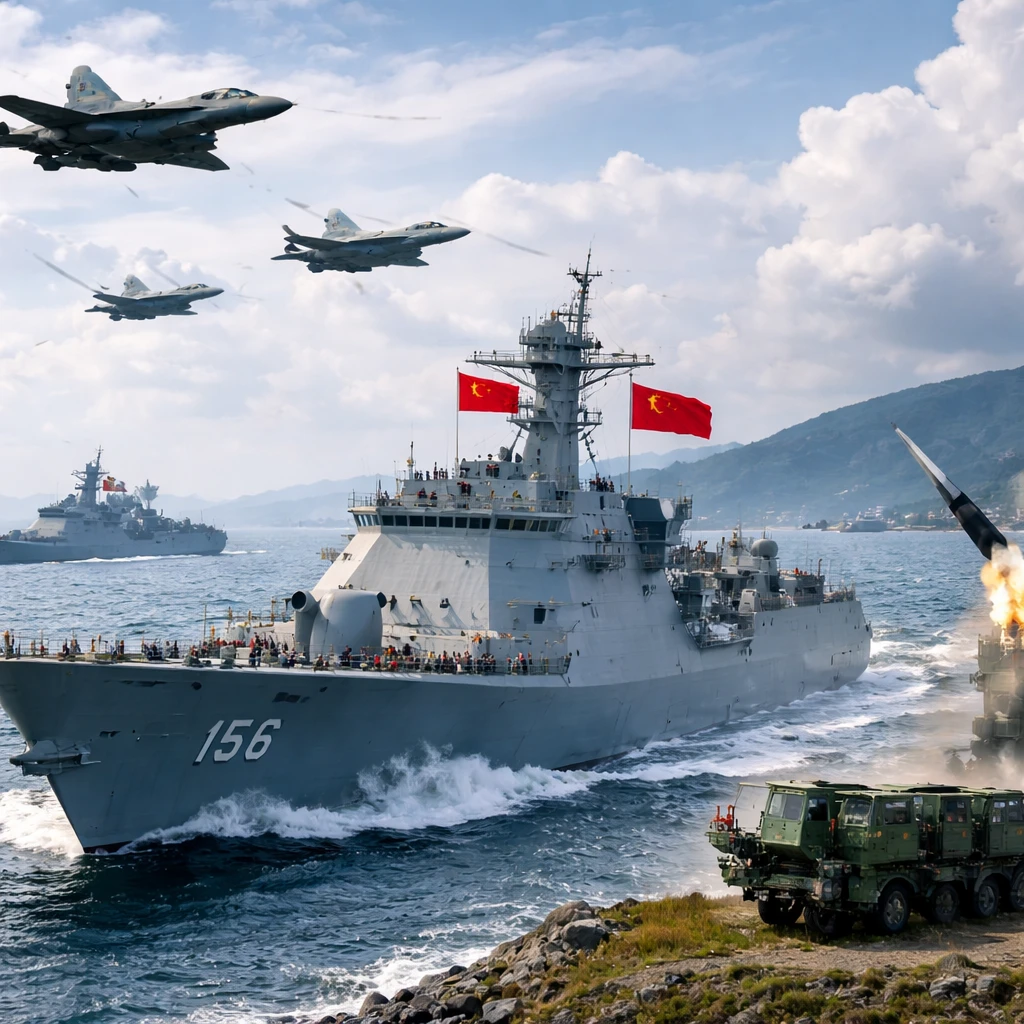

In a display of military coordination, China's armed forces have initiated joint drills involving air, naval, and rocket units around the territory of Taiwan. This maneuver, conducted by the People's Liberation Army’s Eastern Theater Command, was described as a "stern warning" aimed at deterring separatist elements on the island and external forces viewed as interfering in the regional status quo.
Taiwanese authorities responded swiftly, announcing an elevated readiness posture among their defense units and branding China's actions as the primary source of regional instability and a threat to peace. Taiwan's Defense Ministry communicated, via its social media channel on X, that rapid response exercises are currently underway, deploying appropriate military assets to maintain combat readiness.
The joint drills followed expressions of displeasure from Beijing over a sizable US arms transaction to Taiwan, valued at over $10 billion, and statements from Japan's Prime Minister Sanae Takaichi indicating the possibility of military engagement should China initiate aggressive moves against Taiwan. Despite these contexts, the Chinese military's announcement of the drills refrained from explicitly mentioning the United States or Japan.
Senior Colonel Shi Yi, representing the Eastern Theater Command, detailed the geographic scope of the exercises, indicating operations would span the Taiwan Strait and adjoining sectors to the island's north, southwest, southeast, and east. The focus of these activities includes sea and air combat readiness patrols, combined dominance exercises, and blockade drills targeting critical ports.
This marks the first significant drill explicitly citing the objective of "all-dimensional deterrence outside the island chain," which reflects a broader strategic posture. Shi framed the exercises as a necessary and legitimate response to the pursuit of Taiwan's independence and external meddling, reinforcing China's commitment to its sovereignty and territorial integrity.
The Eastern Theater Command's operations involve multi-platform assets, such as fighters, bombers, unmanned aerial vehicles, and long-range rocket systems, emphasizing the capacity to execute precision strikes on mobile targets within the middle sectors of the Taiwan Strait. The drills are slated to continue with live-fire exercises scheduled for the following day, covering five distinct areas encircling Taiwan.
Posters released by the command to accompany the drills illustrate martial themes like the "Shield of Justice" and call for the elimination of any foreign or separatist influence encroaching upon China's territorial defenses. This propaganda reinforces the hardline messaging accompanying the military exercise.
In light of these developments, Taiwan's government condemned the drills, with spokesperson Karen Kuo accusing Beijing of violating international norms and employing military intimidation to threaten regional neighbors. The ongoing pattern of near-daily incursions by Chinese military aircraft and vessels in Taiwan's vicinity has intensified over recent years, provoking Taipei's initiative to expedite its indigenous air defense capabilities, notably through the "Taiwan Shield" or "T-Dome" system.
These military tensions arise against the long-standing backdrop of divided governance since 1949, when the Chinese Communist Party took control of the mainland, and the Nationalist Party retreated to Taiwan, which has since functioned as a de facto independent government despite Beijing's claims of sovereignty over the island.
Recent sanctions imposed by China on US defense contractors and executives are part of this ongoing friction, triggered by the US government's planned arms sales that would represent the largest package ever approved. The US maintains a statutory obligation to assist Taiwan's defense, a policy point that remains a critical factor in cross-strait and Sino-US relations.
Meanwhile, amid the growing military posturing, Taiwanese leadership has called for peace and stability in the Taiwan Strait, contrasting the current turbulent environment marked by "crashing waves and howling winds" with aspirations for a future of prosperity and calm.