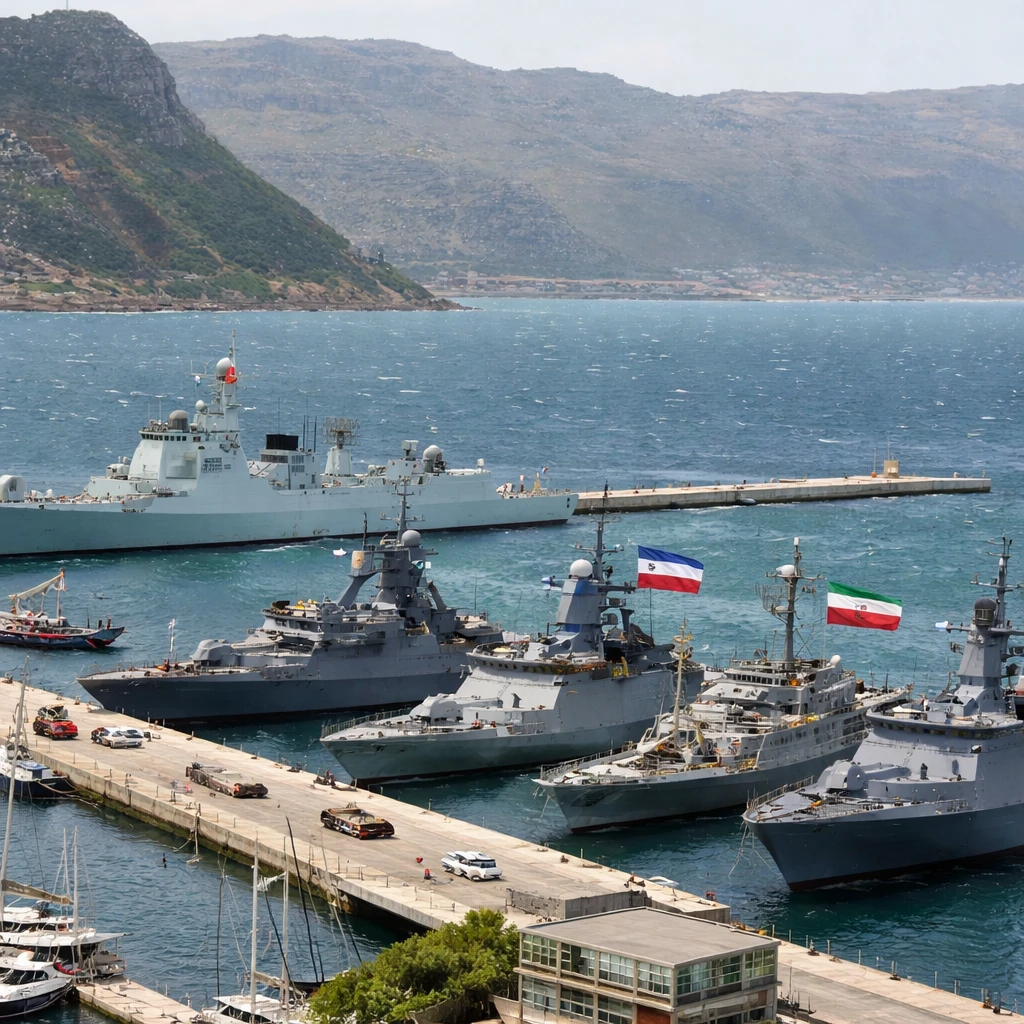

Off the coast of Cape Town, South Africa, a fleet of warships representing China, Russia, Iran, and South Africa itself have launched a week-long naval exercise, marking a strategic gathering amid increasing global geopolitical tensions. These maneuvers, which began last Friday, are designed to enhance maritime security cooperation and increase joint capacity to combat piracy, with South Africa acting as the host nation.
The exercises, orchestrated primarily under the leadership of China and established last year within the BRICS framework, intend to deepen the collaboration between participant nations' naval forces through complex operational drills. South Africa’s military authorities emphasized the dual objectives of practicing anti-piracy operations and boosting overall maritime security.
China, Russia, and South Africa are longstanding members of the BRICS group, while Iran joined this bloc more recently, in 2024. Despite Iran's domestic unrest with growing protests against its government, its navy has actively taken part in these drills alongside its BRICS partners.
Currently, it remains unclear whether other BRICS members—namely Brazil, India, and the United Arab Emirates—are also participating. A South African military spokesperson noted that the full roster of countries engaged in the exercises has yet to be confirmed, with the drills scheduled to continue until the coming Friday.
Port activities in Simon’s Town, the primary naval base near the southern tip of the continent where the Indian and Atlantic Oceans converge, have been bustling. Multiple Chinese, Russian, and Iranian vessels have been docking and departing. Among Chinese deployments is the Tangshan, a sizable destroyer class ship measuring approximately 161 meters in length. Russia has contributed a smaller warship called the Stoikiy alongside a replenishment tanker, as reported by the Russian Baltic Fleet.
South Africa has prior experience hosting Chinese and Russian naval exercises, including sessions held in 2023. The current deployment was initially slated for late November but was postponed due to diplomatic considerations connected to South Africa hosting the Group of Twenty (G20) summit around the same period.
These military engagements risk further straining diplomatic relations between South Africa—the continent’s most developed economy and a key African voice—and the United States. Earlier in February, then-President Donald Trump signed an executive order criticizing South Africa’s support for certain global actors and cited its ties with Iran as justification for cutting U.S. aid.
BRICS forums, often leveraged by China and Russia, have provided platforms for critiques of U.S. foreign policy and Western influence. While South Africa traditionally pursues a non-aligned foreign policy stance and maintains neutrality, the intensified presence of Russia in southern African waters has previously created diplomatic friction with Washington. In 2023, the former U.S. administration accused South Africa of allowing a sanctioned Russian vessel at Simon’s Town naval base to load weapons destined for the conflict in Ukraine—a claim South Africa has denied.