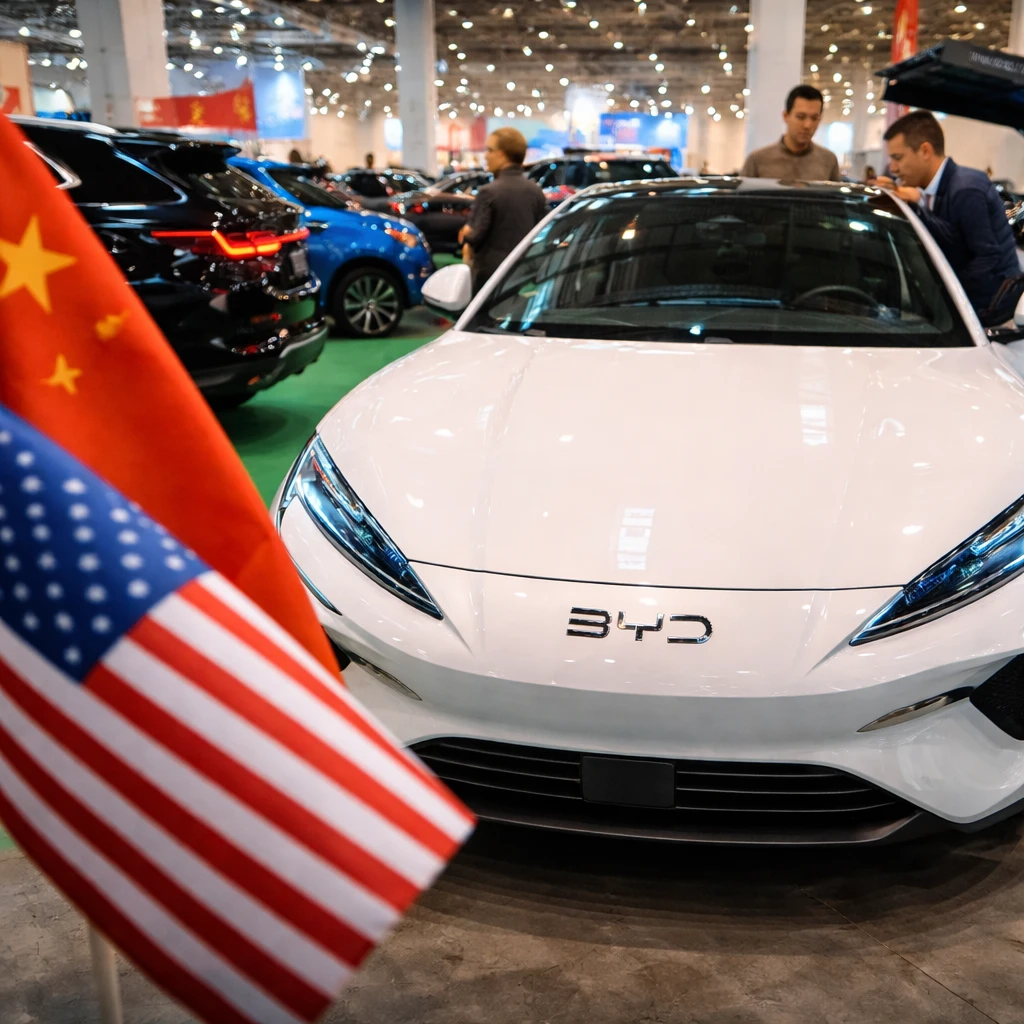

Chinese automakers have been expanding their influence worldwide, increasing sales of electric vehicles (EVs) characterized by advanced technology, attractive design, and competitive pricing. Recently, Canada agreed to reduce tariffs on Chinese-made EVs as part of a trade arrangement involving concessions on Canadian agricultural goods. Experts suggest this more accessible entry into the Canadian market could significantly benefit Chinese automakers seeking to solidify a dominant position in the global EV sector, particularly as China’s domestic EV sales exhibit deceleration. This evolution raises concerns among established automobile manufacturers, notably those based in the United States.
United States officials have expressed apprehension about these developments. At a Stellantis Jeep assembly facility in Toledo, Ohio, Transportation Secretary Sean Duffy criticized the Chinese government’s investments in its auto industry. He asserted that the Chinese Communist Party’s objective is market dominance: "They want to control the auto industry and displace existing jobs," he stated. Regarding Canada’s tariff decision, Duffy warned, "Partnering with China to import their vehicles will have regrettable consequences for Canada."
Meanwhile, some analysts view the increasing presence of Chinese EVs on the world stage as an unstoppable trend. Ilaria Mazzocco, deputy director and senior fellow at the Center for Strategic and International Studies, noted, "Chinese automakers’ popularity is rising rapidly and they are making inroads beyond marginal or peripheral global markets that are less critical to American manufacturers."
Chinese EVs distinguish themselves through a combination of affordability, quality, and technological sophistication. Mazzocco elaborated, "These vehicles are competitively priced yet technologically appealing, often featuring extensive software capabilities and advanced connectivity, which resonates well with consumers." Price points for Chinese EVs can range between $10,000 and $20,000, substantially lower than the approximate $50,000 average cost for new vehicles in the U.S., where EVs tend to command even higher prices.
In addition to cost advantages, China’s auto industry demonstrates strengths in manufacturing efficiency and vehicle lightweighting techniques that improve electric range. Sam Fiorani, vice president of AutoForecast Solutions, highlighted how Chinese manufacturers have successfully produced small and mid-sized cars—segments largely abandoned by U.S. companies in favor of larger, more profitable SUVs and pickup trucks.
As the global auto market transitions swiftly toward electrification, Chinese EV makers are positioned advantageously to capture market share. Benchmark Mineral Intelligence reports a 17% growth in electric and plug-in hybrid vehicle sales in China for 2025, with Europe experiencing an even larger increase of 33%, whereas U.S. electrified vehicle sales only grew marginally by 1% last year. This divergence marks a challenge, particularly since some American automakers have scaled back their electrification investments amid shifting federal policies that are less supportive of EV adoption.
Tesla, once the preeminent global EV producer, delivered 1.64 million vehicles in 2025, trailing behind Chinese rival BYD, which achieved 2.26 million deliveries. Experts express concern that U.S. industry competitiveness may erode, particularly considering levels of regulatory support and international market pressures.
Chinese EV imports into Canada must meet regulatory standards comparable to U.S. requirements, which may incentivize Chinese automakers to establish production facilities within Canada and strategically select their target segments—whether higher-end vehicles or lower-cost models aiming for greater volume. Mark Wakefield of AlixPartners predicts that Chinese brands could account for 30% of the global automotive market by 2030, with recent market entries in Europe, South America, Mexico, and Canada signaling expansive ambitions.
Governments worldwide have sought to regulate Chinese EV imports due to concerns about their disruptive impact on local industries and potential implications of data sovereignty. Vehicles operating as “data centers” raise issues regarding how state-owned Chinese companies might access driver location data and exert leverage through this information. European Union tariffs on Chinese EVs, and U.S. and Canadian import taxes, exemplify protective measures, although recent adjustments such as Canada lowering its tariffs may signal shifts in trade policy.
The Mexican market has notably embraced Chinese EVs, reflecting the broadening geographic footprint of these vehicles. Fiorani notes, "The proliferation of Chinese manufacturers in global markets is inevitable, prompting negotiations to establish appropriate controls over data management and market share." Despite protective measures, Chinese EVs are expected to permeate Western markets gradually, prompting a re-evaluation of competitive strategies among incumbent automakers and policymakers alike.