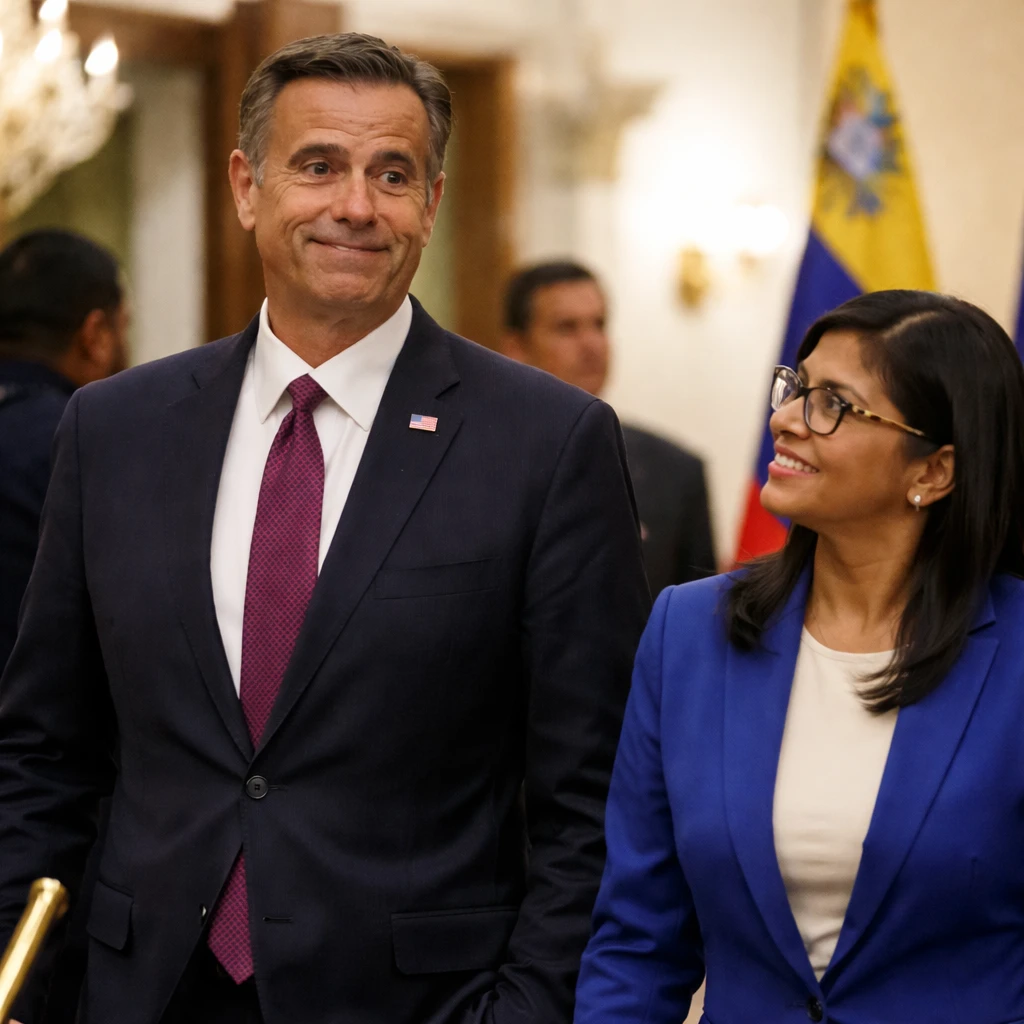
In a notable diplomatic outreach, CIA Director John Ratcliffe traveled to Caracas to engage with Venezuela's acting President Delcy Rodríguez. This meeting represents the highest-level visit by an official of the Trump administration to the South American nation since a U.S. military operation led to the capture of former President Nicolás Maduro.
The two-hour discussion, held on a Thursday, was confirmed by an anonymous U.S. government official who spoke under the condition of confidentiality. According to this official, the meeting occurred at the behest of President Donald Trump and served to convey the United States’ intent to cultivate a more constructive partnership with Venezuela.
Coinciding with this development, Venezuelan opposition leader María Corina Machado presented her Nobel Peace Prize medal to President Trump at the White House. Despite this gesture, Machado remains largely sidelined within the broader political dialogue. The timing and nature of Ratcliffe’s visit signal a possible shift in U.S. engagement towards aligning with Rodríguez, who formerly held the role of vice president under Maduro until the recent U.S. operation that forcibly removed Maduro to the United States on drug trafficking offenses.
The delegation accompanying Ratcliffe was reportedly composed of a limited number of U.S. officials. As initially reported by The New York Times, the visit's agenda was to lay foundational groundwork for enhanced cooperation between the Trump administration and Venezuela’s emerging leadership.
The discussions explicitly covered the prospects of economic collaboration between the two nations. A key point stressed by Ratcliffe was the absolute necessity for Venezuela to prevent the establishment or continuation of any hostile actors within its borders, explicitly including narcotics traffickers.
U.S. authorities have indicated that the CIA was instrumental in the operation capturing Maduro, providing essential intelligence support and previously executing a drone strike on a dock utilized by criminal cartels.
Following Ratcliffe’s meeting, opposition leader Machado expressed strong confidence from Washington that Venezuela is on course for a deliberate and organized transition to democratic governance. Nevertheless, Machado rejected the perception that President Trump had favored Rodríguez over her movement, which has been widely regarded as triumphant in the 2024 presidential election.
In a recent address to the Venezuelan assembly as acting president, Rodríguez advocated for the liberalization of the state-controlled oil sector to accommodate greater foreign investment. This stance parallels the Trump administration's commitment to supervising Venezuelan crude oil transactions.
However, President Trump has cast uncertainty on his commitment to promoting democratic rule in Venezuela by refraining from setting a timeline for elections. Correspondingly, Machado avoided specifying her plans regarding a return to Venezuela or any election dates when questioned.
Trump has publicly commented that Machado lacks sufficient domestic support and respect to effectively lead Venezuela, underscoring the complex dynamics surrounding U.S. policy and Venezuelan opposition forces.