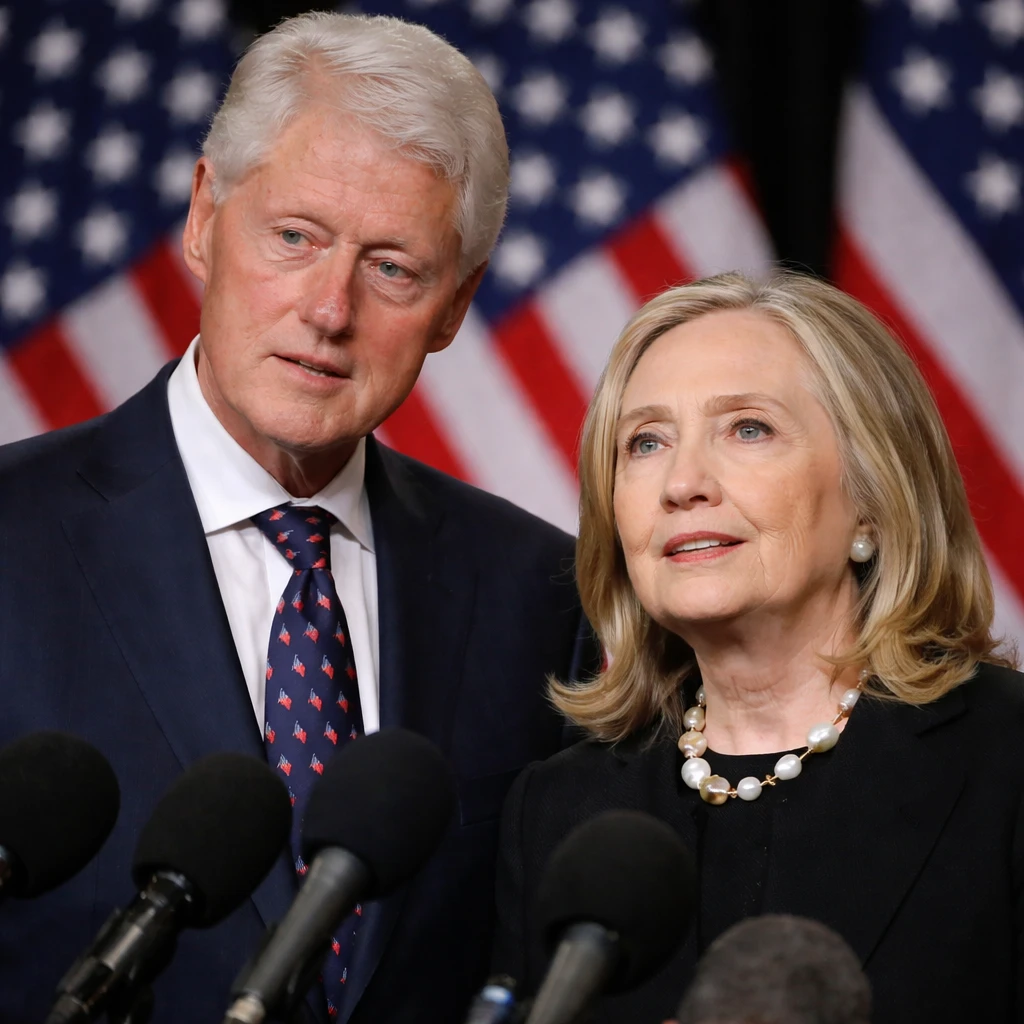

Former President Bill Clinton and former Secretary of State Hillary Clinton have indicated their willingness to provide testimony in the House Oversight Committee's inquiry into convicted sex offender Jeffrey Epstein. Despite this apparent acquiescence, Representative James Comer, a Republican from Kentucky and the chair of the committee, stated Monday evening that no formal agreement regarding the terms of their testimony has been confirmed.
Comer, who has been advocating for criminal contempt of Congress charges against both Clintons due to their initial failure to comply with subpoena requests, received communication from the Clintons' legal representatives signaling their acceptance of his conditions. The attorneys conveyed that the Clintons "will appear for depositions on mutually agreeable dates." However, they requested that Comer delay further action on pursuing contempt charges.
Comer responded by indicating that he was not ready to withdraw the threat of contempt charges, which, if approved by the House and prosecuted successfully by the Department of Justice, could lead to significant penalties, including fines or imprisonment.
"We don’t have anything in writing," Comer told reporters, clarifying that his willingness to accept the Clintons' offer depends on the precise nature of their commitment.
The developments occurred amidst Republican efforts to push a contempt resolution through the House Rules Committee, a requisite step before the measure could be brought to the floor for a vote. Should the resolution advance, it would represent a historically significant moment, as Congress would be moving to hold a former president in contempt, exposing them potentially to criminal sanctions.
In earlier discussions on Monday, Comer declined an alternative proposal from the Clintons' legal team. They had suggested that Bill Clinton participate in a four-hour transcribed interview and that Hillary Clinton submit a sworn written declaration concerning the Epstein investigation; Comer rejected this, asserting that both must provide sworn depositions before the committee to comply fully with the subpoenas.
A committee letter addressed to the Clintons’ attorneys highlighted the offer involving Bill Clinton’s transcribed session and Hillary Clinton's sworn declaration, but Comer emphasized that "The Clintons do not get to dictate the terms of lawful subpoenas."
Both Clintons had resisted compliance with the subpoenas issued by the Oversight Committee in August, early in the investigation into Epstein and his network. Their attorneys contested the legitimacy of the subpoenas, but as Comer escalated the threat of contempt proceedings, negotiations toward a resolution began to take shape. The Republican-led Oversight Committee had already voted to initiate criminal contempt charges the prior month, with significant bipartisan support: nine of the committee’s 21 Democrats joined Republicans in backing charges against Bill Clinton, and three Democrats supported charges against Hillary Clinton.
Republicans have spotlighted Bill Clinton's past relationship with Epstein as part of their broader push to investigate individuals connected to Epstein. Clinton’s interactions with Epstein, prominent during the late 1990s and early 2000s, have been extensively documented, though Clinton has not faced any accusations of wrongdoing related to Epstein.
The Clintons have critiqued Comer, accusing him of politicizing the investigation and alleging that he has neglected to hold the previous Trump administration accountable for delays in providing Department of Justice case files pertinent to Epstein. A spokesperson for the Clintons, Angel Ureña, responded to Comer’s statements on Monday by asserting that "They negotiated in good faith. You did not. They told you under oath what they know, but you don’t care.”
The prospect of a House vote raised the possibility of Congress employing one of its most severe sanctions against a former president—an action without precedent, as former presidents have generally been afforded deference and none have been compelled to testify before Congress, although some have done so voluntarily.
On Monday, House Democratic leader Hakeem Jeffries indicated that the caucus planned to deliberate on the contempt resolutions later in the week but refrained from committing to directing votes against them. Jeffries declared his own opposition to contempt measures and accused Comer of pursuing political vendettas rather than focusing on substantive matters, particularly the delayed disclosure of case files by the Justice Department. Democrats also point to the incomplete release of materials concerning Epstein from federal authorities.
"They don’t want a serious interview, they want a charade," Jeffries stated, critiquing the Oversight Committee’s approach.