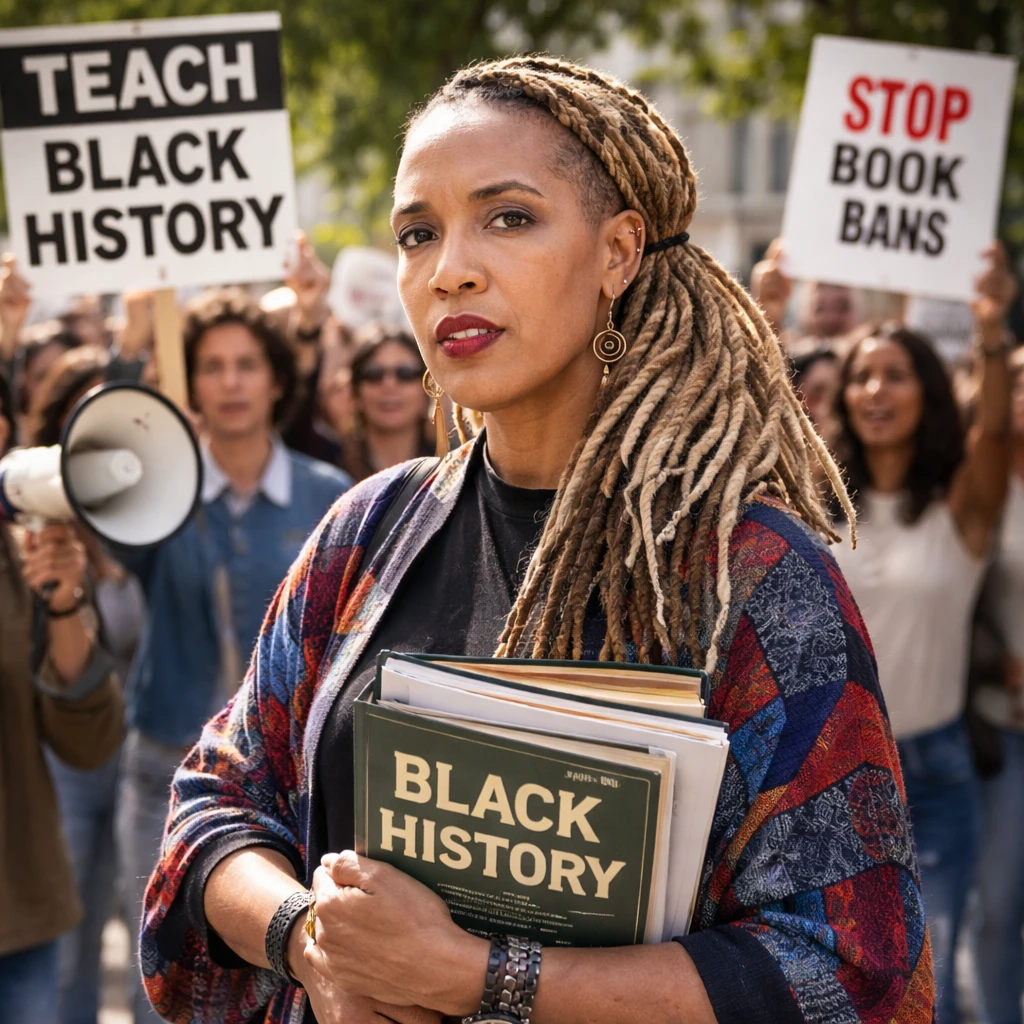

The past year has been a period of considerable difficulty for those dedicated to the preservation and education of Black history in the United States. Despite the formal recognition of February as National Black History Month, the continuation of the Trump administration saw assertions that some lessons on African American history aim to indoctrinate citizens with anti-American sentiments. This stance has manifested in tangible actions, such as the removal of an exhibit on slavery from a national park in Philadelphia just last month, a move seen by advocates as part of an overarching effort to suppress Black historical narratives within federal sites.
DeRay Mckesson, an experienced activist and executive director of Campaign Zero—an organization committed to police reform—remarked on the broader climate this has created. "States and cities are nervous about retribution from the White House," he noted, indicating that this atmosphere has led even well-intentioned proponents of racial education to become more reticent in their work.
As the nation marks 100 years since the inception of Black History Month, originally founded as Negro History Week by scholar Carter G. Woodson, efforts to honor and expand the understanding of Black history continue unabated. This political environment has galvanized civil rights organizations, academic circles, and artists to more actively engage young people with a comprehensive representation of America's past. Numerous lectures, educational initiatives, and newly published books, ranging from nonfiction works to graphic novels, are part of this centennial commemoration.
Mckesson highlighted an initiative in which over 150 educators nationwide are collaborating to develop a Black History Month curriculum. In partnership with Afro Charities and respected Black scholars, the aim is to ensure that young scholars receive intentional, thoughtfully crafted educational content tailored to deepen their understanding of Black history.
Graphic Novel Chronicles Juneteenth's Legacy
Approximately three years ago, Angélique Roché, a journalist and adjunct professor at Xavier University of Louisiana, embraced a unique opportunity to author a graphic novel recounting the life of Opal Lee, referred to as the "grandmother of Juneteenth." Lee, approaching her centennial birthday this year, is widely credited with advocating for the federal recognition of Juneteenth, the June 19 holiday commemorating the emancipation of enslaved people in Texas. Notably, under the Trump administration, Juneteenth no longer provides free access to national parks aligned with the observance.
The graphic novel, titled "First Freedom: The Story of Opal Lee and Juneteenth," is scheduled for release next Tuesday. It represents the culmination of Roché's extensive archival research, interviews, and on-site visits to Texas, including meetings with Lee and her granddaughter, Dione Sims. Roché emphasized that the graphic novel is grounded in rigorously researched facts drawn from primary sources, dispelling notions of indoctrination.
Though centered on Opal Lee, the narrative also introduces readers to less widely known historical figures, including William "Gooseneck Bill" McDonald, the first Black millionaire in Texas, and Opal Lee's mother, Mattie Broadous Flake. Roché hopes that this engaging format will inspire younger generations to emulate Lee's principle of becoming "a committee of one," encouraging individual initiative in driving social change.
New Campaign Trains Emerging Black Historians
When executive orders opposing Diversity, Equity, and Inclusion (DEI) policies were enacted last year, Harvard professor Jarvis Givens was teaching in London, where Black History Month is observed in October. He had already been contemplating authoring a book in honor of the centennial but found renewed motivation amid what he perceived as an attack on Black history education by the administration.
The forthcoming book, "I'll Make Me a World: The 100-Year Journey of Black History Month," features four in-depth essays exploring central themes in Black history while addressing common misunderstandings. Drawing its title from a line in the 1920s poem "The Creation" by James Weldon Johnson—also known for "Lift Ev'ry Voice and Sing," dubbed the "Black National Anthem"—the publication coincides with wider educational efforts.
Campaign Zero and Afro Charities, in partnership with Givens' scholarship, are launching a "living history campaign" designed to empower young people to become historians capable of distinguishing truth from misinformation, reflecting Carter G. Woodson's original vision for Black history education.
"Historically, the preservation of history was confined to professional historians," Mckesson observed. The movement now aims to equip younger students to actively record and preserve their own historical narratives.
The Enduring Legacy of Carter G. Woodson
Carter G. Woodson, born in 1875 to parents who had been enslaved, was a pioneering figure in Black history. As part of the first generation of African Americans born free of slavery, Woodson viewed education as a critical tool for empowerment. Robert Trent Vinson, director of the Carter G. Woodson Institute at the University of Virginia, explains that Woodson was disillusioned by the dismissal of Black history and was determined to validate the cultural memories of less formally educated African Americans.
When Woodson established Negro History Week in 1926, the era was characterized by widespread Black stereotypes, including minstrel shows and blackface, that distorted the Black experience. He responded by fostering Black history clubs and surreptitiously integrating educational content into periodicals like the "Journal of Negro History" and the "Negro History Bulletin." This work extended outside formal schools into churches and community groups, promoting historical education within informal networks.
Recognizing the importance of the movement, in 1976, President Gerald Ford formally expanded the week into Black History Month. However, pushback to the progress achieved during the Civil Rights Movement is not new, as noted by Givens. Vinson suggests that the current resistance to Black history education aligns with historical patterns but would be seen by Woodson as an indicator of progress. Woodson advocated for strategic dissemination of history, balancing moments for open activism with more guarded, subversive efforts.
DeRay Mckesson points out that opposition to Black history teaching resurfaces each generation but expresses confidence that the persistent informal networks of Black educators and activists will sustain the movement through these challenges.