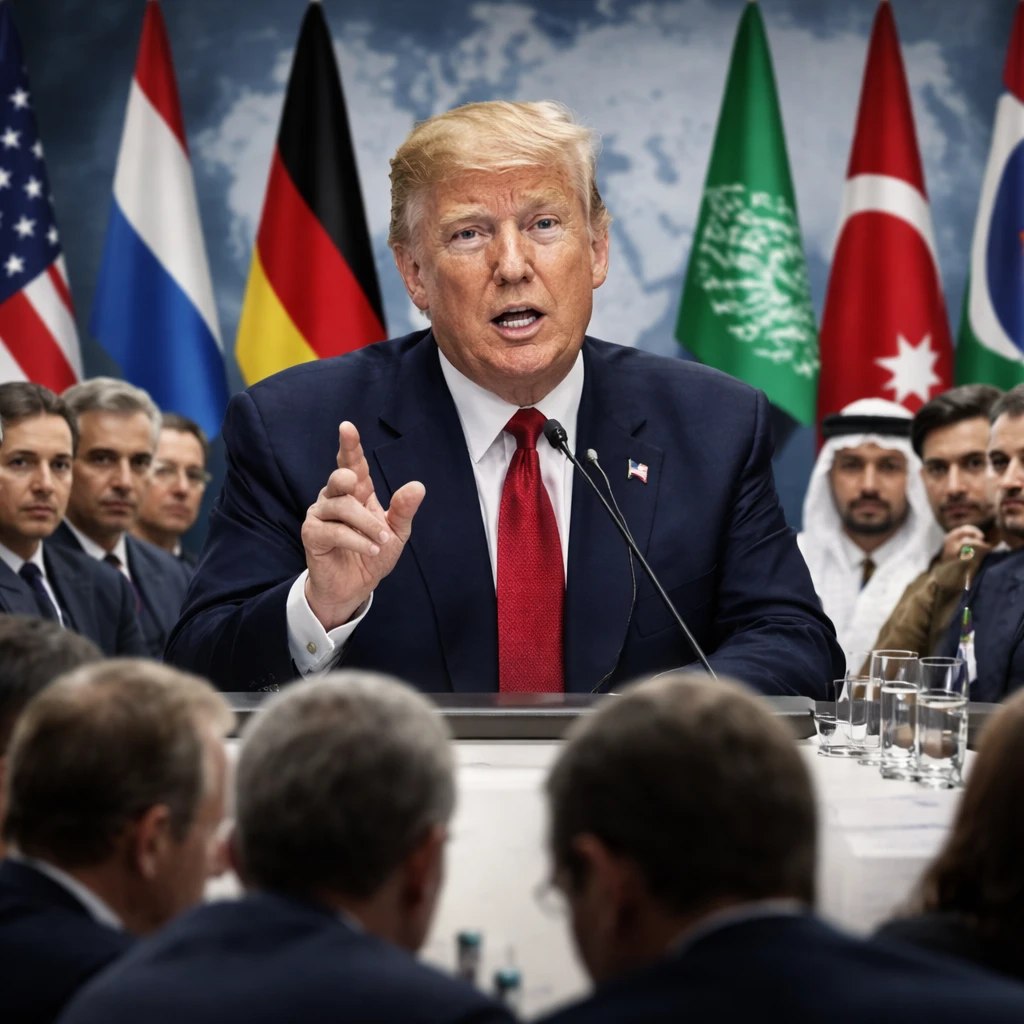

In Jerusalem, noticeable discord surfaced surrounding U.S. President Donald Trump’s Board of Peace, as its scope has extended past the Gaza situation to encompass a wider range of global conflicts. This expansion has resulted in a split among invited countries, with several Western European states opting out or withholding commitment, contrasted by a group of predominantly Muslim nations agreeing to participate.
Specifically, Norway and Sweden declined their invitations to join the board, following France's earlier refusal. In contrast, a consortium of Muslim countries—namely Egypt, Indonesia, Jordan, Pakistan, Qatar, Saudi Arabia, and the United Arab Emirates—issued a unified declaration affirming their leaders' participation. The divergence illustrates European apprehension towards the board’s broader, and potentially contentious, ambitions, which some interpret as an attempt to supplant the United Nations Security Council’s longstanding conflict mediation role.
The formal establishment of the board is slated for this week during the World Economic Forum in Davos, Switzerland. However, the exact number of countries willing to engage remains fluid. According to a White House representative, approximately 30 nations are expected to join from an invitation list of around 50. Two other U.S. officials, speaking anonymously due to the sensitive nature of the process, referenced a slightly different tally—about 60 invitations with only 18 confirmations received to date.
President Trump expressed optimism prior to a scheduled board event, noting that while some countries required parliamentary approval, the majority of invitees appeared desirous of participation.
Initially, the board was designed as a smaller entity of global leaders tasked with overseeing the Gaza ceasefire plan. Nonetheless, the administration’s broadened vision has transformed it into an expansive mechanism with potential mediation responsibilities across various international disputes. Israeli Prime Minister Benjamin Netanyahu has agreed to join the board, marking a shift from his previous criticism against another Gaza-focused committee's composition.
Norway's State Secretary Kristoffer Thoner articulated that their decision to abstain stemmed from the need for further discussions with the U.S., emphasizing unresolved questions about the board's intentions. Similarly, Swedish Prime Minister Ulf Kristersson dismissed joining in its current form, pending a formal response. Slovenian Prime Minister Robert Golob cited concerns that the board’s wide-ranging mandate could jeopardize the existing international framework premised on the U.N. Charter. France’s Foreign Minister Jean-Noel Barrot reinforced this viewpoint, supporting the U.S. peace plan but opposing the creation of a new body perceived as competing with the United Nations.
Responses from the United Kingdom, the European Union, Canada, Russia, Ukraine, and China remain pending. Meanwhile, several Middle Eastern and other countries have announced their participation, including key entities involved in the Gaza ceasefire such as Egypt and Israel, alongside Argentina, Armenia, Azerbaijan, Bahrain, Belarus, Hungary, Kazakhstan, Kosovo, Morocco, Uzbekistan, and Vietnam.
Netanyahu's decision to participate signifies an important development since his administration had previously denounced another Gaza oversight committee—which included Turkey—as uncoordinated with Israeli policy. His participation may provoke dissent within his coalition, where figures like Finance Minister Bezalel Smotrich have criticized the board and advocated for unilateral Israeli control over Gaza’s future.
Fundamental uncertainties persist regarding the board’s ultimate design and authority. When queried whether the board might supplant the U.N., President Trump responded ambiguously, saying, “It might.” Such comments underscore the unresolved nature of the board’s role and the implications for international diplomacy.
The mixed reactions and broad ambitions of the board highlight significant geopolitical complexities amid critical efforts to maintain and expand peace initiatives in the Middle East and potentially other global hotspots. The ongoing developments will necessitate close observation as they unfold in the context of international governance and conflict resolution paradigms.