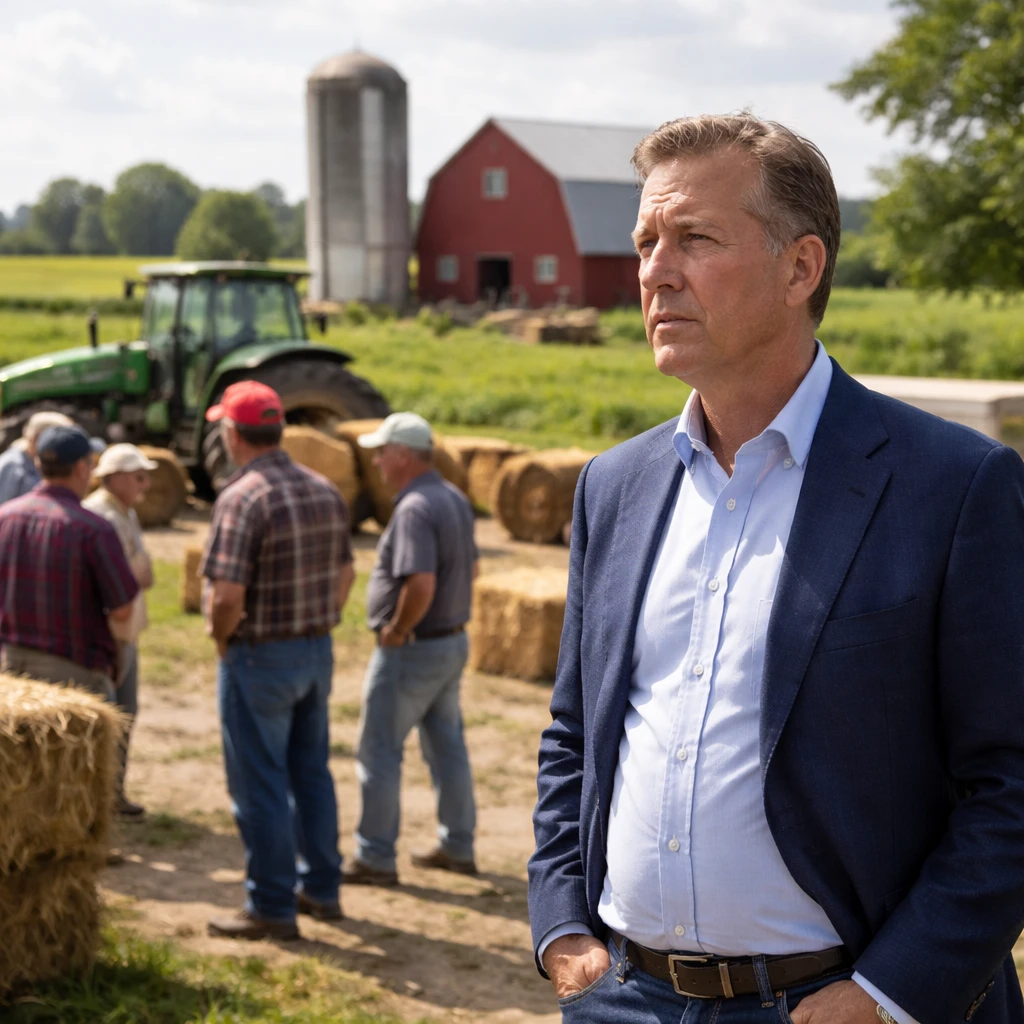

In a significant policy reversal, Connecticut Governor Ned Lamont instructed his administration on Monday to suspend the implementation of new agricultural land valuations. This move comes in response to extensive pushback from farmers who warned that the proposed reassessments would substantially elevate property taxes, potentially forcing family farms to sell their land.
The original valuation adjustments, some of which could have doubled the taxable value of farmland, were tied to an "unforeseen lack of data" the state encountered when attempting to establish current rates for the state's shrinking farmland inventory. As a result, the governor's order preserves the existing recommended land values established in 2020 until further notice.
Alongside pausing the reassessments, Lamont convened a working group composed of farmers, local government officials, property assessors, and representatives from the Department of Agriculture. This group is tasked with recommending improvements to how data is collected and farmland is evaluated, aiming to prevent sudden, significant increases in taxation.
Governor Lamont emphasized the importance of family farms to Connecticut's economy and cultural heritage in a statement accompanying the announcement. He acknowledged the challenges posed by rising land use values and reaffirmed the administration's commitment to working with the agricultural community to preserve farming as a vital way of life within the state.
The announcement provided immediate relief to many farmers who gathered the following day at Hartford's Legislative Office Building. The forum, organized by Senate Republicans before the governor's decision, proceeded as planned to facilitate dialogue between lawmakers and farmers about their tax-related and economic concerns.
Paul Larson, president of the Connecticut Farm Bureau, described the governor's pause as a "huge step forward" alleviating some short-term anxiety among farmers; however, he cautioned that this respite is temporary. The heightened awareness and concern over the assessment levels escalated in recent weeks as municipalities approached the January 31 deadline for finalizing grand lists.
Supporting the farming community's position, Senate Minority Leader Stephen Harding commended Lamont's reversal, noting the political sensitivity in an election year and the pressure exerted by farmers to protect their livelihoods. Harding observed that the initial assessments risked pushing many smaller family farms out of operation.
The root of the dispute traces back to Public Act 490, a decades-old state law intended to conserve farmland and open spaces by taxing land based on its agricultural use rather than its development-market value. Under this law, state officials update recommended land values every five years, which municipalities use to determine property tax assessments. The Office of Policy and Management, working with the Department of Agriculture, conducts this update process.
During the recent revaluation cycle, the state partnered with the University of Connecticut to survey farmers leasing or renting farmland to gather data for valuations. However, this survey suffered from low participation and incomplete information, hampering accurate valuation efforts. Although the state made efforts including mailed postcards featuring QR codes, emails, and assessor-facilitated paper distribution, engagement remained limited, with only 145 rental or lease agreements documented out of roughly 5,000 farms statewide.
The survey’s shortcomings resulted in surprising and steep valuation increases upon release in October, including up to a 72% jump in taxable value for certain productive farmland types like Tillable A soils. Some regions, particularly the Connecticut River Valley, saw even higher increases. Farmers like Kim Grijalva, who manages a 100-acre cattle farm in North Stonington, experienced an alarming quadrupling in land value for grazing pastures, with less arable land such as rock outcroppings also seeing dramatic hikes—from $40 to $970 per acre.
Following protests from farmers and revisions proposed by the Office of Policy and Management in January to mitigate extreme increases, the final proposed assessments were ultimately placed on hold by Governor Lamont’s recent directive. Grijalva described the prospective tax increases as financially untenable, likely forcing her family to cease cattle operations.
The survey methods and communication strategies faced criticism from farmers, highlighting generational and technological barriers. Shannon Chatfield, owner of Stead Farm in Barkhamsted, underscored that many farmers may not engage with digital surveys or emails, preferring direct mail correspondence. This communications gap contributed to the survey’s limited effectiveness.
The controversy has shaken some farmers’ trust in the Department of Agriculture and its commissioner Bryan Hurlburt. At a Tuesday forum, Grijalva expressed dissatisfaction that farmers felt compelled to rely on external lobbying groups for protection against the very agency established to support them. Commissioner Hurlburt acknowledged survey flaws despite efforts to increase response rates and emphasized ongoing attempts to strengthen relations with farmers and expand agricultural grant funding.
A spokesperson for Governor Lamont stated the governor’s continued support for Commissioner Hurlburt, indicating no leadership changes are planned at the agency. Larson noted constructive discussions between the Farm Bureau, the Office of Policy and Management, and the Department of Agriculture had contributed to the initial revisions and the decision to suspend reassessments this year.
Looking ahead, Larson highlighted the need to develop alternative data collection practices that do not rely on extensive self-reporting by farmers, acknowledging that older farmers may lack the time or willingness to complete detailed surveys. Commissioner Hurlburt projected that the newly convened working group would take up to two years to formulate recommendations for improving the assessment process, which may require legislative action to enact.
Meanwhile, Senator Harding advocated for expedited action from the working group, urging greater reliance on insights from active farmers to craft timely and equitable reforms that serve all stakeholders.
This comprehensive issue underscores the complex intersection of agricultural policy, property taxation, and rural economic sustainability in Connecticut, with significant implications for family-owned farms and local economies.