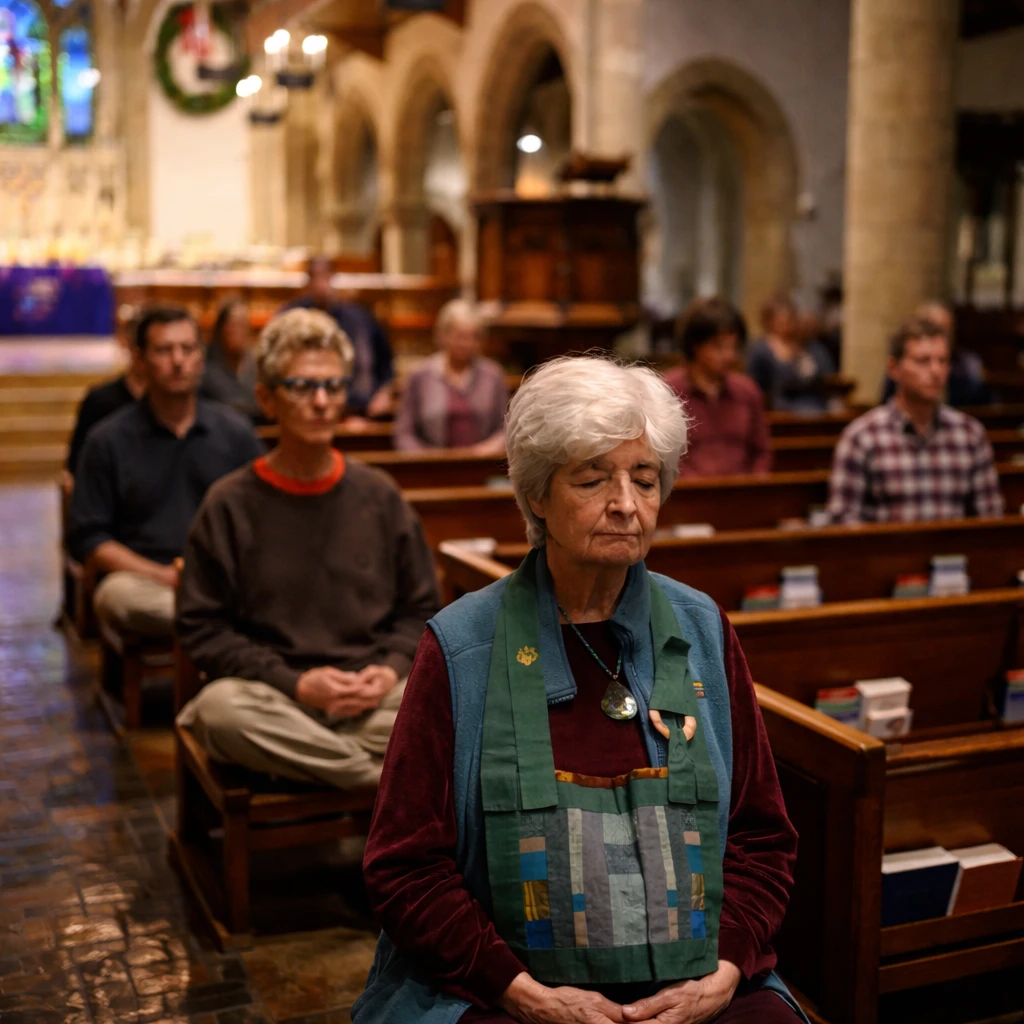

Every Monday evening, the sanctuary at All Saints Episcopal Church in Pasadena, California, undergoes a transformation that invites introspection and calm. Within this Gothic Revival edifice, characterized by its stone arches and vibrant stained-glass windows, Betty Cole—a dedicated Zen meditation practitioner and a practicing Episcopalian—guides an interfaith group through sessions of seated and walking meditation.
Since founding the group in 2001, Cole observed its evolution into a "quiet fellowship," primarily attracting individuals who find themselves less drawn to traditional church elements such as liturgy and music but value the meditative ambiance the chapel provides, alongside a supportive communal silence.
This phenomenon is part of a broader movement across American Christian, Jewish, and various other faith communities, where meditation practices originating from Eastern religious traditions like Buddhism and Hinduism are being woven into spiritual life. Simultaneously, some groups are reviving long-standing meditative customs within their own religious frameworks, adapting these to contemporary expectations and lifestyles characterized by rapid pace and high demands.
While practitioners such as Cole emphasize the fundamental spiritual and religious dimensions of these contemplative practices, they acknowledge additional benefits for mental health and social cohesion.
Despite some opposition—instances where meditation is viewed with suspicion as connected to demonic influences in certain religious contexts, or dismissed as superstition in secular circles—interest in contemplative techniques continues to grow nationwide. Concerns around cultural appropriation have been voiced, particularly addressing the commercial commodification of Eastern spiritual practices. Regardless, faith institutions increasingly support diverse meditative forms as part of their communal offerings.
Within these contexts, participants encounter a tapestry of practices: the chanting of “Om” resonates alongside the tones of singing bowls and piano within an Ivy League university chapel; virtual sessions led by rabbis integrate breathwork with Jewish sacred texts; Unitarian Universalist congregations delve into Buddhist dharma and immersive sound bath experiences.
Buddhism has historically centered meditation as a path toward enlightenment, while Hinduism roots many contemplative exercises, including yoga, within its ancient tradition. Parallel to these, many religions have their own meditative customs aimed at forging a direct, experiential connection with the divine. These include the silent meditation of early Christian ascetics known as the Desert Fathers and Mothers in Egypt, Jewish Kabbalistic and Hasidic meditative techniques, and the Sufi practice of whirling dervishes within Islam's mystical branch.
Author and Buddhist instructor Lodro Rinzler notes an emerging dynamic where individuals may opt not to commit to a specific religious tradition outright, yet embrace selected practices drawn from those spiritual lineages. This engagement sometimes leads to renewed interest in the heritage religious traditions themselves, as historic meditative customs are reabsorbed into communal practice.
The Or HaLev – Center for Jewish Spirituality and Meditation, established in 2011 by Rabbi James Jacobson-Maisels, exemplifies this return to tradition. Its mission is to offer Jewish meditation experiences rooted in Hasidic teachings while harmonizing with influences from westernized Eastern traditions. Jacobson-Maisels points out that modernity and historical traumas like the Holocaust have contributed to the decline of such mystical Jewish practices, often sidelined due to perceptions of irrationality or incompatibility with modern sensibilities. Nevertheless, key elements such as Kabbalah are witnessing a revival.
At Princeton University's nondenominational Gothic chapel, meditation sessions augmented with chamber music, breath control techniques, and mantra chanting have become increasingly popular. Composer and facilitator Hope Littwin describes attendees as often seeking repeated participation, drawn by the intangible, transformative nature of these musical meditations. Meditation teacher A.J. Alvarez comments on the universal appeal of meditation across religious and nonreligious individuals alike, as it touches dimensions transcending doctrinal boundaries.
Unitarian Universalist communities have likewise integrated meditation deeply into spiritual programming. The Mindfulness, Meditation, Buddhism initiative led by Reverend Pamela Patton since 2016 has expanded to serve approximately 800 members, reflecting the congregation’s openness to diverse spiritual expressions and practices.
Meanwhile, Omid Safi, a religion professor at Duke University, highlights contemporary trends among younger Muslims who engage in yoga, mindfulness, and breath practices in ways that resonate with Islamic mysticism's long developmental history. Safi emphasizes that Sufi traditions incorporate meditative attention to subtle bodily centers termed “lataif,” analogous but distinct from yoga's chakras, focusing on balancing earthly and heavenly dimensions of experience. While mosque settings traditionally have not been venues for meditation, associated spiritual activities including poetry, music, and meditative sessions are common, underscoring spiritual unity expressed through symbolic language and artistic mediums.
Catholic spirituality also reflects a renewed emphasis on contemplative techniques. Spiritual director Susan Stabile notes a resurgence of interest in meditation and centering prayer within Catholic parishes. Having journeyed through Buddhist monastic life before returning to Catholicism, Stabile appreciates how Buddhist practices have enriched her understanding of Christian thought. She remarks that early Christian hermits historically practiced forms of meditation that have largely been forgotten or overlooked in recent centuries. The current renaissance in interest is fueling a collective desire for deeper mystical experience and transformative spiritual growth.
Overall, this broadening embrace of meditation—spanning various faith traditions and contexts—indicates a significant cultural and spiritual phenomenon in contemporary American religious life, intertwining ancient wisdom with modern-day quests for meaning, peace, and connection.