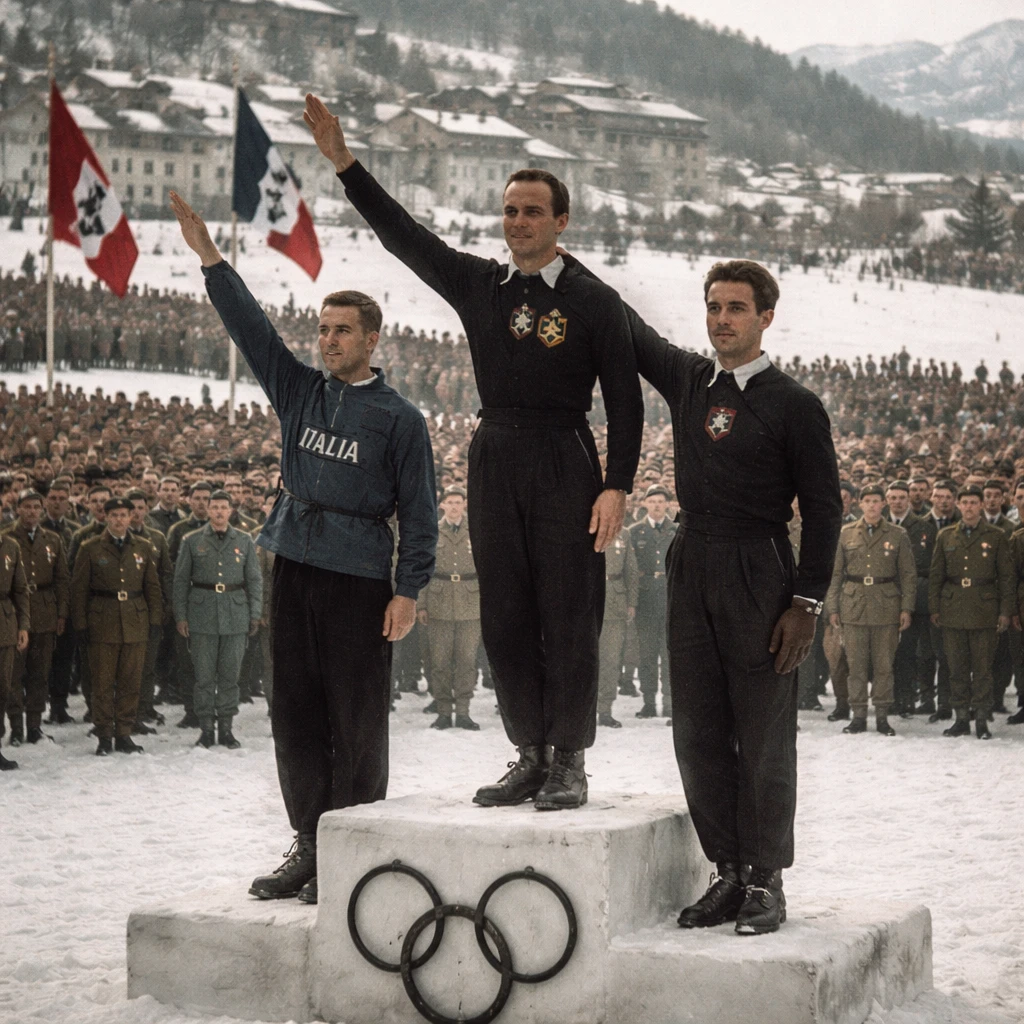

Nestled in the Dolomite mountains of northern Italy, Cortina d’Ampezzo is renowned today as a host for winter sports, including the upcoming Milan Cortina Winter Olympics. Yet, beneath its snowy peaks lies a largely forgotten chapter: the World Ski Championships held in 1941 amid the tumult of World War II, an event manipulated by fascist Italy and Nazi Germany to demonstrate Axis dominance.
The site of the championships bore marks of the era’s political regime. A giant portrait of Benito Mussolini loomed over what was known as the “Snow Stadium,” in the same location that will host curling events for the contemporary Games. Nearby, where a modern Athletes’ Village is now planned, lay the shooting range used in the military patrol discipline, a forerunner to today's biathlon.
While Cortina’s 1956 Winter Olympics are part of well-documented Olympic history, the 1941 ski championships remain obscure. This event, deeply entangled with fascist propaganda, served as a platform for the Axis powers to exhibit strength and unity. Athletes competed under the flags of Nazi Germany, featuring skiers from annexed Austria, and Mussolini’s Italy. In contrast, Allied countries including Britain, France, and the United States were barred from participation. Representation from occupied Norway was limited and only partially loyal, and neutral Switzerland did not participate fully.
Visual records and amateur films from that time capture the charged atmosphere: athletes on podiums delivering fascist salutes, swastika flags lining Cortina’s streets, and a conspicuous military presence. In the postwar years, the International Skiing Federation (FIS) annulled the championship results, contributing to the event’s obscurity. Nicola Sbetti, a sports historian at the University of Bologna, observes that the competition is often treated as if it never took place, reflecting a lack of accountability by the postwar Italian republic.
The championships formed part of a broader Axis strategy to maintain the appearance of normalcy and reinforce their vision of a “new world order,” even within the realm of sports. Sbetti emphasizes that while this was one of the last major international sporting events before World War II further escalated, it was not a truly international competition, due to the exclusion of many countries and the presence of puppet states imposed by Nazi Germany.
Originally, Cortina had been slated to host the 1944 Winter Olympics, but the conflict forced their cancellation. Undeterred, Mussolini’s regime staged the 1941 world championships as a substitute event, encompassing not only Alpine but also Nordic disciplines like cross-country skiing, ski jumping, and Nordic combined. Max Vergani, communications director for the Italian Winter Sports Federation and author on the subject, refers to it as a “mini-Olympics,” demonstrating Italy’s resolve to maintain a global sports presence.
The event carried strong political undertones similar to those evident in the 1936 Olympics hosted by Nazi Germany. For the Italian regime, it was a demonstration of strength and defiance - conveying a message that Italy was unshaken by war and capable of producing major international sports spectacles.
The championships unfolded against a grim backdrop. Nazi Germany was intensifying persecutions and preparing to invade the Soviet Union, while Italian forces struggled against British troops in North Africa, prompting Germany to increase support. Amidst this turmoil, the championships proceeded as a propaganda tool.
The performances highlighted both athletic prowess and political symbolism. German skier Christl Cranz dominated, winning gold in downhill and combined events and silver in slalom. During the medal ceremony for downhill, Cranz and her fellow German teammates gave Nazi salutes while wearing jerseys adorned with swastikas. These results were later voided, but her 15 career World Championship medals remained noteworthy until equaled by Mikaela Shiffrin in 2025.
On the men’s side, Josef Jennewein, an Austrian competing for Germany, also secured golds in downhill and combined, while the only notable non-German Alpine winner was 20-year-old Italian Celina Seghi, who upset Cranz in the slalom. The medal count was dominated by Germany (11 Alpine medals) and Italy (7), illustrating the political orchestration behind the event’s outcomes.
In Nordic events, Finland led the medals tally, followed by Sweden, Germany, and Italy. Notably, many medalists came from countries either occupied by or allied with Nazi Germany, such as Germany’s Nordic combined medalists from Czechoslovakia and Austria. Norway, typically strong in Nordic skiing, failed to secure any medals under the Nazi-collaborative regime.
The fate of several athletes was tragic: many who competed in 1941 died in the war. Josef Jennewein was killed in action as a Luftwaffe pilot; Rudolf Cranz, Christl’s younger brother and a bronze medalist, also died on the Eastern front. Paavo Vierto of Finland, a gold medal ski jumper, was another casualty. Gustav Berauer, seriously wounded, ceased competition but later led FIS’ Nordic combined committee. Celina Seghi continued in sports after the war, achieving further success before retiring in 1956 and passing in 2022 at age 102.
In the postwar FIS congress of 1946, the cancellation of the 1941 championships was formally confirmed, with all medals withdrawn, largely due to the event’s exclusionary and propaganda-driven nature. This official annulment helped consign the event to historical obscurity, overshadowed in memory by Cortina’s 1956 Winter Olympics, which represented a postwar democratic renaissance for Italy.
Today, few physical reminders of the 1941 championships survive, though some memorabilia, including posters bearing the event’s official imagery, are still sold in Cortina. Experts argue that while the championships are marred by their political context, acknowledging and contextualizing this history is important rather than ignoring it entirely.
As the world prepares again to witness global winter sports in Cortina, this hidden episode remains a somber reminder of the complex intersection between international sports and historical politics during a dark period of the 20th century.