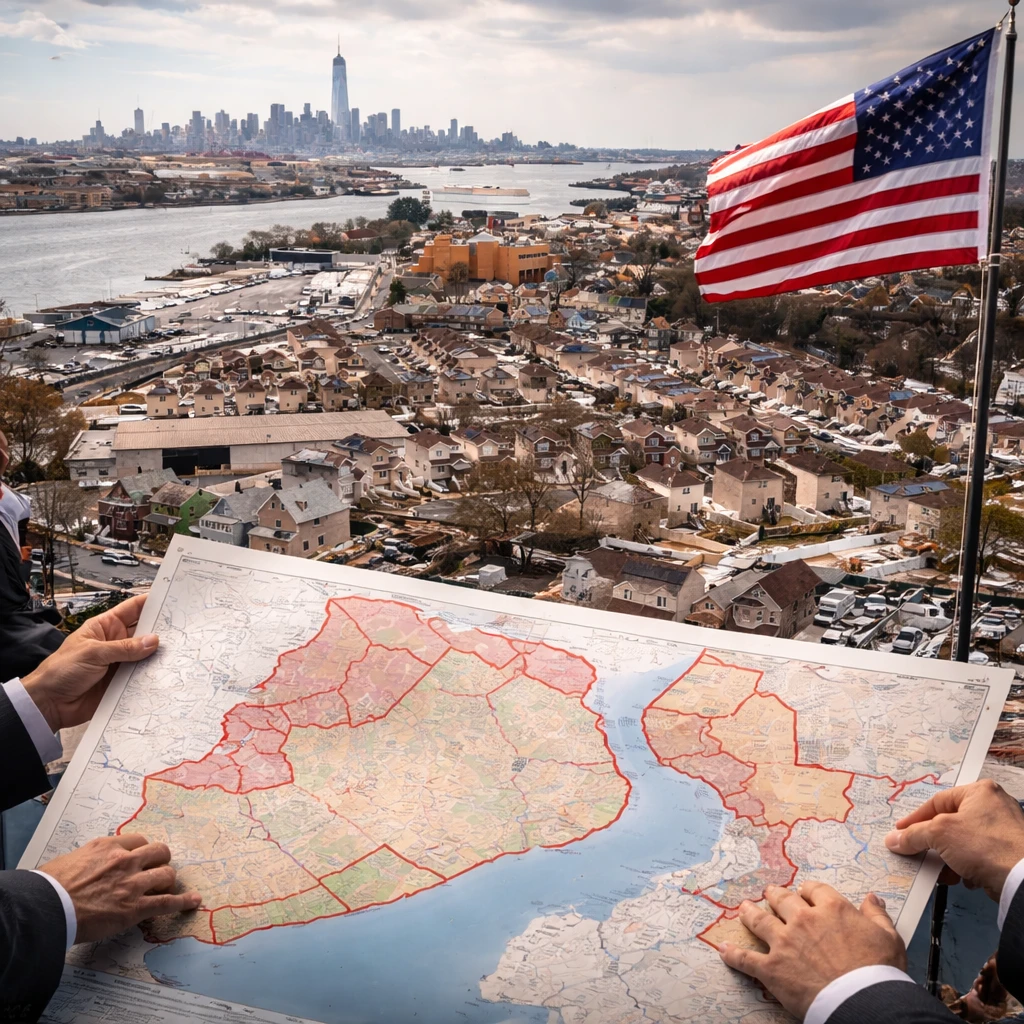

A judge's recent ruling to discard the existing boundaries of New York City's only Republican congressional district poses a formidable challenge amid the national battle over redistricting, introducing a heightened level of uncertainty about the district's future configuration.
With party primaries scheduled in just five months, the court has mandated a prompt redrawing of district lines, a task complicated by the political sensitivity and legal complexities involved. Republicans have announced intentions to appeal the judgment, potentially prolonging the resolution process and leaving the final district outline unclear for an extended period.
Blair Horner from the New York Public Interest Research Group captured the prevailing sentiment succinctly, describing the situation as "chaos".
The district in question, currently represented by U.S. Representative Nicole Malliotakis, encompasses suburban Staten Island and a portion of Brooklyn, areas long held by Republicans in New York City. The litigation, advanced by a Democratic-aligned election law firm, advocates for reorienting the district to encompass more liberal sections of Manhattan, specifically the affluent neighborhoods of Tribeca, the historically bohemian West Village, and the upscale retail corridor of SoHo.
This strategic redistricting would likely render the district more favorable to Democratic candidates by integrating zones with strong liberal electorates, heightening the competitiveness of the congressional race this fall, as both major parties vie for control of the U.S. House of Representatives.
Malliotakis has criticized the move, labeling it a partisan maneuver aimed at skewing electoral advantages toward Democrats.
The task of redefining the district boundaries now falls to the state's Independent Redistricting Commission, a bipartisan panel charged with such responsibilities, but only if an appeals court does not intervene to halt the judge's order.
The legal challenge stems from a broader national dispute over gerrymandering that intensified after efforts led by former President Donald Trump sought to redraw congressional maps in Republican-dominated states to maintain slender House majorities.
Justice Jeffrey Pearlman invalidated the current district map on grounds that its configuration unlawfully diminishes the voting efficacy of Black and Hispanic populations. His ruling identified the existing boundaries—comprising all of Staten Island and a segment of Brooklyn—as a contributing factor to the underrepresentation of minority voters.
According to the judge, this unconstitutional dilution violates principles of equitable voter representation.
The court directed the Independent Redistricting Commission to complete a new congressional map by February 6, imposing a stringent deadline requested by state election officials to accommodate the outset of candidate petitioning at the end of February.
The commission, consisting of appointees from both Democratic and Republican leaders in the state legislature, must accomplish this politically delicate undertaking in approximately 16 days. The task includes potentially adjusting the boundaries of several districts beyond just Malliotakis’ seat.
The co-executive director of the commission acknowledged the formidable nature of the timeline but expressed readiness to meet the court's demand. Conversely, Republican leaders have vowed to contest the ruling, which could result in a legal stay pending appeals and prolong uncertainty surrounding the district's status.
John Faso, a former Republican congressman engaged in his party's redistricting efforts, condemned the decision as a "political gerrymander disguised as a voting rights case."
The dispute may ascend to New York's highest judicial authority, the Court of Appeals, which has a history of mandates and reversals concerning congressional map validity within the state.
Challenges abound regarding the commission's ability to finalize an acceptable new map so rapidly. Historically, the panel has struggled to reach consensus, and the legislature, dominated by Democrats, retains ultimate authority to reject and amend proposals, potentially influencing outcomes in their favor.
Horner characterized the commission’s equitable partisan makeup as effectively engineered to generate gridlock on contentious subjects.
Legal expert Jeffrey Wice from New York Law School noted the plan's feasibility but questioned the practicality of the compressed timeframe.
The judge declined to endorse the specific redistricting proposal submitted in the lawsuit, noting the state constitution entrusts such decisions to the Independent Redistricting Commission.
Nonetheless, Democrats appear poised to advocate for a reconfiguration that would detach southern Brooklyn neighborhoods currently within Malliotakis’ jurisdiction—areas close in geography and culture to Staten Island—and integrate them into a district extending from southern Brooklyn into Manhattan's Chinatown.
Representative Dan Goldman, a Democrat serving a district covering parts of lower Manhattan and Brooklyn, is reportedly amenable to changes that could strengthen Democratic prospects for House majority control.
As background, Staten Island has predominantly elected Republican congressional representatives since the 1980s, save for a brief interlude when Democrat Max Rose held the seat before Malliotakis reclaimed it in 2020. The current representative secured reelection decisively in 2024, defeating a Democratic challenger by 28 percentage points.